



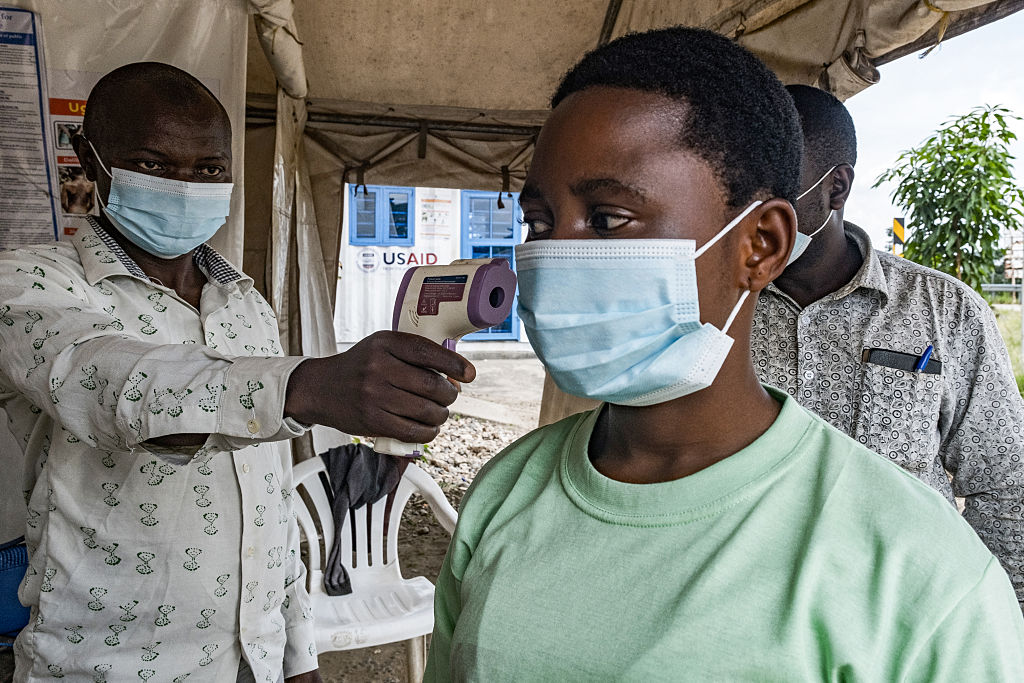
Health officials in Congo are racing to contain a growing Ebola outbreak after a dangerous strain of the virus spread through eastern parts of the country, overwhelming hospitals and prompting an international emergency declaration.
According to the New York Post, authorities announced plans to open three treatment centers in Ituri province as cases continue climbing.
The outbreak has already killed more than 100 people, according to health officials, while neighboring Uganda has also reported deaths linked to the virus.
“We know that the hospitals are already under stress because of the patients,” Congolese Health Minister Samuel Roger Kamba said during a visit to Bunia, the capital of Ituri province.
“But we are preparing to have treatment centers at all three sites in order to be able to expand our capabilities,” he added.
The World Health Organization declared the outbreak a public health emergency of international concern on Sunday and sent teams of experts along with emergency medical supplies to the region.
Officials said the first known victim died April 24 in Bunia before the body was transported back to the mining region of Mongbwalu.
“It was the return of this body to the Mongbwalu health zone — a mining area with a large population — that caused the Ebola outbreak to escalate,” Kamba said.
The outbreak involves the Bundibugyo strain of Ebola, a rare variant that currently has no approved vaccines or treatments.
Health authorities initially struggled to identify the virus because early samples were tested for the more common Zaire strain of Ebola.
“The province analyzed the Zaire strain, for which they have the expertise, and it came back negative,” said Dr. Richard Kitenge, the Health Ministry’s Ebola incident manager. “So, for the province, Ebola was negative.”
The outbreak has now spread beyond Ituri, with cases also reported in Kinshasa and Goma.
Aid organizations, including Médecins Sans Frontières and the International Rescue Committee, have dispatched emergency response teams to assist local officials.
Meanwhile, U.S. health officials said the risk to Americans remains low, though the Centers for Disease Control and Prevention issued travel advisories urging travelers in Congo and Uganda to avoid anyone showing symptoms such as fever, muscle pain, or rash.
Ebola spreads through bodily fluids, including blood, vomit, and semen, and is often fatal.
The Bundibugyo strain has only been detected twice before — first in Uganda in 2007 and later in Congo in 2012.
Complicating response efforts is the ongoing humanitarian crisis in eastern Congo, where armed violence and mass displacement have strained already fragile healthcare systems.
“The outbreak is currently occurring in provinces marred by crisis, including insecurity, presence of armed actors or de facto authorities with large displacement, weak health systems and insufficient availability of services,” Congo’s Health Cluster warned Monday.
A U.N. official based in Bunia described growing uncertainty surrounding the outbreak.
“No one really has a full understanding of how serious this crisis is,” the official told The Associated Press. “The extent to which it’s expanding is very much unknown.”
Africa CDC Director Jean Kaseya said he is in “panic mode” over shortages of vaccines and treatments as the death toll rises.
Rwanda has since closed its land border with Congo amid fears the outbreak could spread further across the region.