




Whether the Iran War ends in two weeks or two months, global markets may not stabilize for years.
Since President Donald Trump launched Operation Epic Fury on Feb. 28, Iranian retaliation has successfully shut the Strait of Hormuz. With the international oil trade at a near standstill and the Pentagon spending tens of billions on the war effort, U.S. consumers are footing the bill.
“Bottom line: I believe we have seen the last of sub-$3.00 per gallon gas prices and sub-$80 per barrel oil prices, at least for the remainder of my lifetime,” energy industry veteran David Blackmon told the Daily Caller News Foundation.
An oil supply crunch means paying more for gasoline or any commodity that needs transportation, like groceries and fertilizer. Increased deficit spending drives up interest rates, making mortgages and car loans more expensive. Even if the conflict stopped immediately, global markets may take months or even years to recover.
All About The Oil
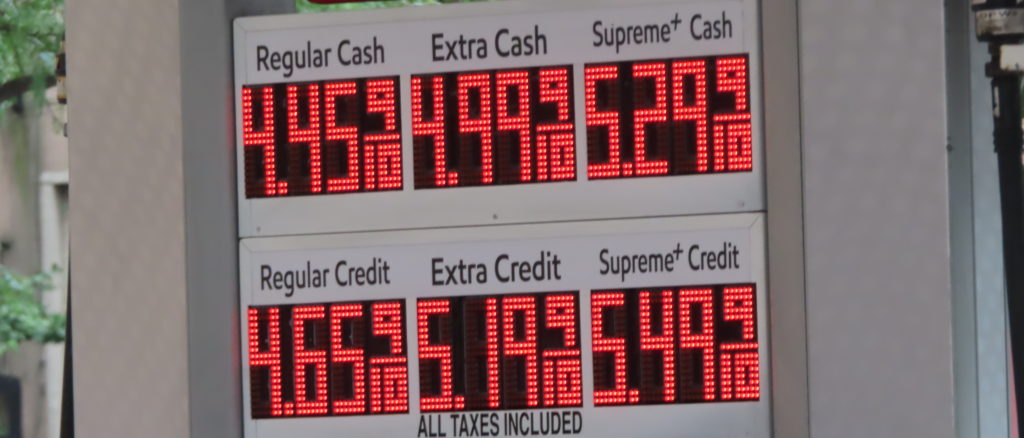
U.S. gasoline prices move alongside Brent crude, the global benchmark oil blend. For every $10 Brent increase, U.S. gas rises roughly 24 cents per gallon. Since striking Iran, the American Automobile Association (AAA) national gas average price increased from $2.98 to $4.11. Sudden restrictions to global supply often drive up Brent crude’s price, as occurred when Russian exports dipped following the Ukraine War’s 2022 escalation.
Some ships remained in transit after the Strait of Hormuz shuttered, the last of them only reaching European ports in late March. Floating storage Global markets haven’t yet adjusted to an impending supply crisis. Other strategic buffer sources have also been nearly depleted, and war-damaged infrastructure makes rapid restocks unlikely.
“Pre-Feb. 28 floating storage – oil on ships at sea – which amounted to as much as 400 million barrels has been largely depleted. It will take many months to rebuild that cushion,” Blackmon told the DCNF. “Massive damage to Middle East oil infrastructure will take months, in some cases years, to repair. National petroleum reserves are being similarly depleted as part of the IEA’s scheme. It will take the U.S. and other countries YEARS to rebuild those stocks.”
Even when these stocks are refilled, there may be no return to the pre-war status quo.
“The absence of those cushions will inevitably lead to higher volatility on crude oil prices, putting upward inertia into the market regardless of the supply/demand balance, i.e., a return of the ‘fear factor’ or ‘risk premium’ to oil markets that I’ve written about before,” Blackmon continued. “If the war ended today, I don’t believe the market could be rebalanced until into 2027. That’s the short term problem.”
“The incredible backwardation that we’ve seen in recent days shows just how desperate many refineries are to get crude into their facilities immediately,” Heritage Foundation Chief Economist Dr. E.J. Antoni told the DCNF, painting a similar picture.
Backwardation refers to a commodity’s spot or current price spiking relative to its futures price, typically caused by supply crunches. Futures are binding contracts to buy or sell a commodity at a predetermined date. Brent currently sits around $110 per barrel, but its September futures are trading for only $87.
“All the data from the oil market are pointing to severe shortages today,” Antoni continued.
An American Enterprise Institute (AEI) analysis, “The Economic Costs of the Iran War,” estimated increased expenditures per household according to gasoline price trends.
“The cumulative costs of gasoline expenditures, through April 1 work out to ~$6.7B or ~$50 per household,” AEI Senior Fellow Roger Pielke found. “If gas prices remain where they are that cost will increase to about $300 per household by June 30, and almost $550 by Sept. 30.”
Diesel has also risen over 45% to $5.65 a gallon since late February, according to AAA. Most American households don’t own diesel operated vehicles. However, they’re still impacted by increases in prices per gallon.
“Diesel is not primarily a consumer fuel. But every American household is a diesel consumer because everything that arrives at a store — groceries, construction materials, furniture, online orders — are moved by diesel-powered trucks,” Pielke writes.
Grocers Squeezed For Cash
Existing contracts and previously amassed inventories mean groceries don’t immediately increase in cost from fuel spikes. It’s only a matter of time until pain at the pump translates into pain in the aisle, and gasoline isn’t the only factor poised to drive up prices.
“Since energy affects the price of everything we do and everything we buy, higher energy prices will put upward pressure on the price of everything else in the months to come,” Heritage’s Antoni told the DCNF. “Some products, like fertilizer, are made directly from energy (mostly natural gas) so the price of those products will rise even more. Higher fertilizer prices specifically will make food more expensive starting later this year, a good example of a delayed impact from the war.”
Nearly 33% of seaborne fertilizer is produced in the Gulf and transits via the Strait of Hormuz. Urea, ammonia, and sulfur are often sourced from Iran and the Arab Gulf states due to their inexpensive, abundant natural gas resources.
“The global supply shock due to this extended closure will be severe and enduring, and will relate to many major necessities besides. We’re already seeing impacts in India, where dozens of fertilizer plants have shut down due to lack of feedstocks from the Middle East, and in the Philippines, where small farmers are skipping harvest seasons due to the cost of fuel,” industry veteran Blackmon clarified. “We will see hundreds of similar stories from most parts of the world due to the Hormuz situation.”
AEI’s analysis found that farmers may pay an additional $1.3 billion in fertilizer costs by September 30 at current prices. Urea alone has risen to $826/ton, a 35% increase since Operation Epic Fury began.
“It takes weeks for rising fuel prices to translate into higher retail grocery prices, but we’re now seeing reports of rising wholesale prices that will ultimately hit consumers,” Blackmon noted when asked about delayed impacts to grocery prices.
Cars and grocery carts aren’t the only U.S. household expenses getting more expensive. Increased deficit spending may also end up inflating mortgage rates.
Interest Rates At Risk
The Pentagon is requesting $200 billion in supplemental funding for the Iran War, according to the Associated Press. The Iran War is already costing the federal government nearly $900 million per day, according to a Center for Strategic and International Studies analysis.
“The $200 billion war supplemental will increase the demand for loanable funds and thereby put upward pressure on interest rates. Those higher rates will extend far beyond the market for Treasuries, meaning interest rates will rise on everything from credit cards to mortgages,” Antoni explained. “Since it’s unclear to me how long the war will be, it’s impossible to determine its total costs, but it’s clearly going to be in the billions of dollars.”
When the government spends more than it taxes, it borrows the difference by selling off U.S. Treasury bonds. This increases loan demand, and sees prospective homeowners competing for a reduced pool of available cash to borrow from for mortgages. This makes borrowing more expensive, translating to increased interest rates.
“Higher government spending is going to increase the deficit regardless of the source. Therefore, this supplemental will put upward pressure on interest rates. Should the costs of the war continue to increase, these upward pressures will become more intense,” Pacific Research Institute Senior Economics Fellow Dr. Wayne Winegarden told the DCNF.
“As for mortgage rates, a rising interest rate environment for government bonds will increase mortgage rates. Therefore, housing affordability will worsen under the current conditions,” Winegarden continued, highlighting a thorny political issue ahead of the midterms.
“Similarly, since we don’t know how long the war will be and how much more damage will be inflicted on energy infrastructure, it’s also unclear how much financial pain will be inflicted on the average American household,” Antoni added. “Such a calculation is further complicated by the fact that there are now many price increases baked into the cake.”
U.S. households will almost definitely be paying more for the foreseeable future, according to energy expert David Blackmon. “To be blunt, I don’t expect oil markets to ever fully recover to their pre-Feb. 28 status quo. EVER.”
All content created by the Daily Caller News Foundation, an independent and nonpartisan newswire service, is available without charge to any legitimate news publisher that can provide a large audience. All republished articles must include our logo, our reporter’s byline and their DCNF affiliation. For any questions about our guidelines or partnering with us, please contact [email protected].