



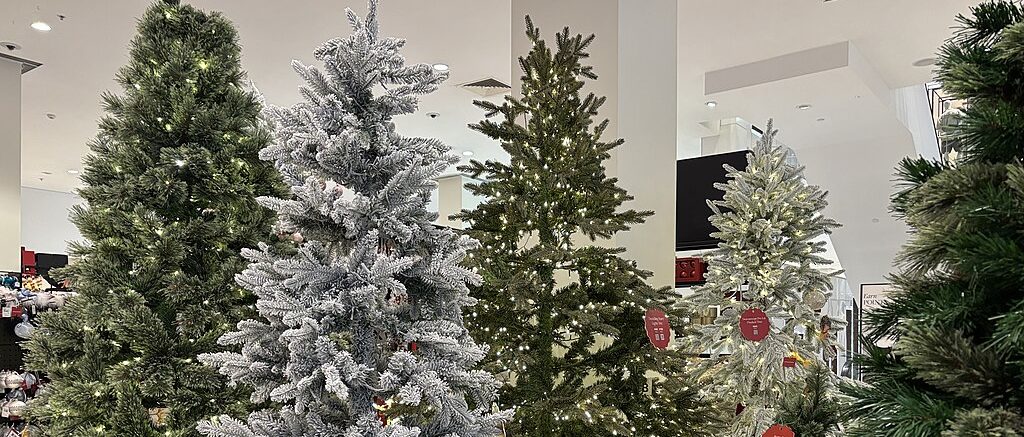
Many Americans are embracing artificial Christmas trees this holiday season despite them potentially being priced higher due to tariffs, the Associated Press (AP) reported Tuesday.
Prices for fake Christmas trees increased an estimated 10% to 15% in 2025 due to new tariffs, the AP reported, citing recent data from the American Christmas Tree Association (ACTA), a non-profit trade organization. Some tree companies in the U.S. have been having to slash their orders and shell out increased tariffs for the stock they gained this year, per the AP.
Roughly 80% of Americans who intend to put up a Christmas tree this year are planning to use an artificial one, the AP reported, citing data from the ACTA. Many Americans now prefer to buy fake trees even if they are not made in the U.S., according to the outlet.
“Putting a ‘Made in the U.S.A.’ sticker on the box won’t do any good if it’s twice as expensive,” Chris Butler, CEO of the National Tree Co., which sells over 1 million artificial trees each year, told the AP. “If it’s 20% more expensive, it won’t sell.”
Moreover, some artificial tree businesses have recently begun moving their production so that they are relying less heavily on China, the AP reported.
Mac Harman, founder and CEO of Balsam Brands, which sells hundreds of thousands of Balsam Hill trees annually, told the AP that many Americans prefer to put up their Christmas trees around Thanksgiving and keep them on display for weeks, which can result in fresh-cut trees drying out. Harman added that some Americans turn to putting up artificial Christmas trees because they are allergic to mold spores which can be found on real trees, the AP reported.
Harman also told the outlet that his tree sales have decreased 5% to 10% this year in the U.S. but have increased 10% or more in Germany, Australia, Canada and France, likely as a result of Trump’s tariffs having made demand in the U.S. drop.
“If a merry Christmas is measured in how many decorations people put up, by that measure it’s going to be a slightly less merry Christmas,” Harman told the AP.
A June survey conducted by Ipsos on behalf of the ACTA showed that 61% of respondents are worried that tariffs will have a negative impact on Christmas, such as affecting the availability of holiday decorations, toys and electronics and being able to afford purchases during holiday season.
Many American consumers are expected to rely on credit card purchases this holiday season, the Daily Caller News Foundation previously reported. An estimated 158.9 million Americans are planning to shop on the last Saturday before Christmas, up from 157.2 million shoppers in 2024, according to a National Retail Federation (NRF) and Prosper Insights & Analytics survey released on Monday.
Some American retailers have been either reducing or postponing plans to hire seasonal workers this year due to rising uncertainty over the impacts of President Donald Trump’s tariffs, Fortune reported on Oct. 13. Moreover, U.S. business owners have reportedly been concerned about Trump’s tariffs negatively impacting their companies in 2026.
Additionally, Christmas trees in the U.S. are expected to cost between $80 and $100 on average this year, Southern Living reported on Oct. 7.
All content created by the Daily Caller News Foundation, an independent and nonpartisan newswire service, is available without charge to any legitimate news publisher that can provide a large audience. All republished articles must include our logo, our reporter’s byline and their DCNF affiliation. For any questions about our guidelines or partnering with us, please contact [email protected].