



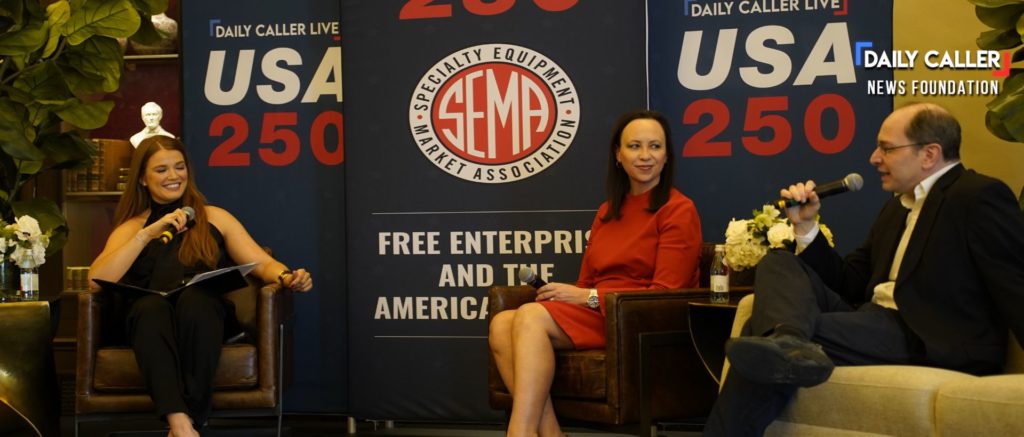
Daily Caller Live hosted business analysts Thursday in Washington to discuss how cutting red tape can promote the American dream.
American Commitment President Phil Kerpen and Senior Vice President of Public and Government Affairs at the Specialty Equipment Market Association (SEMA) Karen Bailey-Chapman joined the Daily Caller’s Ashley Brasfield for the conversation at the Waldorf Astoria Washington DC.
Bailey-Chapman said regulatory reform has been “absolutely critical” to the automotive industry, crediting Environmental Protection Agency (EPA) Administrator Lee Zeldin.
“What Administrator Lee Zeldin has done over at the EPA has been incredible for our industry in particular, simply because you can’t build a business on hope. You can’t build a business on ‘maybe’ or theoreticals,” Bailey-Chapman said. “When you build a product you have to make sure that you’re going to be enforced against because a change in Washington now has made you a target.”
Kerpen said the environment of regulatory reform “changed dramatically” after President Donald Trump took office to begin his second term.
“We went from one of the most stringent, most aggressive regulatory administrations to one of the most deregulatory,” he said. “I thought [former President Barack] Obama was going to be the world record regulator for a long time, and his record was very short-lived because the Biden administration piled up regulations with much, much higher costs.”
The Biden-era EPA alone introduced over $1.3 trillion in regulatory costs — including “Multi-Pollutant Emissions Standards” costing an approximate $870 billion — according to a 2025 report by the American Action Forum. Kerpen said the de facto electric vehicle (EV) mandate was “the single most costly regulation in world history.”
![[Photo by the Daily Caller News Foundation]](https://cdn01.dailycaller.com/wp-content/uploads/2026/03/Untitled-design7.png)
[Photo by the Daily Caller News Foundation]
Bailey-Chapman said during the panel that some regulations induce major losses for businesses in the automotive sector.
“You have these copycat products coming in from overseas of our members’ products that had to go through the regulatory compliance and spend the money and the time — now they’re coming in without compliance, without testing,” she stated.
“Just one product copycat is $12 million of revenue sales on one retail platform here in the U.S.,” Bailey-Chapman continued. “So, that’s super important.”
“How many years now have we heard, ‘everyone agrees we need to do permitting reform, it’s bipartisan,’ and they don’t pass anything? They don’t actually do it,” Kerpen added.
The panelists also discussed the Trump administration’s tariffs, which reports indicate could have a disproportionate effect on the automotive industry. Bailey-Chapman said that while SEMA’s members “understood the purpose of the tariffs” and “do want to redomesticate” their manufacturing, “they need a bridge.”
“They need that bridge, whether it’s to buy the machines, get everything moved here, get their tooling back, maybe make their machines and tooling non-tariffed so that a machine isn’t double the cost,” Bailey-Chapman said. “There has to be some kind of relief in the steel and aluminum space, domestically.”
![[Photo by the Daily Caller News Foundation]](https://cdn01.dailycaller.com/wp-content/uploads/2026/03/Untitled-design6.png)
[Photo by the Daily Caller News Foundation]
Kerpen noted the importance of understanding “what the president is trying to do from a strategic standpoint,” adding, “you need to give him the latitude to see how these things shake out.”
“He has got some major concessions that have moved in a direction of better policy,” Kerpen said.
The panelists shared optimism for future deregulation at the federal level. Kerpen said he was encouraged by “a lot of financial deregulation” while adding that more deregulation at the Food and Drug Administration could save “not only a huge amount of money but can save a lot of lives.” Bailey-Chapman agreed there is “a lot of reason for optimism.”
“America is a country of ingenuity and innovation, and we always figure it out,” she said. “And I think the less that government stands in the way of being able to do that is always good for our country.”
Bailey-Chapman also said there is a “disconnect” between the automotive industry “not realizing that the American consumer still decides what we get to do.”
“There’s one way to make Americans not do something, and that’s when you tell them to do something, and you must do something,” she added.
All content created by the Daily Caller News Foundation, an independent and nonpartisan newswire service, is available without charge to any legitimate news publisher that can provide a large audience. All republished articles must include our logo, our reporter’s byline and their DCNF affiliation. For any questions about our guidelines or partnering with us, please contact [email protected].