




A Chinese intelligence official’s autobiography details decades of efforts to cultivate ties with American officials, culminating in an alleged plot with a three-star U.S. general to annex strategic territory for Beijing, a Daily Caller News Foundation investigation discovered.
Chinese-American businessman Eugene Ji, who owns two golf courses flanking Louisiana’s Barksdale Air Force Base, developed a years-long professional and personal relationship with retired Army Lt. Gen. Russel Honoré, which allegedly included expensive gifts and meetings with high-ranking Chinese government officials, according to DCNF translations of Chinese government announcements and Ji’s 2014 Chinese language autobiography “New Circle.” Among other concerning episodes, the autobiography claims the pair organized an event to bring Chinese military officers to a U.S. nuclear base and also repeatedly propositioned Chinese political insiders with a half a billion dollar plan to seize Japan’s Senkaku Islands for China through weaponized migration, which the general denies.
“When I asked his opinion on the matter of the [Senkaku Islands], the general said those few small islands are of course Chinese territory — why keep talking without acting? No need to consult Japan. If pigs can be raised on the islands, set up a pig farm. If tourism is possible, build dozens of houses. Sovereignty is China’s. Welcome tourists from around the world. Japanese can go too, just get a visa at the Chinese embassy in Japan, so what’s the hang-up?” Ji wrote, according to a DCNF translation of the autobiography. “Do your friends think the price is too high?”
Honoré, who retired in 2008, allegedly served as the “U.S. affairs advisor” for an organization founded by Ji called the G2 Club, which has offices in the U.S. and China, and is comprised of business leaders and government officials from both nations, according to DCNF translations of “New Circle.”

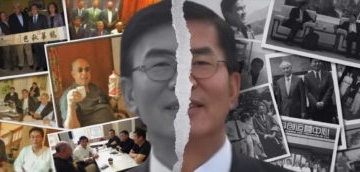
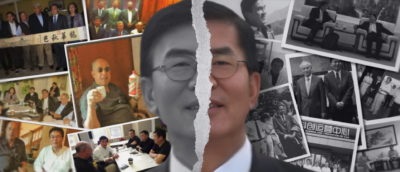
[Image created by DCNF with “New Circle” and Jinan ACFIC arm photos]
Honoré, who coordinated military relief efforts after Hurricane Katrina and later led then-House Speaker Nancy Pelosi’s security review task force following the Jan. 6 U.S. Capitol riot, denied involvement in the Senkaku scheme and told the DCNF that Ji is “full of shit.” However, he did not deny being pictured with the businessman in multiple photos featured in “New Circle” and in Chinese government announcements unearthed by the DCNF.
“I did meet with them, but I had no agreement with them, and was no kind of official advisor,” Honoré said. “I’ve never gotten anything out of it, never been paid anything, and it’s mostly cost me time as a courtesy to Eugene, because he’s a serial entrepreneur and I do consulting work.”
Honore’s more than decade-long relationship with Ji — who has held multiple Chinese government positions, including serving as an official for an arm of a Chinese Communist Party (CCP) influence and intelligence agency called the United Front Work Department (UFWD) — raises red flags about how China targets influential Americans.
“What makes this especially concerning is that a documented United Front–affiliated actor openly describes influencing senior U.S. military officers and elected officials, getting meetings arranged, access granted, projects discussed, and relationships leveraged,” L.J. Eads, a former Air Force intelligence analyst, told the DCNF after reviewing select chapters of Ji’s autobiography. “When a foreign political influence system is able to shape behavior, decisions, or access among generals and politicians through informal business and social channels, that crosses from engagement into a national security vulnerability.”
Ji did not respond to multiple requests for comment.

[Image created by the DCNF with screenshots from StoneBridge, Olde Oaks, Regrid and Canva]
‘Oblivious’
The scheme to seize the Senkaku Islands for China involved using Chinese prefabricated dwellings to build a resort on the islands, which would be staffed by “100 black people” from an unspecified U.S. civil rights organization explicitly in order to deter the Obama administration from intervening, according to a DCNF translation of “New Circle.”
The Senkaku Islands are a small chain in the East China Sea administered by Japan and claimed by China, which contribute to ensuring “U.S. strategic, political, and economic interests in the Indo-Pacific region and elsewhere,” according to the Congressional Research Service.
Ji wrote that he and Honoré repeatedly pitched the $500 million project to Chinese counterparts as a pretense to assert Beijing’s sovereignty over the uninhabited isles, according to DCNF translations of the third-to-last and final chapter of “New Circle.”
Ji’s Chinese business contacts would first secure state–backed loans to manufacture prefabricated dwellings in China, which the government would then escort to the Japanese islands, after which China’s flag would be raised and access controlled by its visa authority, according to the plan.
“[W]e would also hire the American black civil rights Martin Luther King organization to organize 100 black people to provide security and hotel services for Chinese tourists,” Ji wrote, according to a DCNF translation of the autobiography. “The U.S. government wouldn’t dare interfere — this is private commercial cooperation. Black civil rights organizations helped Obama get into the White House.”
“What the government can’t do, we the people will handle,” Ji continued, according to a DCNF translation of “New Circle.”
However, it’s unclear if the scheme ever advanced beyond attempts to recruit Chinese business partners.
“All that’s lies,” Honoré told the DCNF.
Ji and Honoré allegedly had at least one discussion concerning the progress of the scheme after playing golf at one of the businessman’s courses, according to “New Circle.”
After golfing on or around the same day, the pair also allegedly discussed organizing a “Sino-U.S. Generals’ Friendly Golf Tournament” that was later held, according to the autobiography.
“Every year, the club invites 50 Chinese military personnel to visit the U.S., make friends with U.S. military personnel, play golf and increase mutual understanding,” Ji wrote, according to a DCNF translation of the autobiography. “The G2 Club specially invited three-star First Army General Russel Honoré and other senior U.S. military officers to participate in the club’s golf-themed annual meeting, tour a U.S. B-52 bomber training base, visit General Chennault’s military museum, and revisit the history of the Flying Tigers’ assistance to China during World War II to promote friendly exchanges between the two militaries.”
“It’s all fabricated shit,” Honoré told the DCNF when asked about the alleged tournament.
“I hate fucking golf,” Honoré said. “I live on a golf course. I’ve been on it one fucking time since 2010.”
A spokesperson for Barksdale AFB, which is the only Louisiana base hosting B-52s, neither confirmed nor denied Ji’s claims.
“[W]e do not discuss specific intelligence, investigative matters, or alleged interactions involving individual personnel,” the spokesperson said.
The U.S. military is not doing enough to protect its bases and personnel from Chinese influence operations, author and China expert Gordon Chang told the DCNF.
“The Air Force in particular and the Pentagon in general need to stop being oblivious,” Chang said. “We’ve known about China’s infiltration of areas around military bases and done little or nothing about it. What is wrong with us?”
“The Department of War should take its name seriously. China thinks it is at war with us, so, yes, we’re at war,” said Chang.

[Image created by DCNF with New Circle photos]
‘Made In China’
Ji also allegedly gave Honoré a number of gifts, including expensive liquor and LED lights for his home, according to DCNF translations of the autobiography.
“New Circle” claims that after playing golf Ji and Honoré frequently drank Moutai liquor together, which is made from sorghum and is China’s “most-prized liquor,” according to Chinese state-run media.
During one G2 Club dinner in New Orleans with visiting Chinese state-owned enterprise executives, Ji allegedly gifted Honoré a bottle of Moutai costing more than $400, according to a DCNF translation of “New Circle.”
On another occasion, Ji allegedly procured an entire case of Moutai for Honoré from the distillery in China.
“Whenever I return to China, if I have the time, I make a special trip to Guizhou. My alumnus Hu Pinglin will give me a few bottles to take back. Since there is counterfeit liquor on the market, I’m afraid something could go wrong if the general drank fake alcohol, so I only buy it through friends directly from the distillery,” Ji wrote, according to a DCNF translation. “Last time, Mr. Hu managed to obtain an entire case directly from the Moutai distillery. The general took it back to Washington D.C., where more than 10 generals finished it all in one sitting.”
Hu has held numerous high-level Chinese government positions, including serving as the Communist Youth League secretary of an unspecified Chinese defense enterprise, and the deputy chairman of a branch of the Chinese Culture Promotion Society (CCPS), which is an arm of the Ministry of Culture and Tourism, according to DCNF translations of “New Circle” and CCPS announcements.
Honoré told the DCNF he did not recall receiving Moutai from Ji, and could not account for a “New Circle” photo showing him holding a bottle of the Chinese liquor.
“I got LED lights and a globe from him, never any boxes of expensive liquor,” Honoré said. “He gave me a globe, I’ve got the globe in my office, it’s one you can buy out of any Amazon shop.”
While Ji did not mention gifting Honoré a globe in “New Circle,” the autobiography claims he outfitted the general’s entire home with Chinese LED lights.
“Shenzhen Punai Optoelectronics sent over some energy-saving LED lights that could be installed in shipping containers. I had a friend deliver three boxes and replace all the lighting in the general’s villa with ‘Made in China’ products that had American UL certification,” Ji wrote, according to a DCNF translation. “Later, the general even asked me to introduce Shenzhen Punai’s products to 25 U.S. military bases.”
Although the autobiography presents the LED company as an unrelated third party, business filings reveal it shares its phone number with a similarly-named Chinese LED manufacturer called Shenzhen Punai Energy Saving Lighting Co. Ltd., which Ji owns. Furthermore, both of Shenzhen Punai Optoelectronics’ board members also sit on the board of Ji’s LED company, one of whom likewise serves as the G2 Club’s secretary general, according to a DCNF translation of a Guizhou University announcement.
“He had them at his office, and he said ‘you want some LED lights for your house,’ and I said, ‘okay, I’ll take some,’” Honoré told the DCNF, while denying he asked Ji to introduce the lights to 25 U.S. military bases.
Ji’s activities go beyond “normal civic behavior,” Eads told the DCNF.
“When a foreign political intermediary supplies luxury goods and installs electronic systems inside the home of a senior U.S. military official without clear disclosure or vetting, that is not just a social courtesy,” Eads said. “It is a counterintelligence concern.”
All content created by the Daily Caller News Foundation, an independent and nonpartisan newswire service, is available without charge to any legitimate news publisher that can provide a large audience. All republished articles must include our logo, our reporter’s byline and their DCNF affiliation. For any questions about our guidelines or partnering with us, please contact [email protected].