



A bold daylight robbery at the Louvre Museum in Paris has left the art world shaken — and it’s not just about the stolen jewels. It’s about what the thieves exposed: a security system at one of the most famous and heavily visited museums in the world… that didn’t stop them.
Let that sink in.
The Louvre. Home of the Mona Lisa, the Venus de Milo, and thousands of priceless artifacts. You’d think it would be a fortress. But on Sunday, thieves managed to slip in, steal valuable jewelry, and escape — sparking alarm bells not just in Paris, but in every museum across the globe.
#France Louvre Robbery in 7 Minutes — Criminals Acted Like in “Ocean’s Eleven”
Unknown perpetrators pulled off a daring robbery at the Louvre, entering the Apollo Gallery using a cherry picker through a building under construction. The entire heist took just 7 minutes.… pic.twitter.com/TCYAGN8sxu— Military Conflicts (@Alex_RobertsJ) October 19, 2025

And now? Everyone’s looking over their shoulder.
Security experts say this was more than just a one-off crime. According to retired DHS special agent Jim Hayes, it’s a warning shot. He told FOX Business that museums and galleries are now scrambling to “review locks, access points, and overall protection strategies.” Translation? If it could happen at the Louvre, it could happen anywhere.
Hayes didn’t stop there. He said museums should be upgrading ID badges, access control systems, and maybe even start treating their entrances like high-security government buildings. Because let’s be honest — if a gang of jewel thieves can pull off something like this in broad daylight, in the middle of one of the most watched public spaces on Earth, how many more are thinking about trying something similar?
And here’s where things get more intense.
Was it an inside job? Former jewel thief Larry Lawton — who now helps police track down people just like his former self — says it had to be. Either that, or the crew had detailed insider knowledge. This wasn’t some smash-and-grab. It was coordinated. It was fast. And it worked.
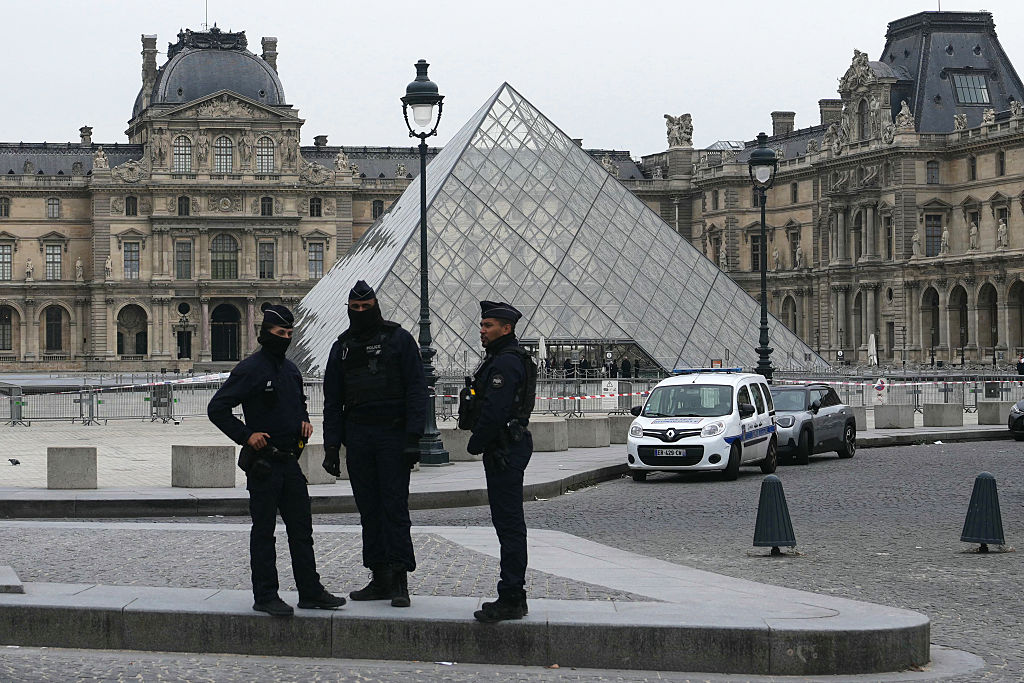
Photos from the scene show police standing guard outside the Louvre, and forensic teams examining a cut window and a balcony that may have been used to gain entry. That kind of precision doesn’t happen without planning.
And it’s not the first time.
Security consultant Spencer Coursen pointed out that museums keep repeating the same mistakes. Dresden Castle in Germany was hit in 2019, losing royal jewels. The Isabella Stewart Gardner Museum in Boston suffered one of the biggest unsolved art heists in history back in 1990. And more recently, the British Museum revealed in 2023 that thefts had been happening for years right under their noses.
Several people disguised as construction workers broke into the world-famous Louvre museum in Paris, cracking open display cases and stealing jewelry of “inestimable heritage and historical value.”
Here’s a look at the stolen pieces: https://t.co/kDl2KFdgMM pic.twitter.com/IxNfGGJDWw
— ABC News (@ABC) October 19, 2025
What’s the common thread? Weak points. Not in technology, but in people, processes, and oversight.
Coursen said it best: Luxury stores protect handbags and watches better than some museums protect the legacy of entire civilizations. That’s not just a problem — it’s a massive liability.
While the world is focused on digital threats — hacking, phishing, cyberattacks — this robbery reminds us that sometimes the biggest breach walks in through a side door or climbs up a balcony.
The Louvre remains closed as the investigation unfolds. But behind the scenes, you can bet every major museum and gallery is running an emergency audit of its own. Staff are being rechecked. Cameras repositioned. Access logs pulled.
Because here’s the real story: the theft didn’t just steal jewelry. It stole the illusion of safety.