



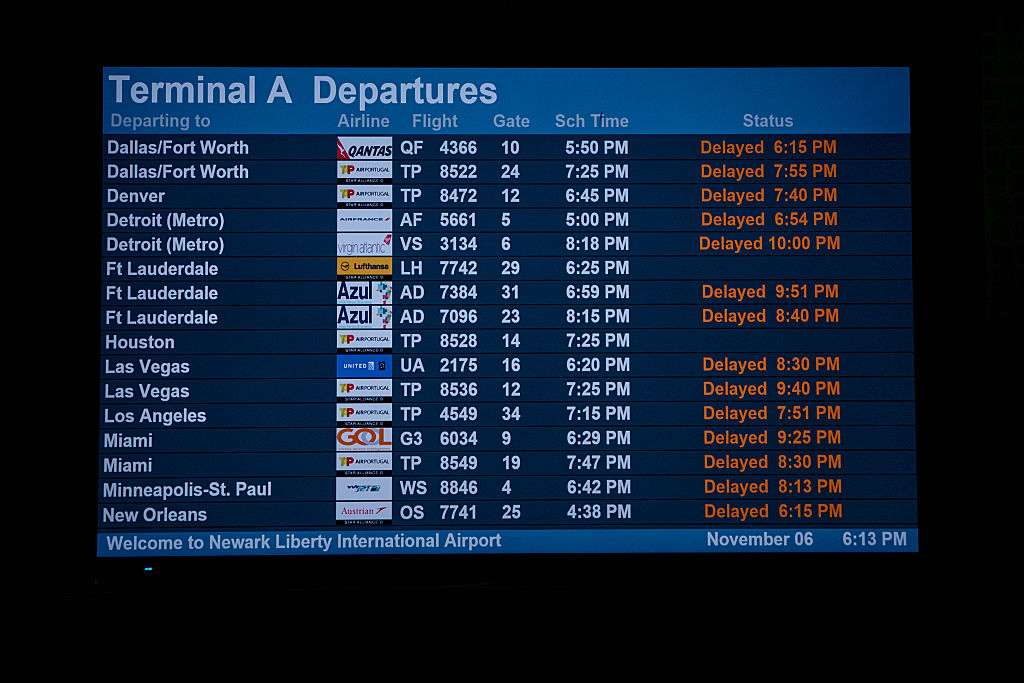
Hundreds of flights were canceled Friday as airlines began complying with the Federal Aviation Administration’s unprecedented directive to reduce service nationwide due to the ongoing government shutdown.
According to The Associated Press, the FAA’s order targets 40 major airports across more than two dozen states, including hubs in Atlanta, Dallas, Denver, Los Angeles, and Charlotte, North Carolina.
More than 800 flights were canceled nationwide — four times the number canceled Thursday, according to FlightAware, though not all disruptions were linked to the FAA order. Chicago, Atlanta, Denver, Dallas, and Phoenix led the nation in flight interruptions.
While many travelers were able to adjust with minimal disruption, others faced major headaches. Karen Soika of Greenwich, Connecticut, discovered her flight out of Newark was rebooked for an earlier departure from John F. Kennedy International Airport instead, more than an hour away.
“I’m a surgeon, I’m used to chaos,” she said. “I’m going to U-Haul and I’m going to drive a truck cross country to get back to Utah,” she added, as she advised on medical scenes for a “Yellowstone” spinoff.
Airport staff shortages added to the turmoil. At Houston’s George Bush Intercontinental Airport, security lines were reportedly endless, forcing some passengers to lie down while waiting. Many flights were delayed as a growing number of airport and air-traffic personnel called out amid the financial strain of working without pay.
Transportation Secretary Sean Duffy said the cuts are designed to reduce pressure on overworked air traffic controllers. “There could be a benefit if I can get the controllers to come back to work,” he said.
Airlines focused their reductions on smaller regional routes to minimize the impact. Delta canceled roughly 170 flights Friday, American Airlines cut 220 daily through Monday, and Southwest cut about 120 flights.
Routes in the Northeast, Florida, and between Dallas and smaller cities were most affected. Some travelers turned to car rentals, with Hertz reporting a sharp spike in one-way bookings.
Passengers are entitled to refunds for canceled flights, though airlines aren’t required to cover food or lodging unless the cancellation is under the carrier’s control. “People really should be thinking what else can I do? Can I already research some other potential flights?” travel adviser Christina Schlegel said.
The FAA said the cuts will begin at 4% of flights at busy airports and could ramp up to 10% in the coming week, potentially intensifying travel chaos ahead of the Thanksgiving holiday. Airlines noted international flights are not expected to be affected.
Henry Harteveldt, an industry analyst, warned, “Next week the airlines are going to have to say, ‘OK, the easy cuts are made. Now we’ve got to start making the difficult cuts.’”
Savanthi Syth of Raymond James said travel is currently in a slower season, giving airlines more flexibility to rebook passengers, but disruptions are expected to continue as the shutdown persists.