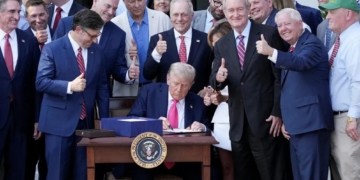




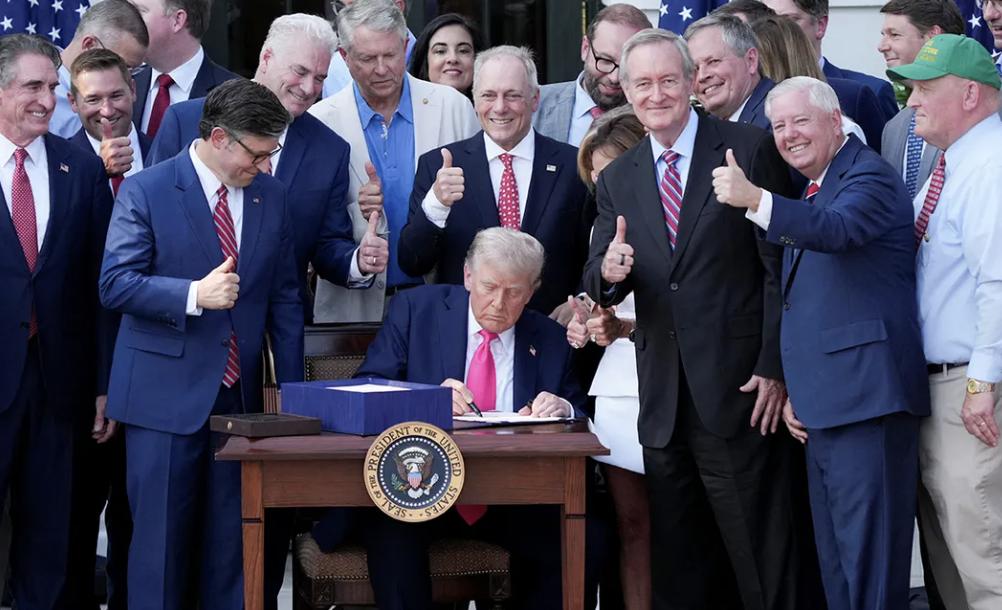
President Donald Trump signed the sweeping package, widely known as the “Big Beautiful Bill,” into law on July 4, 2025. The legislation locked in his 2017 tax cuts and pushed forward key priorities, including border security funding, changes to Medicaid, and support for rural health systems.
Early polling showed the bill struggled to gain traction with voters, prompting a shift behind the scenes. By the fall of 2025, Trump administration officials were advising Republicans on Capitol Hill to rethink their messaging. The recommendation was simple: stop leading with the nickname and start emphasizing what the law does.
Instead of “Big Beautiful Bill,” Republicans began using the more formal title, the “Working Families Tax Cuts Act,” aiming to highlight direct financial benefits.
“Republicans in Congress, alongside President Trump, delivered a transformative piece of legislation on America’s 249th anniversary. I refer, of course, to the One Big Beautiful Bill Act — the largest Working Families Tax Cut package in American history.
I am of the camp that…
— House Republicans (@HouseGOP) February 25, 2026
That shift is now fully embedded in the GOP’s midterm playbook.
Major Republican campaign arms — including the RNC, NRCC, and NRSC — are instructing candidates to localize their messaging rather than defend the nearly 1,000-page law as a whole. The strategy focuses on pulling out specific provisions and tying them to real people and local communities.
“If you’re in a border state, you should absolutely be highlighting what we did on the immigration front,” said RNC communications director Zach Parkinson. In states where health care dominates, Republicans are instead pointing to rural health funding included in the bill.
Internal polling reinforced the approach. Data shared with the Daily Caller showed that when voters were told the legislation would improve child care affordability, roughly two-thirds said they were more likely to support it. Provisions eliminating taxes on tips and overtime also tested strongly, particularly when framed as putting more money directly into workers’ pockets.
Nora Pruitt, a Baltimore resident and working mom at Marlin Steel: “With the Big Beautiful Bill, we were able to buy one of the most expensive tools our factory’s ever bought… it totally changed our lives. We were able to buy a 5 bedroom home on an acre of land.” pic.twitter.com/mmSWpq5j00
— Rapid Response 47 (@RapidResponse47) March 12, 2026
Republicans are now building campaigns around those individual stories.
Party officials describe a steady stream of messaging across texts, ads, and local media appearances — highlighting a waitress benefiting from tax-free tips, a police officer keeping more overtime pay, or a family receiving an expanded child tax credit.
In many cases, campaigns are using both names for the law to avoid confusion, pairing “Working Families Tax Cuts Act” with “One Big Beautiful Bill” in parentheses.
Trump himself has stuck with the original branding, continuing to promote the law under its nickname at rallies and public events. Still, his messaging aligns with the broader strategy, focusing on specific benefits and personal stories as he travels.
The Working Families Tax Cuts include real relief for rural America.
From expanded Opportunity Zones, to a permanent Death Tax exemption that protects family farms, our Republican majority is delivering bigger paychecks, bigger tax refunds, and bigger opportunities in 2026! pic.twitter.com/t4PHvsqVjy
— Mike Johnson (@MikeJohnson) March 21, 2026
Cabinet officials have joined the effort, spreading out across the country to promote different parts of the law. Treasury Secretary Scott Bessent has highlighted new “Trump Accounts” designed to help families save for children, while Education Secretary Linda McMahon has focused on tax credits tied to school choice.
Despite the coordinated push, Republicans acknowledge two ongoing challenges: the sheer size of the legislation and keeping it relevant in a fast-moving news cycle.
The law spans nearly 1,000 pages, and early messaging focused mostly on top-line talking points, leaving room for critics to define it first. Now, the strategy is to break it down into digestible pieces and repeat them consistently through Election Day.
The post GOP Resurrects ‘Big Beautiful Bill’ Ahead Of Midterms appeared first on Red Right Patriot.