



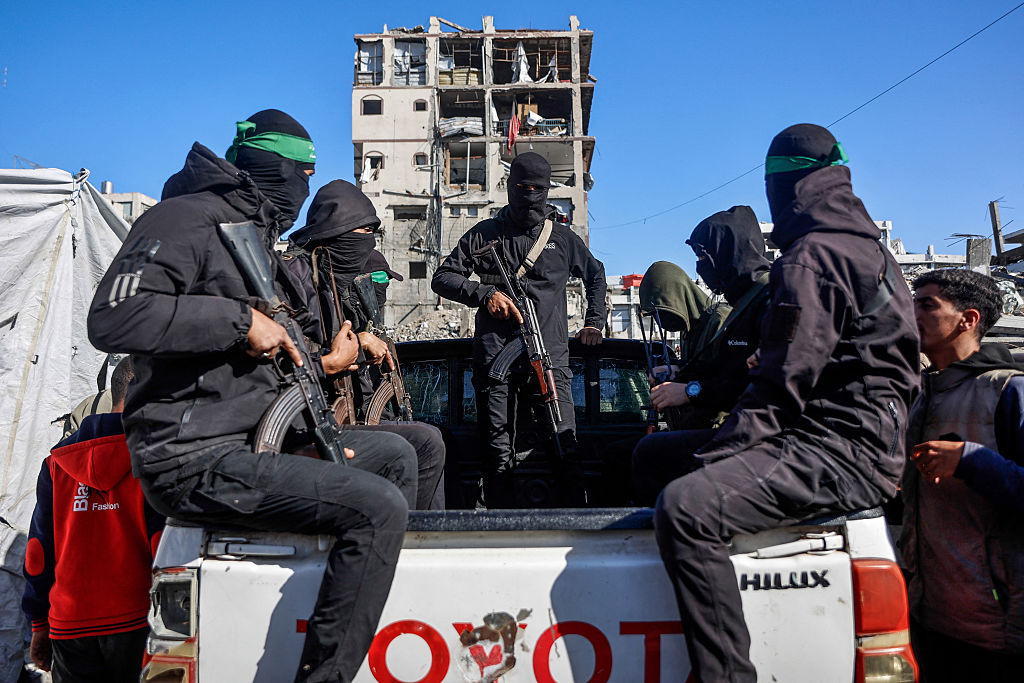
Negotiators edging toward the next phase of a fragile truce between Israel and Hamas are confronting one of the most difficult questions in the entire agreement: what happens to Hamas’ weapons.
According to The Associated Press, in a rare public glimpse into the group’s thinking, a senior Hamas official suggested the organization might consider freezing or storing its arsenal rather than surrendering it outright.
Bassem Naim, a member of Hamas’ political bureau, spoke Sunday in Doha as discussions moved toward the second stage of a U.S.-brokered plan meant to stabilize Gaza and prevent a return to full-scale war.
“We are open to have a comprehensive approach in order to avoid further escalations or in order to avoid any further clashes or explosions,” Naim said.
The October truce halted a two-year Israeli offensive that began after Hamas’ Oct. 7, 2023 attack. Since then, the two sides have exchanged hostages and prisoners, leaving only the remains of one Israeli hostage still held in Gaza.
With the first phase nearly complete, attention has shifted to the broader political and security framework for Gaza — including troop withdrawals, governance structures, and, most prominently, disarmament.
Israel has insisted that Hamas must lay down its weapons before progress can continue. Hamas, however, has long framed armed resistance as central to its identity.
Naim reiterated that stance while hinting at a compromise.
“Hamas retains its ‘right to resist,’” he said, “but we are ready to lay down its arms as part of a process aimed at leading to the establishment of a Palestinian state.”
He offered limited specifics but mentioned a long-term truce as a possible setting for negotiations.
“This time has to be used seriously and in a comprehensive way,” he said.
Naim suggested several options for the weapons.
“We can talk about freezing or storing or laying down, with the Palestinian guarantees, not to use it at all during this ceasefire time or truce,” he said.
Whether such a proposal meets Israel’s demand for full disarmament remains unclear.
The ceasefire is anchored in a 20-point plan introduced by President Donald Trump and endorsed by the U.N. Security Council, though many details still require negotiation.
“The plan is in need of a lot of clarifications,” Naim admitted.
Meanwhile, both sides accuse each other of violating the truce, and Gaza remains devastated after months of fighting.
Naim acknowledged the heavy toll on Palestinians but rejected the idea that Hamas regrets the Oct. 7 attack.
“History didn’t start on Oct. 7,” he said. “Oct. 7 for us, it was an act of defense.”












