



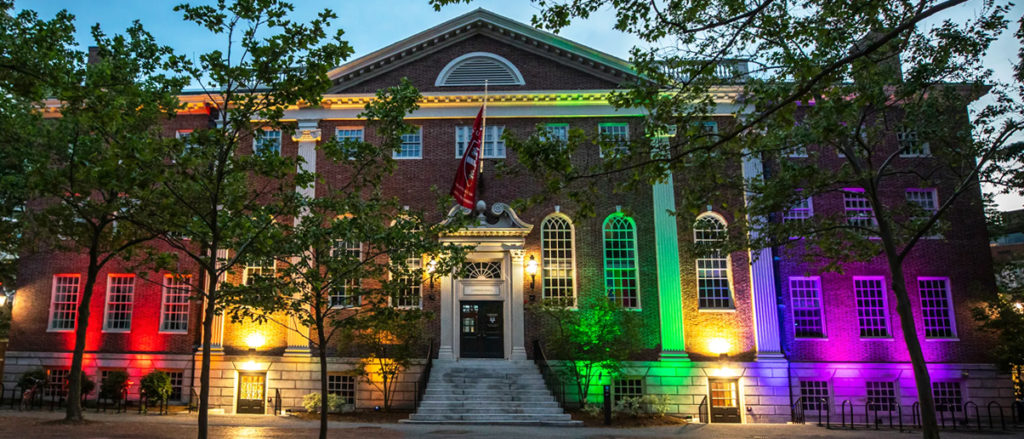

A history professor who has taught at Harvard for 40 years is publicly calling out the Ivy League school over race-based hiring and admissions policies, a “shocking indifference” to antisemitism, and for its eroding commitment to teaching students about Western history.
James Hankins wrote in a Compact Magazine essay titled “Why I’m Leaving Harvard” that his decision was largely influenced by the school’s abandonment of merit in favor of diversity quotas, which he said entirely changed “the way we conducted our affairs,” leaving extraordinary candidates behind if they did not have Harvard’s desired skin color or gender.
In 2020, Hankins said, “the university had collectively taken a knee during the Summer of Floyd.”
“This turned out not to be empty virtue-signaling, as I expected, but had serious consequences for the way we conducted our affairs,” he wrote. “In reviewing graduate student applicants in the fall of 2020 I came across an outstanding prospect who was a perfect fit for our program. In past years this candidate would have risen immediately to the top of the applicant pool. In 2021, however, I was told informally by a member of the admissions committee that ‘that’ (meaning admitting a white male) was ‘not happening this year.’”
Hankins said such treatment was not confined to Harvard. After making inquiries with colleagues, he determined that the same “unspoken protocol” was being followed all across the nation.
“The one exception I found to the general exclusion of white males had begun life as a female,” Hankins said.
His concerns were only compounded in 2023 when the university failed to properly address antisemitism, describing the university’s attitude as a “shocking indifference.”
Furthermore, Covid protocols at the institution “mirrored to a fault the whole country’s uncritical acceptance of The Science and its proclivity, when backed by public power, for tyrannous invasions of private life,” Hankins added.
More broadly, Hankins warned that the university has for decades neglected its responsibility to teach Western civilization as a serious, foundational subject, to the detriment of both students and society.
“When late liberal pedagogy replaced Western civilization courses with global history, serious harm was done to the socialization of young Americans. When you don’t teach the young what civilization is, it turns out, people become uncivilized,” Hankins wrote. “It is hard to avoid the impression that, whether through hostility or neglect, Western history is being phased out or allowed to die on the vine at Harvard.”
Hankins contrasted how history is taught in China, where national identity and patriotism are openly reinforced, with how it is taught in the United States, where Western history is often presented as something to be condemned or dismantled. “In the hands of hyper-progressive (or ‘woke’) practitioners, Western global history is often, indeed, actively anti-Western,” he wrote.
Harvard’s downfall, Hankins said, had begun decades prior. In the 1990s, the university was “under increasing pressure to hire more women faculty,” and thus, was forced to abandon some of its longstanding expectations.
“Since at the time women formed less than 10 percent of PhDs in history and were even rarer in the mid-career cohorts from which Harvard tended to hire, equality required that standards be lowered,” the professor observed.
Hankins added that he is continuing his career at the Hamilton School of Classical and Civic Education at the University of Florida, which he says is still “committed to teaching the history of Western civilization” and takes in “the dreaded population of white males whose intersectional scores were too low for employment in legacy universities.”
“It should by now be evident why Harvard and its ‘peer’ institutions in the Ivy-Plus category do not offer fertile ground for a new flowering of courses in the Western tradition,” Hankins wrote. “Many now believe that our civilization is on the point of collapse, but few seem willing to take the steps necessary to preserve it.”
Even more devastatingly, he concluded that, while one can “hope” for change in America’s existing higher education institutions, “for now, a better hope lies in building new institutions unencumbered by the corruption and self-hatred that infect the old.”
All content created by the Daily Caller News Foundation, an independent and nonpartisan newswire service, is available without charge to any legitimate news publisher that can provide a large audience. All republished articles must include our logo, our reporter’s byline and their DCNF affiliation. For any questions about our guidelines or partnering with us, please contact [email protected].