



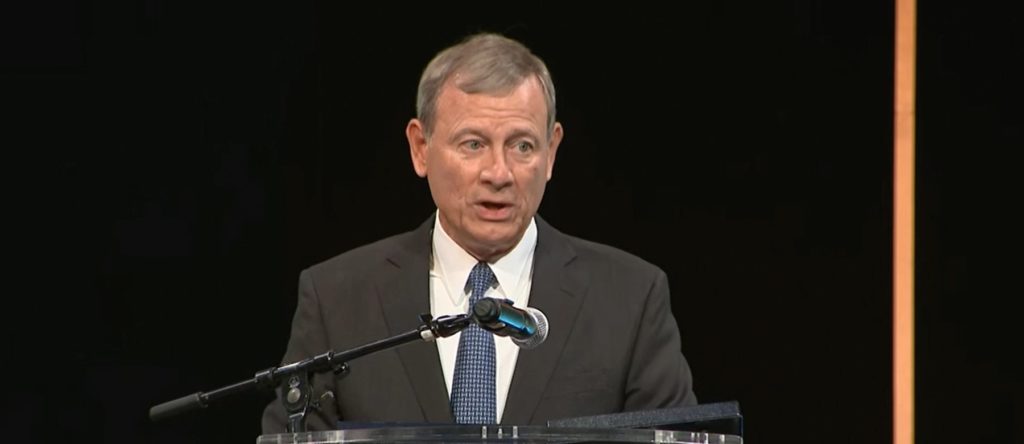

You would think being the United States Supreme Court Chief Justice would be enough for any man, but John Roberts also likes being a shadow senator. Yes, he did it again. Responding to perceptions of public opinion and his own views, Roberts didn’t “call balls and strikes” on Trump’s tariffs. Roberts went to bat, just as he did 14 years ago to save Obamacare.
As an unabashedly free-trade economist, I’m not entirely comfortable with using tariffs to bludgeon friend and foe. But I grant the necessity. Our trading partners do us dirty time and again. Tariffs create leverage to force them to clean up their act. It has mostly worked and beats watching our “friends” con America with empty trade talks year after year.
I tread gingerly into the Supremes’ debates, but as with the Obamacare precedent, dissecting the tariff ruling isn’t hard. Writing for the majority, Roberts observed the statute in question authorizes the president to “investigate, block during the pendency of an investigation, regulate, direct and compel, nullify, void, prevent or prohibit … importation or exportation.”
Roberts observed the statute omits tariffs and duties in this lengthy list and hence the punch line. “Had Congress intended to convey the distinct and extraordinary power to impose tariffs, it would have done so expressly, as it consistently has in other tariff statutes.”
The flaw in Roberts’ argument is obvious. Suppose a president invoked the statute to regulate importation as per the statute. Regulating importation requires a means, an agency, a tool. But what tool? The statute doesn’t say. But Congress surely intended some mechanism be available. Along with quotas and bans, a tariff is the obvious option.
Justice Kavanaugh in dissent, in an opinion joined by Justices Alito and Thomas, made these points clearly. Logically, the dissent is insuperable, yet Roberts led two other “conservatives,” Justices Barrett and Gorsuch, to join with the Court’s three liberals.
True, the ruling was 6 to 3. Roberts could have dissented, leaving Trump with a 5 to 4 loss. But would Barrett or Gorsuch stand with the liberals against the Chief Justice in such an important ruling? Alternatively, did Barrett and Gorsuch ignore the obvious to support the Chief?
We’ll likely never know, but in light of Kavanaugh’s argument, Justice Gorsuch’s comments were so lame as to suggest he grasped for straws. In a ruling in which the Court played dumb to disregard congressional intent, Gorsuch emphasized the centrality of congressional action in settling major questions. Gorsuch and Roberts doubtlessly took comfort in the theoretical possibility Congress could yet legislate to expressly add a reference to tariffs. World peace is possible, too, in theory.
Roberts isn’t stupid. He intentionally glided past the obvious to reach his preferred solution and likely carried Barrett and Gorsuch in the majority.
Which raises the greater question: Why did he (again) break his vow to only call balls and strikes, imposing his own preferences? This, too, we’ll likely never know.
But as two points make a line, we now have a worrisome pattern. The previous point was the Obamacare decision involving the “individual mandate” on which much of Obamacare hung.
To operate effectively, the mandate required a penalty mechanism. Roberts invented out of whole cloth his own definition of tax far outside of precedent to find the penalty mechanism was a tax and therefore the individual mandate was constitutionally hunky-dory.
Roberts’ argument at the time was yet another example of logical “applesauce” as per former Justice Antonin Scalia. Hint: when the Court’s argument rests on applesauce, it’s legislating its own preferences.
The greater issue isn’t the mandate, but that Roberts invented a new theory of taxation to support his preferred policy preserving Obamacare. The greater issue isn’t that certain Trump tariffs are now removed through judicial disregard of plain language. The greater issue is the Supreme Court itself.
In his senate confirmation hearings, Roberts insisted he was and would remain a strict constructionist, calling “balls and strikes.” First the individual mandate and now Trump’s tariffs; at his convenience, Roberts governs as a one-man legislature.
For conservatives, as Avik Roy wrote after the Obamacare ruling, the foremost question is how to ensure future candidates are and will remain strict constructionists. How can we be sure when Trump is considering his next nominee that the individual is indeed a Scalia, Alito or Thomas, not a Roberts or worse? This question may come up uncomfortably soon.
J.D. Foster is the former chief economist at the Office of Management and Budget and former chief economist and senior vice president at the U.S. Chamber of Commerce. He now resides in relative freedom in the hills of Idaho.
The views and opinions expressed in this commentary are those of the author and do not reflect the official position of the Daily Caller News Foundation.
(Featured Image Media Credit: (Screen Capture/CSPAN
All content created by the Daily Caller News Foundation, an independent and nonpartisan newswire service, is available without charge to any legitimate news publisher that can provide a large audience. All republished articles must include our logo, our reporter’s byline and their DCNF affiliation. For any questions about our guidelines or partnering with us, please contact [email protected].