




Chinese Communist Party Chairman Xi Jinping recently sacked General Zhang Youxia, first vice-chairman of the Central Military Commission (CMC), and General Liu Zhenli, CMC chief of staff. The CMC is analogous to a combination of America’s Joint Chiefs of Staff and the service secretaries.
To consolidate power Xi often sacks political and military leaders, typically with charges of corruption. Indeed, a recent article carrying a 2023 picture of the CMC’s six-member military leadership. Three have since been expelled and two are on their way. The seventh member is Xi himself.
A couple facets make the most recent sackings particularly interesting. For starters, Zhang, like Xi, is a princeling, party royalty, a descendent of a prominent communist party leader of old.
Also, Zhang and Liu were members of Xi’s inner circle.
And Zhang and Liu had combat experience from the 1979 Sino-Vietnamese war, a rarity in the People’s Liberation Army (PLA).
Zhang and Liu’s downfall is odd for another reason. Under party rules, to expel a member of the CMC, the Commission must meet and vote. It seems no meeting was held.
Further, the CMC had only four members – Xi, Zhang, Liu, and General Zhang Shengmin. A majority vote is required to expel a CMC member. The vote in this case would have been two to two. Some might call Xi’s actions a coup. Lacking any military experience himself, Xi now has direct and full control of the PLA.
Why did Xi fire two heretofore loyal and most senior aides? The likely answer is not comforting.
Xi’s driving ambition is to elevate his place in China’s history to match if not exceed those of Mao Zedong and Deng Xiaoping. Accomplishing this requires a singular achievement. As is widely known, Xi has settled on reincorporating Taiwan into the People’s Republic of China.
But if Taiwan has other ideas, then Xi has a problem or, apparently, multiple problems.
Western observers casually debate China’s willingness and ability to invade and subdue Taiwan. Reality check: The most difficult military operation is an invasion over water. All the troops, weapons, and supplies have to be shipped or flown into the combat area – and then sustained. Ships sink. Planes are shot down. Organization fails.
Second reality check: For all its size and rapid improvements in hardware, the PLA has not fought anything more than a border skirmish in half a century. Practical experience is irreplaceable. Zhang and Liu had it. Xi doesn’t.
Third reality check: The Taiwanese armed forces are well prepared with a nasty “porcupine” defense. A Chinese invasion would likely ultimately succeed, but the cost would be extravagant.
Fourth reality check: The U.S. Navy might well show up and spoil the show entirely.
Fifth reality check: The U.S. Navy may or may not suffice to allow the Taiwanese to prevail, but the Navy can and would cut off all sea lanes to China. No oil. No food. No raw materials. No bueno.
Xi may not care, just as Russia’s Putin doesn’t care how many Russians die in the pursuit of Ukraine. Success and Xi’s immortality in Chinese history may be all that matters.
Perhaps Xi is pressing the PLA to prepare to invade Taiwan in 2026. A common assessment is the PLA will be ready in 2027, but that’s only a guess. What if it’s off by a year? Horseshoes and hand grenades. In this case, the latter.
Further, 2027 is the year of the 21st Party Congress when China’s leadership prefers peace and calm to demonstrate party competence to the people while party leaders jockey for power.
Perhaps Zhang and Liu told Xi the PLA isn’t ready to take on Taiwan and possibly the United States and won’t be ready anytime soon, that an invasion would be a disaster. What happens when messengers tell despots what they don’t want to hear? “Off with their heads!”
So, how should the United States respond?
Warning Xi is both obvious and irrelevant.
Upping the stakes by saying nice things to Taiwan while sending boatloads of hardware would help.
Ramping up munitions production is essential, such as the recently announced RTX contract to build lots of land-attack Tomahawks, air-to-air AMRAAMS, and SM-3 and SM-6 interceptors.
Above all, let the U.S. Navy catch its breath. Whatever President Donald Trump intends with Iran, get it over with so the aircraft carrier Abraham Lincoln can refit and refurbish. Let the aircraft carrier Gerald Ford sail north from Venezuelan waters to refit and refurbish, and so on throughout the Navy. The same applies for all the armed services.
As always, to preserve the peace, prepare for war. We better get to some top-notch preparing, just in case Xi has an itch that can’t wait.
J.D. Foster is the former chief economist at the Office of Management and Budget and former chief economist and senior vice president at the U.S. Chamber of Commerce. He now resides in relative freedom in the hills of Idaho.
The views and opinions expressed in this commentary are those of the author and do not reflect the official position of the Daily Caller News Foundation.
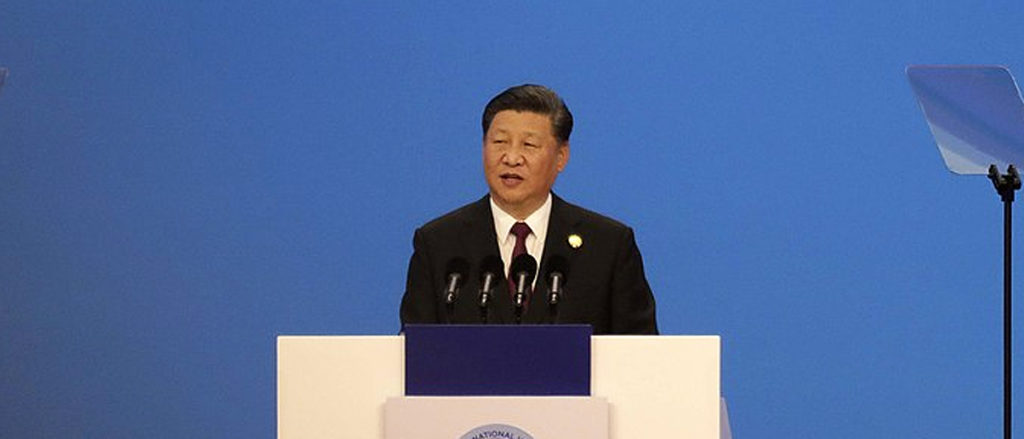
(Featured Image Media Credit: Public Domain Image via Wikimedia Commons)
All content created by the Daily Caller News Foundation, an independent and nonpartisan newswire service, is available without charge to any legitimate news publisher that can provide a large audience. All republished articles must include our logo, our reporter’s byline and their DCNF affiliation. For any questions about our guidelines or partnering with us, please contact [email protected].