



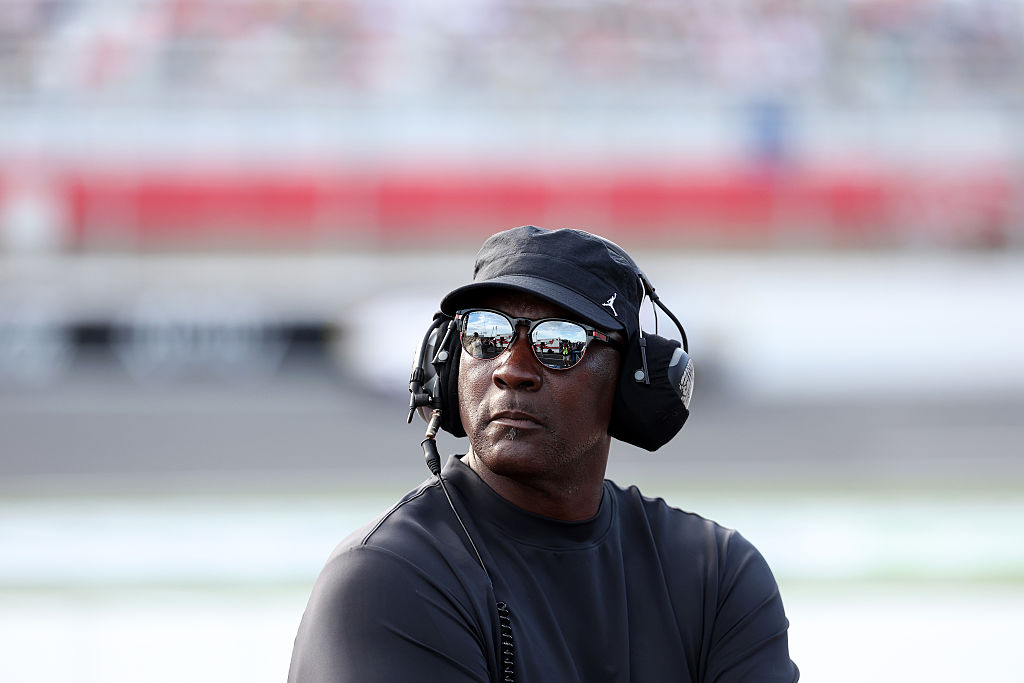
Michael Jordan’s antitrust showdown with NASCAR took a sharp turn this week as a veteran economist told a federal jury the racing giant owes nearly $365 million in damages to the two teams challenging its revenue-sharing system.
According to The Associated Press, testifying on Monday, economist Edward Snyder — a former Justice Department antitrust official with more than 30 cases under his belt, including the NFL’s “Deflategate” saga — laid out why he believes NASCAR operates as a monopoly that locks teams into unfair business terms.
His conclusion: 23XI Racing and Front Row Motorsports took a significant financial hit from 2021 through 2024 because NASCAR allegedly controls the sport’s tracks, teams, and cars.
Snyder said his analysis draws on lost revenue, reduced market value, and profits that would have flowed to teams under what he described as a more competitive system.
He compared NASCAR’s model to Formula 1’s, testifying that F1 shares 45% of its revenue with teams — far higher than the 25% NASCAR provided when its charter structure launched in 2016.
At the heart of the lawsuit is the 2025 charter agreement, a 112-page document handed to teams on a Friday in September 2024 with a deadline to sign the same day.
Teams have described the offer as an ultimatum they could not refuse after more than two years of stalled negotiations.
Jordan and Denny Hamlin’s 23XI Racing, along with Bob Jenkins’ Front Row Motorsports, were the only two teams to reject the deal.
Snyder pointed to NASCAR’s exclusivity deals with racetracks as a key indicator of monopoly power. Those contracts, he said, prohibit tracks from hosting competing stock-car series — preventing teams from racing anywhere else and giving NASCAR total leverage over the market.
He testified that NASCAR and Speedway Motorsports control almost every Cup Series track, and said exclusivity agreements were designed to ward off potential rival leagues.
The consequence, he argued, is that teams are forced into revenue-sharing arrangements that undervalue their operations and drag down their worth.
Snyder’s calculations put damages at $215.8 million for 23XI and $148.9 million for Front Row. He also claimed NASCAR shortened the full field of 36 chartered teams by more than $1 billion over three years.
He noted NASCAR’s financial strength — $2.2 billion in assets, a $5 billion equity value, and steady earnings — as evidence that the France family could have adapted to market pressures without locking teams into restrictive agreements.
Citing the PGA Tour’s response to the rise of LIV Golf, Snyder said the racing series could have “got creative” instead of cutting teams out of leverage.
NASCAR disputes Snyder’s findings and argues his F1 comparison is flawed. Defense attorney Lawrence Buterman pressed him on his opinions of NASCAR’s upcoming expert witnesses, prompting Snyder to call them “two of the best economists in the world.”
Monday’s testimony — the sixth day of trial — stretched long enough to test the patience of U.S. District Judge Kenneth Bell.
He opened court early after receiving late-night filings and warned attorneys to meet a strict 10 p.m. deadline going forward. He also asked jurors if they could stay an extra hour each day to prevent the trial from spilling into a third week.
Plaintiffs’ attorney Jeffrey Kessler is expected to wrap his case on Tuesday, though he still intends to call NASCAR chairman Jim France, commissioner Steve Phelps, and Hall of Fame team owner Richard Childress.
NASCAR, for its part, has listed 16 potential witnesses — and the judge made clear he wants the first one on the stand before Tuesday’s session ends.