




An independent review of Los Angeles County’s response to the January fires found a “series of weaknesses” that hindered efforts to alert and evacuate residents, including the sheriff’s department being tied up with preparations for the anniversary of the Jan. 6 attack on the Capitol.
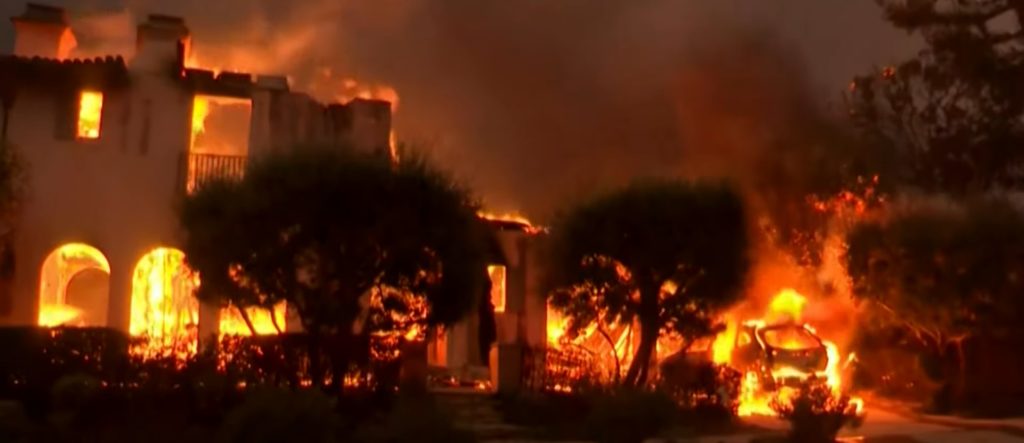
The January blazes killed 31 people, destroyed more than 16,000 homes and buildings from Malibu to Pasadena, and caused more than $100 billion in damages to residential properties, according to the Los Angeles Times. The after-action report, prepared by consulting firm McChrystal Group on behalf of the Los Angeles County Board of Supervisors, cited staffing shortages, outdated policies, inconsistent practices, and communication failures as key factors that hampered the response.
One of the most alarming shortcomings highlighted in the report was the 900 deputy vacancies in the Los Angeles County Sheriff’s Department (LASD). The review also noted that the LASD had been “occupied with preparations for multiple planned events, including the Rose Parade, the anniversary of the January 6, 2021, attack on the U.S. Capitol, and the Presidential Inauguration.”
“While the department had resources in place for a potential extreme wind and fire event, the competing priorities understandably stretched their capacity,” the report stated.
Moreover, the county’s evacuation response was hampered by conflicting and outdated policies, protocols, and standard operating procedures regarding decision-making authority. The report found that the chain of command for issuing evacuation orders was not clearly defined.
Evacuation alerts were inconsistent, with some requiring residents to opt-in or follow an additional link to view full details, which slowed the delivery of critical information. The alert system also lacked key details about the fire’s progression, as well as the names and locations of evacuation zones.
As a result, some residents reported receiving little or no warning before flames reached their neighborhoods. Power outages and cell tower failures further disrupted the flow of evacuation notices, the report noted.
The review also cited antiquated infrastructure and the lack of a unified platform among county agencies as key obstacles to effectively monitoring and responding to the unfolding catastrophe.
“While frontline responders acted decisively and, in many cases, heroically, in the face of extraordinary conditions, the events underscored the need for clearer policies, stronger training, integrated tools, and improved public communication,” the report states.
Neither the Los Angeles County Board of Supervisors nor the LASD responded to the Daily Caller News Foundation’s request for comment in time for publication.
Although the report emphasized it was not intended to “investigate wrongdoing or assign blame,” Los Angeles Mayor Karen Bass, Gov. Gavin Newsom and other officials have been blamed for inadequate management of forested areas, which increased fire risks, as well as for water policies that led to low water supplies while firefighters fought the blaze.
The county’s post-fire recovery has also been plagued by delays and inefficiencies. Despite Newsom and Bass describing the rebuilding efforts as “historic“, only about 21% of building applications have been approved by Los Angeles County to date, according to government data.
Beyond the government’s response, the FireAid concerts — which raised $100 million from two star-studded charity concerts for victims of the fire — have come under scrutiny. An audit report released this month by the Annenberg Foundation, which helps direct the funds, showed millions of dollars went to racial justice nonprofits, advocacy groups, and even a podcast with barely a dozen listeners, with not a single dollar distributed directly to victims from the fund.
All content created by the Daily Caller News Foundation, an independent and nonpartisan newswire service, is available without charge to any legitimate news publisher that can provide a large audience. All republished articles must include our logo, our reporter’s byline and their DCNF affiliation. For any questions about our guidelines or partnering with us, please contact [email protected].