



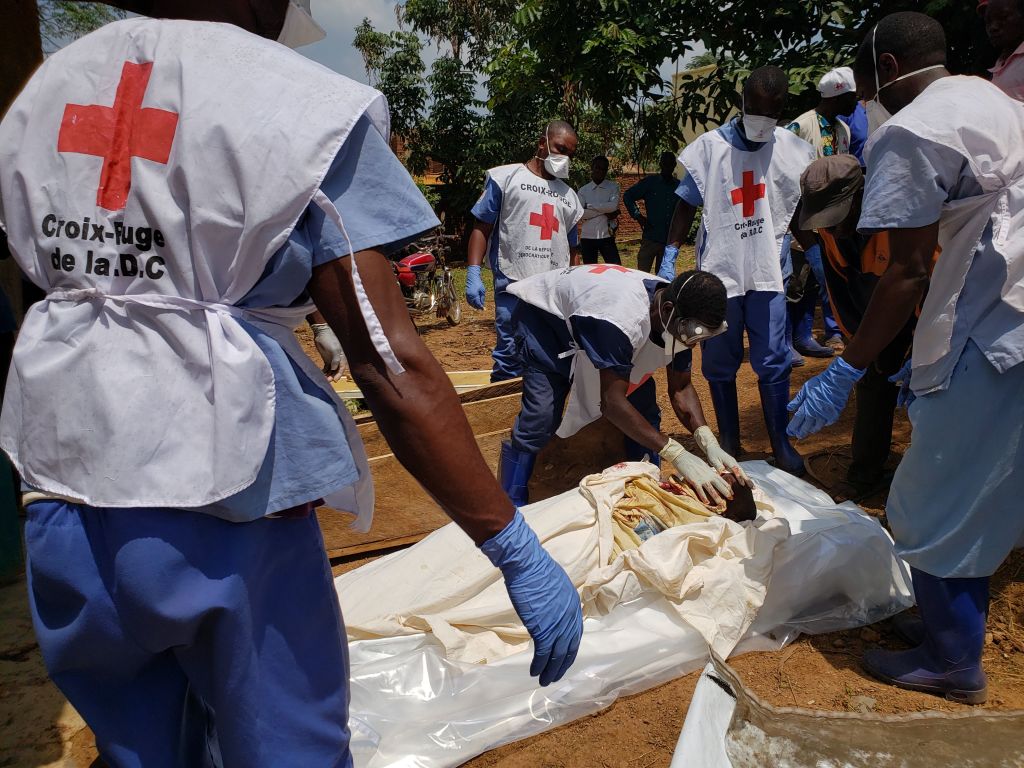
Health officials are facing mounting challenges in containing the latest Ebola outbreak in southern Democratic Republic of Congo, the World Health Organization (WHO) said Friday, citing limited access to remote areas and urgent funding needs as key obstacles.
The outbreak, confirmed on September 4, is Congo’s first in Kasai province in 18 years, according to The Associated Press.
The region, characterized by poor infrastructure and limited medical facilities, lies more than 1,000 kilometers (621 miles) from the capital city, Kinshasa.
To reach the epicenter in Bulape, WHO partnered with the United Nations peacekeeping mission MONUSCO, which deployed a helicopter to deliver 400 vaccine doses on Friday. An additional 1,500 doses are expected to arrive from Kinshasa in the coming days.
“We have struggled in the last seven days with access but are collaborating with MONUSCO (U.N. peacekeeping mission in Congo) now,” said Patrick Otim, WHO’s program area manager, during a briefing in Geneva.
Otim said a full-scale response is underway but emphasized that operations are constrained by limited financial resources. “We need to be able to pay for the operations,” he added.
Since the outbreak was confirmed, the number of suspected Ebola cases has surged from 28 to 68, according to the Africa Centers for Disease Control and Prevention (Africa CDC). As of Thursday, 16 deaths have been reported.
Otim noted that the most recent confirmed case emerged 70 kilometers (43 miles) from Bulape, raising concerns about potential spread.
“Our worry is if we get cases in the other health zone, we need to expand and it will be resource-intensive,” he said.
WHO has projected a $20 million budget for outbreak containment over the next three months. Congo’s national plan, however, estimates the full response will cost $78 million.
The current response is further complicated by recent reductions in U.S. financial support. In previous outbreaks, the U.S. Agency for International Development (USAID) played a key role, including a $11.5 million contribution during the 2021 outbreak.
This funding gap could delay critical interventions, WHO officials warned.
At least four health workers are among the confirmed cases, according to Mathias Mossoko, Ebola response coordinator in Bulape.
“For now, our priority is to vaccinate health care workers. Given the number of cases and deaths among health care providers, protecting these front line workers is essential to ensure the population receives adequate care,” Mossoko said.
More than 600 contacts of suspected cases have been identified, with 94% successfully traced. Only one contact has tested positive so far.
Despite the rising numbers, Mossoko said the risk of wider transmission remains low.
“At this stage, it is not yet appropriate to declare a public health emergency,” he noted.
As WHO and Congolese health officials ramp up response efforts, the success of containment hinges on rapid access to affected areas, logistical coordination, and securing adequate funding.
With vaccine distribution underway and case tracking in progress, authorities hope to stem the outbreak before it spreads beyond provincial borders.