



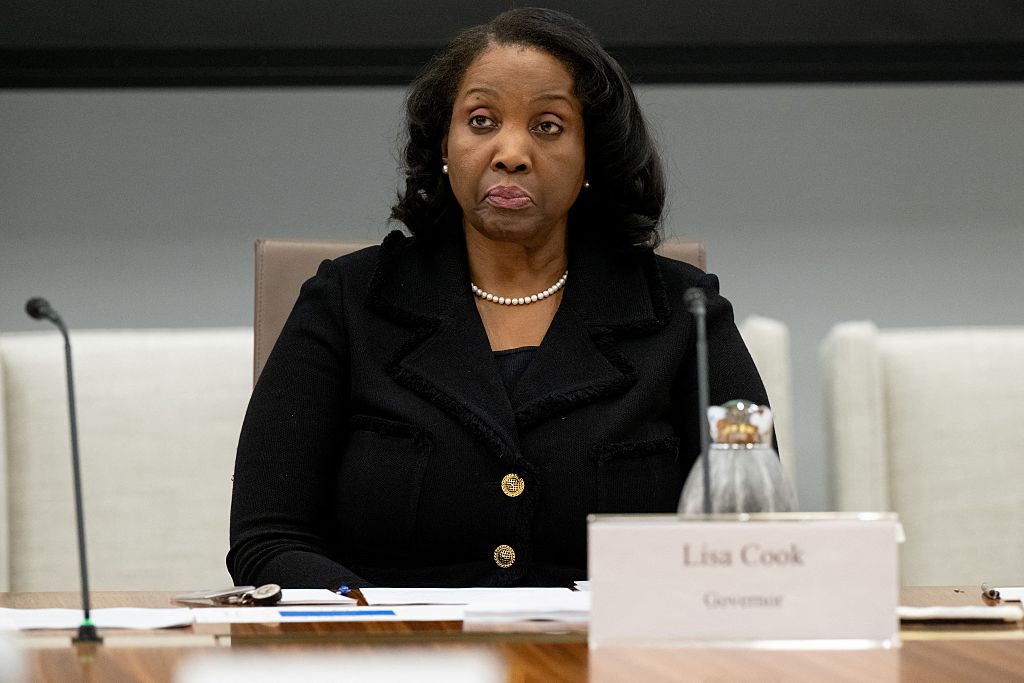
Federal Reserve Governor Lisa Cook is firing back at the Trump administration’s effort to remove her from office, calling the move baseless, unconstitutional, and politically motivated.
In a court filing Tuesday, Cook argued that the very allegations President Donald Trump is now using against her were already disclosed to — and dismissed by — the Biden administration during her vetting process in 2022, according to Law&Crime.
Cook’s attorney, Abbe Lowell — best known for representing figures like Hunter Biden, Jared Kushner, and Letitia James — asked U.S. District Judge Jia Cobb to issue a temporary restraining order preventing Trump from firing Cook without due process. Lowell opened his filing by highlighting the Federal Reserve’s unique legal standing: a “quasi-private entity” with historical independence.
Lowell emphasized that Fed governors like Cook can only be removed “for cause,” meaning “inefficiency, neglect of duty, or malfeasance in office.” The government’s interpretation that “any articulable justification” by the President is enough to warrant removal, he said, “simply cannot be right.”
Lowell also dismissed the notion that a criminal referral posted on social media by FHFA Director Bill Pulte, followed by Trump’s immediate call for Cook’s resignation, meets the standard for due process.
“This Court should reject the Government’s sweeping and unprecedented arguments and grant preliminary relief to preserve the status quo,” the filing stated.
Cook’s legal team pointed to longstanding Supreme Court precedent — including a dissent by Justice Samuel Alito in CFPB v. Community Financial Services Association of America — that defines the Federal Reserve Board as a “unique institution with a unique historical background.” Alito noted that its funding system is “a special arrangement sanctioned by history.”
Justice Brett Kavanaugh was also cited, specifically his 2009 law review article where he wrote, “The Federal Reserve Board may be one example” of an agency rightly shielded from presidential control “due to its power to directly affect the short-term functioning of the U.S. economy.”
The Trump administration claims Cook “falsified bank documents and property records to acquire more favorable loan terms, potentially committing mortgage fraud.” But Cook flatly denies the accusation and insists it predates her appointment.
“Setting aside the fact that Governor Cook did not ever commit mortgage fraud,” Lowell wrote, “any such pre-office offense plainly would not have been ‘so infamous a nature, as to render the offender unfit to execute any public franchise.’”
Lowell argued that even if any inconsistencies existed, they were already disclosed in documents submitted during Cook’s vetting by both the White House and the Senate. “Before she was appointed by the President and confirmed by the Senate,” the filing says, “the Biden White House and the U.S. Senate were in possession of disclosures that contained the ‘same purported facial contradictions’ about her homes that Trump has cited.”
“A proper hearing would demonstrate that the Government had prior knowledge of the alleged facial contradictions in Governor Cook’s documents well before the President invoked them as the basis for her purported removal,” the filing continued.
The documents in question include her SF-86, where Cook listed her Michigan address as her “primary residence” and Georgia as a “2nd home.” In her e-QIP forms, both Michigan and Georgia were listed as “present” residences, while Massachusetts was described as a “second home and rental property.” The Office of Government Ethics Form 278e also listed “Mortgage on Personal Residence” designations for all properties.
“If those are facial contradictions,” the filing argues, “they certainly existed in the materials that Governor Cook provided as part of her Presidential vetting and Senate Confirmation process—for which Senators or White House advisors could have inquired.”
Cook’s legal team insists the sudden push to remove her has more to do with Trump’s long-standing policy disagreements with the Fed than with any credible misconduct. The filing argues that the allegations are merely a “pretext” for removing a sitting Fed governor who may oppose efforts to lower interest rates for political gain.
With the Federal Reserve’s independence on the line, and legal experts watching closely, the case is shaping up to be a significant test of executive power — and the future of the central bank’s autonomy.












