



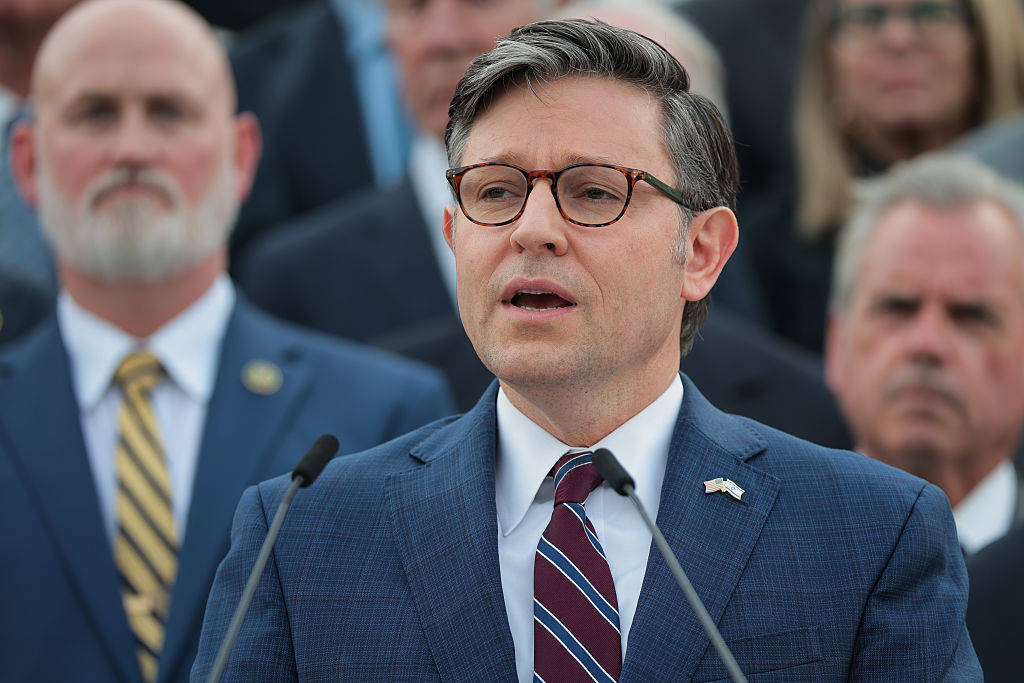
House Speaker Mike Johnson (R-La.) warned Monday that the ongoing federal government shutdown could become the longest in U.S. history, vowing not to negotiate with Democrats until they “hit pause” on their health care demands and agree to reopen the government.
Standing alone at the Capitol on the 13th day of the shutdown, Johnson also said he was unaware of the specifics behind thousands of federal workers being dismissed by the Trump administration — a sweeping move viewed as an attempt to use the shutdown to shrink the size of government, according to CTV News.
Vice President JD Vance has described the layoffs as part of “painful” cuts ahead, even as employee unions launch lawsuits to block them.
“We’re barreling toward one of the longest shutdowns in American history,” Johnson said.
With no end in sight, the shutdown has halted most government operations, shuttered Smithsonian museums and national landmarks, and caused airport delays — all while adding further strain to an already fragile economy.
The House remains out of session as Johnson refuses to call lawmakers back to Washington, while the Senate — closed Monday for the federal holiday — is set to return Tuesday. Yet senators remain at an impasse, with Democrats standing firm on demands that any funding package include an extension of Affordable Care Act subsidies.
Johnson thanked President Donald Trump for ensuring military personnel would receive pay this week, removing one of the key points of leverage that could have forced talks between the two parties. A senior administration official confirmed that U.S. Coast Guard members will also be paid, speaking anonymously to discuss plans not yet formally announced.
At the center of the standoff is a fight over health care — specifically the Obamacare subsidies set to expire for millions of Americans who depend on them to afford insurance. Democrats insist the subsidies must be renewed, while Republicans argue the issue can be handled separately later this year.
House Minority Leader Hakeem Jeffries (D-N.Y.) said on MSNBC that Republicans have effectively abandoned negotiations. “They’re nowhere to be found,” he said, noting that the House has been shuttered for nearly a month.
Some lawmakers believe the end of October could bring renewed urgency to reopen the government. Open enrollment for Obamacare begins Nov. 1, and without congressional action, premiums could skyrocket. The Kaiser Family Foundation estimates monthly insurance costs could double if subsidies expire on Dec. 31. Meanwhile, thousands of federal employees — including congressional staffers — will miss paychecks by the end of the month.
The political battle over health care is a familiar one. In 2013, Republicans forced a 16-day government shutdown under President Barack Obama while attempting to repeal the Affordable Care Act. Former President Trump also tried to dismantle Obamacare in 2017, but the effort collapsed after Sen. John McCain’s famous thumbs-down vote.
With enrollment in Obamacare at a record 24 million, Johnson acknowledged Monday that a full repeal is unlikely.
“Can we completely repeal and replace Obamacare? Many of us are skeptical about that now because the roots are so deep,” Johnson said, adding that he still has “PTSD” from the failed 2017 effort.
Johnson maintains that Republicans have been open to discussing health care with Democrats — but only after they agree to reopen the government.
The current shutdown is on track to rival the 35-day closure that took place in 2019 during Trump’s first term over border wall funding.
Meanwhile, the Trump administration is using broad authority to determine which workers are paid and which agencies remain frozen. That flexibility — bolstered by funding provisions in Trump’s One Big Beautiful Bill Act — allows the administration to sustain certain priorities while cutting others.
The Pentagon said over the weekend that it redirected $8 billion in unused research and development funds to pay military personnel, avoiding missed paychecks. However, agencies such as the Department of Education have been hit hard, disrupting after-school and special education programs.
According to the nonpartisan Congressional Budget Office, the administration could also tap mandatory funds from the 2025 reconciliation act to sustain other key departments, including Defense, Treasury, Homeland Security, and the Office of Management and Budget.
“Some of the funds in DoD’s direct appropriation under the 2025 reconciliation act could be used to pay active-duty personnel during a shutdown, thus reducing the number of excepted workers who would receive delayed compensation,” the CBO said in a letter to Sen. Joni Ernst (R-Iowa).