



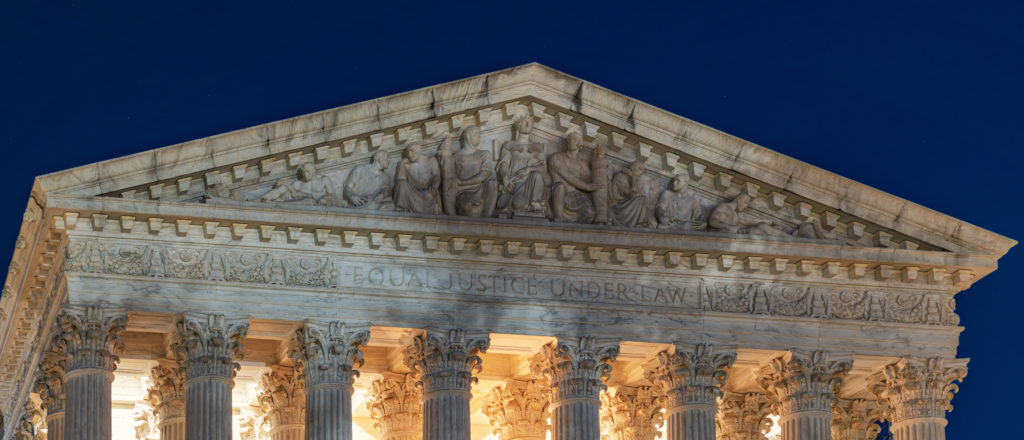

Today, the Supreme Court will hear oral arguments in Trump v. Slaughter, in which it will decide whether Congress may insulate the heads of certain executive agencies, in this case the Federal Trade Commission (FTC), from Presidential removal.
As Advancing American Freedom has argued in both the Biden and Trump administrations, the constitutional answer must be no. However, while a decision in the President’s favor in this case is correct, that decision will also make it imperative that the Court restore Congress’s power to legislate.
The Constitution divides the federal government into three branches and tasks: the Legislative Branch (Congress) with making the laws, the Executive Branch (the President) with enforcing the laws, and the Judicial Branch (the federal courts) with interpreting and applying the law and acting as a backstop against abuses of power by the other two branches. Over about the last century, however, significant power from each of the three branches was consolidated in the unelected administrative state.
In Slaughter v. Trump, the Court is considering whether to restore some of that power to the President. Ninety years ago, the Supreme Court, in a case called Humphrey’s Executor, ruled that Congress could insulate the heads of certain multi-member agencies, including the FTC, which was at issue in that case as well, from presidential removal. In other words, the President could not fire, and thus could not exercise true authority, over the heads of these agencies. This is directly contrary to the Constitution’s design for the President.
Article II of the Constitution is very clear. “The executive Power shall be vested in a President of the United States of America.” The Constitution thus contemplates only one member in charge of the Executive branch: the President of the United States.
As Justice Antonin Scalia explained in his dissent in Morrison v. Olson in 1988, the Framers of the Constitution “consciously declined to sap the Executive’s strength . . . by dividing the Executive power. Proposals to have multiple executives or a council of advisors with separate authority were rejected.” As Alexander Hamilton explained in Federalist 70, a unitary executive is necessary for the effectiveness in the Executive Branch and that necessary unity can be destroyed by subjecting the President’s executive authority “in whole or in part, to the control and cooperation of others, in the capacity of counsellors to him.” The Constitution creates a unitary executive.
The Court in Trump v. Slaughter has the opportunity to right that wrong.
Further, the Court’s decision in this case will come less than two years after its decision in Loper Bright Enterprises v. Raimondo, in which the Supreme Court struck down its Chevron decision and thus restored its own authority to interpret the law. The administrative state, having thus been stripped of much of its judicial and independent executive power, will still hold power that rightly belongs to Congress. The Court’s next step must be to return that power to its constitutionally mandated home: Congress.
In fact, the Court already has an opportunity to take an important step toward doing just that. The Court has already heard oral arguments in Learning Resources v. Trump and Trump v. V.O.S. Selections, cases challenging the President’s unilateral exercise of the tax and tariff power reserved to Congress in Article I, section 8, clause 1. Among the many important issues raised by those cases, one is the nondelegation doctrine, the core constitutional principle that Congress cannot give its power to make laws away to any other entity.
As Justice Gorsuch explained in his 2019 dissent in Gundy v. United States, the framers of the Constitution “believed the new federal government’s most dangerous power was the power to enact laws restricting the people’s liberty” and so they “went to great lengths to make lawmaking difficult.” Congress, alone, is meant to make America’s laws.
Today, the Executive Branch of the federal government exercises vast legislative powers not contemplated by America’s founders and not consistent with the Constitution’s separation of powers.
From tariffs to environmental regulations, the President and administrative agencies wield vast power over the lives of Americans. We hope the Court will restore the President’s rightful authority over the Executive Branch and are confident that it will do so. But it is also critical that the Court, in the tariff cases or elsewhere, reinvigorate the nondelegation doctrine, the rule that Congress, not the Executive, is the one who gets to make the rules.
Marc Wheat is the General Counsel of Advancing American Freedom Vice President Mike Pence, Founder. Follow us on X @AAFLegal.
The views and opinions expressed in this commentary are those of the author and do not reflect the official position of the Daily Caller News Foundation.
(Featured Image Media Credit: Tony Webster/Wikimedia Commons)
All content created by the Daily Caller News Foundation, an independent and nonpartisan newswire service, is available without charge to any legitimate news publisher that can provide a large audience. All republished articles must include our logo, our reporter’s byline and their DCNF affiliation. For any questions about our guidelines or partnering with us, please contact [email protected].