



For a time, Libertarians thought history was on their side.
Back in 2010, the movement was flush with cash and certainty. Think tanks expanded. Ayn Rand novels were fashionable again. Tea Party rallies drew huge crowds. The assumption was simple: America was naturally libertarian and all that remained was to manage the decline of government until someone like Ted Cruz took the Oval Office.
Then Donald Trump happened and exposed the libertarian movement’s limits.
In many ways libertarians got what they wanted — tax cuts, deregulation, and an aggressive assault on bureaucratic waste through DOGE. In other ways, Trump has governed at odds with their agenda. He imposed a sweeping tariff regime to stand up for forgotten post-industrial communities that establishment conservatives say “deserve to die.” He has also cracked down on visa abuse, illegal immigration, and Silicon Valley abuses.
So how is Libertarian Inc. handling this?
Not well. Instead of adapting, it unraveled.
The most visible example is the Cato Institute, which increasingly behaves less like a right-leaning think tank and more like a progressive NGO with a lower tax preference. Its public-facing voices routinely minimize the real-world costs of open borders and defend Chinese fentanyl manufacturers, dismiss concerns about open borders because illegals don’t kill that many Americans and treat national cohesion as an afterthought.
When cities were burning and Americans were bedded for law and order, Cato published reform-first commentary on inequality, systems, sociology instead of law and order.
When Charlie Kirk was assassinated, it publicized an error-riddled pie chart saying that right-wing political violence in America kills six times as many people as left-wing political violence.
Other organizations continue to live in the past in much the same way and are thus slipping into irrelevance.
Americans for Tax Reform (ATR) still treats tariffs as heresy, calling them taxes and arguing they will destroy the economy. The reality is markets adjusted, growth continued and manufacturing investments rose.
The stock market dipped on Liberation Day, then resumed its upward trajectory. According to the Atlanta Fed, U.S. GDP grew at an annualized 5.4% in the final quarter of 2025. At the same time, even as our trade deficit hit a 16-year low in October.
Tariffs did not end prosperity — they coexisted with it.
ATR and other right-libertarian organizations also remain tethered to big business, especially Big Tech. They oppose antitrust enforcement even when consolidation threatens competition, speech, and culture.
Just last month, ATR came out in favor of Netflix’s acquisition of Warner Bros.-Discovery, a deal that would further concentrate power in the hands of one of the most woke companies in America. ATR’s press release framed it as opposition of far-left politicians like Democratic Sen. Elizabeth Warren of Massachusetts. What ATR conspicuously omitted is that prominent conservatives have raised the same alarms, including Republican Sen. Mike Lee of Utah and activist Jack Posobiec. Even Trump himself has publicly cautioned against it. This should be a moment of reflection for ATR; however, the organization’s default position seems to be to protect consolidation whenever it benefits powerful corporate actors.
The same dynamic is on full display with the R Street Institute — another libertarian think tank that devotes resources to oppose age verification law designed to keep kids off porn sites and social media apps that demonstrably harm their mental health.
Libertarian journalism is out of touch too. Reason magazine openly admitted in 2024 that not a single one of its staffers would vote for Trump, the preferred candidate for a huge share of self-described libertarians.
The Libertarian Party itself had a chance to nominate Trump — a president that stopped eight wars and realized more of their agenda than any other figure in recent memory — and instead chose a garden-variety liberal named Chase Oliver, further cementing Libertarian Inc.’s leftward drift.
Today, populist Vice President JD Vance is vice president and heir apparent to the MAGA movement. So is Secretary of State Marco Rubio, who entered the Senate as a Tea Party conservative but embraced a pro-worker, pro-sovereignty conservatism informed by New Right institutions such as The American Compass. This shift did not happen in spite of libertarian orthodoxy. It happened because of its failures.
Mehek Cooke, an attorney and political strategist, was a surrogate for the Trump for President Campaign and the Republican National Convention.
The views and opinions expressed in this commentary are those of the author and do not reflect the official position of the Daily Caller News Foundation.
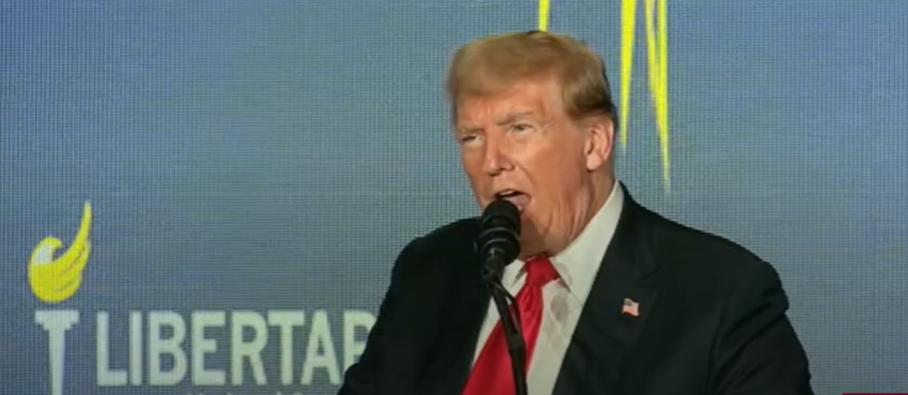
(Featured Image Media Credit: Screen Capture/CSPAN)
All content created by the Daily Caller News Foundation, an independent and nonpartisan newswire service, is available without charge to any legitimate news publisher that can provide a large audience. All republished articles must include our logo, our reporter’s byline and their DCNF affiliation. For any questions about our guidelines or partnering with us, please contact [email protected].