




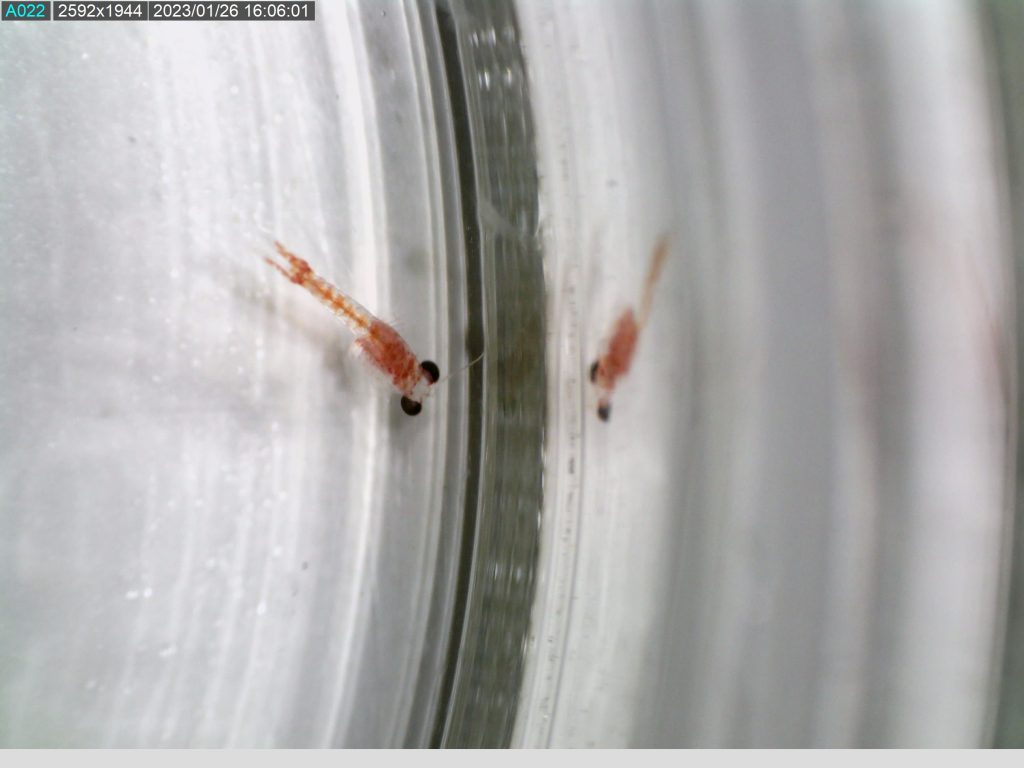

Shrimps “sniff” their way back to their underwater cave homes, reveals new research.
Scientists say the tiny aquatic creatures’ ability to navigate through the vast ocean is due to their cave’s special smell.
They explained that homing is an animal’s ability to navigate towards an original location, such as a breeding spot or foraging territory.
Salmon and racing pigeons are famous for homing, but similar behavior occurs in bees, frogs, rats, and sea turtles.
Those species are known or suspected to rely on landmarks, the Earth’s magnetic field, or the sky’s pattern of polarised light to find their way back.
Another group known to display homing is cave-dwelling mysid shrimp, also known as possum shrimp, for the pouches in which females carry their larvae.
Results from previous research suggested that mysids might use chemical cues to navigate to underwater caves.
Study lead author Dr. Thierry Pérez, CNRS research director at the marine research station of Endoume near Marseille, France, said: “We show for the first time that mysids can tell the water-borne odor bouquet – its so-called chemical seascape – characteristic of their home cave apart from that of nearby caves.
“This strongly suggests that these distinctive seascapes help them find their home cave again when they return from their nightly migrations.”
Dr. Pérez and his colleagues studied the mysid species Hemimysis margalefi, which lives in sea caves in the Mediterranean.
It forms dense swarms, with millions of individuals per cave.

At dusk, they move hundreds of meters into open water to feed on algae, detritus, and other zooplankton, but at dawn, they return to the same cave to shelter from predators. FRONTIERS IN MARINE SCIENCE VIA SWNS.
Individual shrimp are thought to tend to remain faithful to their natal caves throughout their lifespan of one to two years.
At dusk, they move over hundreds of meters into open water to feed on algae, detritus, and other zooplankton.
But, at dawn, they return to the same cave to shelter from predators.
Divers sampled seawater from three caves in Calanques National Park off southern France: Fauconnière, 3PP, and Jarre. These caves lie between 11 and 24 meters (78.74 feet) underwater and are eight to 20 km (65616.8 feet) apart.
The researchers caught hundreds of adult H. margalefi from the Fauconnière and Jarre caves.
For comparison, they also collected individuals of another mysid – an unnamed species in the genus Leptomysis – which doesn’t reside in caves but lives in shallow waters near Endoume station.
In each experimental trial, they placed a single shrimp at the origin of a Y-shaped channel.
Each arm was connected to a 10-litre tank filled with seawater from one of the caves.
The water flowed out of the tanks into the channel, carrying any water-soluble metabolites.
Each shrimp was given the choice between water flows native to two caves, while time spent per arm was a proxy for their preference. Water from the 3PP cave was always used as the control.
Between trials, the channel was emptied and rinsed with control water, after which the tanks were swapped between the arms.
The researchers tested 286 individual shrimps, of which 230 were H. margalefi and 56 were Leptomysis.
Trials were conducted in the morning and afternoon to determine whether the time of day affected the shrimps’ preferences—but that turned out to have no effect.
The results, published in the journal Frontiers in Marine Science, showed that H. margalefi “strongly preferred” water from their own cave.
Individuals from Jarre cave spent 16 times longer in arms with Jarre water than in arms with 3PP water, while individuals from Fauconnière cave spent three times longer in arms with Fauconnière water than in arms with 3PP water.
In contrast, individuals from Jarre cave had no preference for Fauconnière over 3PP water, while individuals from Fauconnière cave had no preference for Jarre over 3PP water.
The non-cave dwelling Leptomysis never had a preference for one type of water over another.
The researchers used ultra-high-performance liquid chromatography coupled with high-resolution mass spectrometry (UHPLC-HR-MS) to reveal differences in metabolites between caves.
The findings showed that the seascape was mainly composed of natural peptides, fatty acids, steroids, and alkaloids, as well as anthropogenic pollutants.
The chemical signature of Jarre water was highly distinct from that of Fauconnière water, while that of 3PP water was intermediate between the two.
The research team believes that sessile organisms like sponges, abundant in the caves and known to produce many specialized metabolites, are major contributors to the local seascape.
Dr. Pérez said: “We know that food availability in marine cave ecosystems largely depends on the daily migrations of zooplankton such as mysids.
“Our results suggest that any change in water quality or sessile fauna inside caves can alter their chemical seascape, with a likely negative impact on the functioning of the whole ecosystem.
“This is concerning because due to global change, mass mortality of sponges and corals are becoming more frequent.”
He added: “We are currently following up on our results by trying to correlate the chemical seascapes from different caves with the biodiversity of sessile organisms living in them, focusing on the role of metabolites from sponges and corals.”
Produced in association with SWNS Talker












