



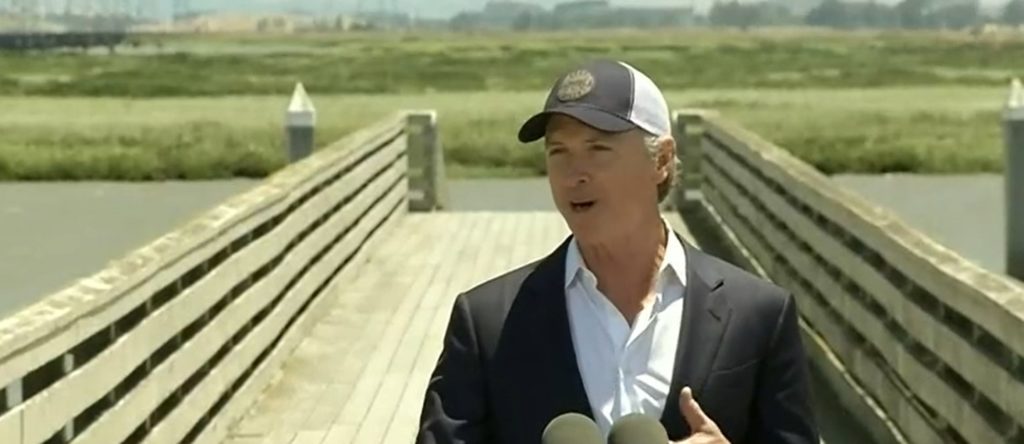

Democratic California Gov. Gavin Newsom celebrated the completion of the California High-Speed Rail Authority’s Southern Railhead Facility in Kern County, even though the bullet train was originally supposed to be fully operational by 2020.
California’s high-speed rail project was approved by voters in 2008 through ballot measure Proposition 1A. After 18 years of work, only about 80 miles of guideway and 58 structures (i.e. bridges, overpasses, etc.) have been fully completed.
During a press conference Tuesday afternoon, Newsom joined community leaders and construction workers to mark the facility’s completion in the Bakersfield area, describing it as “another critical step in the track laying stage.”
“California is building the nation’s first high-speed rail system, and we’re proving it can be done,” Newsom said. “We’re laying the foundation for cleaner, faster, and more connected transportation while investing in communities and creating good-paying jobs. California isn’t waiting for the future. We’re building it.”
As track installation nears completion near the Wasco site, the new facility will serve as a “central logistics hub for the delivery, storage, and deployment of critical materials needed to electrify and operate the system,” according to Newsom’s office.
California Transportation Secretary Toks Omishakin and California High-Speed Rail Authority CEO Ian Choudri joined the Democratic governor in calling the facility’s completion a major “milestone.”
The announcement comes just over a year after Newsom declared construction begin on the railhead facility.
The full Phase 1 high-speed rail route is planned to span 494 miles, designed to connect San Francisco to Los Angeles in about two hours and 40 minutes. Currently, only 119 miles are under active construction, mostly in the Central Valley, representing roughly 24% of the planned route.
When voters approved the project in 2008, the full Phase 1 system was estimated to cost $33 billion to $45 billion, backed by a $9.95 billion bond measure.
As of this year, the total projected cost has risen to between $89 billion and $135 billion, with some recent estimates placing it closer to $128 billion to $135 billion — a roughly 200% to 300% increase over the original projection.
The Merced-to-Bakersfield segment now under construction is estimated to cost more than the entire original project budget.
Despite the criticism and cost concerns, Newsom has emphasized the project’s economic benefits across the state.
“To date, the project has generated approximately 121,910 job-years—the combined number of years worked of full-time employment supported by the project—and nearly $25 billion in economic output,” Newsom’s press release states.
According to the governor’s office, 98.6% of project spending in the 2024-2025 fiscal year supported California businesses and workers. The project supported 13,200 job-years in 2024, generating $1.3 billion in wages and contributing $2.9 billion to the state’s economy.
All content created by the Daily Caller News Foundation, an independent and nonpartisan newswire service, is available without charge to any legitimate news publisher that can provide a large audience. All republished articles must include our logo, our reporter’s byline and their DCNF affiliation. For any questions about our guidelines or partnering with us, please contact [email protected].