




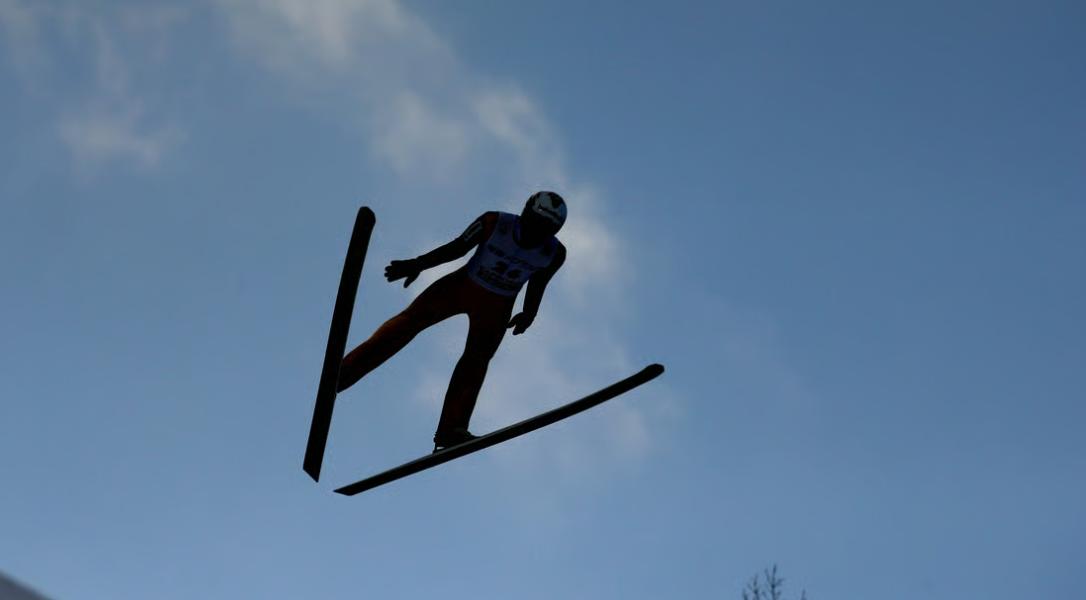
Winter Olympics anti-doping officials are being forced to confront one of the strangest allegations to hit elite sports in years, amid claims that male ski jumpers may be injecting their penises with hyaluronic acid to manipulate equipment measurements and gain a competitive edge.
The allegation, first reported by Germany’s Bild, suggests that temporary genital enlargement could distort 3D body scans used to approve ski jumping suits. A lower measurement point in the crotch area could theoretically allow for a looser, more aerodynamic suit, increasing lift and distance during a jump. In a sport where centimeters matter, the accusation has set off a wave of disbelief, scrutiny, and uneasy laughter.
Speaking in Milan on Thursday, the World Anti-Doping Agency said it has no evidence that the practice is occurring but would investigate if credible proof emerges. WADA Director General Olivier Niggli told reporters he was unfamiliar with the specifics of ski jumping equipment rules and had not previously heard the claim, according to Reuters. Still, he made clear that any substantiated information would be taken seriously.
Ski jumping suits are among the most tightly regulated pieces of equipment in international sport. The crotch seam is measured down to the bottom of the athlete’s genitals, meaning even a slight shift in anatomy could affect how much material is permitted in a critical area. More fabric can translate to more lift, and more lift can mean longer flights.
NEW: The World Anti-Doping Agency is reportedly investigating whether or not Olympic ski jumpers are injecting their pen*s’ with hyaluronic acid for a competitive edge.
The announcement comes after German newspaper Bild reported on the bizarre accusation.
The outlet reports… pic.twitter.com/SxpKubSKp2
— Collin Rugg (@CollinRugg) February 5, 2026
Should authorities investigate ski jumpers' doping claims involving hyaluronic acid?
That possibility is not purely theoretical. A 2025 study published in Frontiers simulated suit-size tolerances and found that a difference of just two centimeters could add nearly six meters to a jump on a 130-meter hill. In a discipline often decided by fractions of a point, that kind of advantage would be massive.
WADA President Witold Bańka also weighed in, acknowledging the sensitivity of the issue while promising to look into it. Speaking to journalists in Milan, he noted that ski jumping is hugely popular in Poland and said the allegation deserved attention, according to Australia’s ABC.
The timing could not be worse for the sport. Ski jumping is already reeling from a recent equipment scandal that exposed deliberate manipulation at the highest levels. Reuters reported that Norwegian Olympic medalists Marius Lindvik and Johann André Forfang were suspended for three months after their team was caught secretly altering seams around the crotch area of their suits at the 2025 world championships. Team staff members were also sanctioned.
Against that backdrop, even an outlandish allegation takes on added weight. For fans and officials alike, the concern is not just about whether this specific claim proves true, but about how far athletes and teams might be willing to go to exploit loopholes in a sport governed by razor-thin margins.
For now, WADA says there is no evidence. But the fact that the question is being asked at all underscores a growing trust problem in elite competition, where innovation, manipulation, and outright cheating often sit uncomfortably close together.