




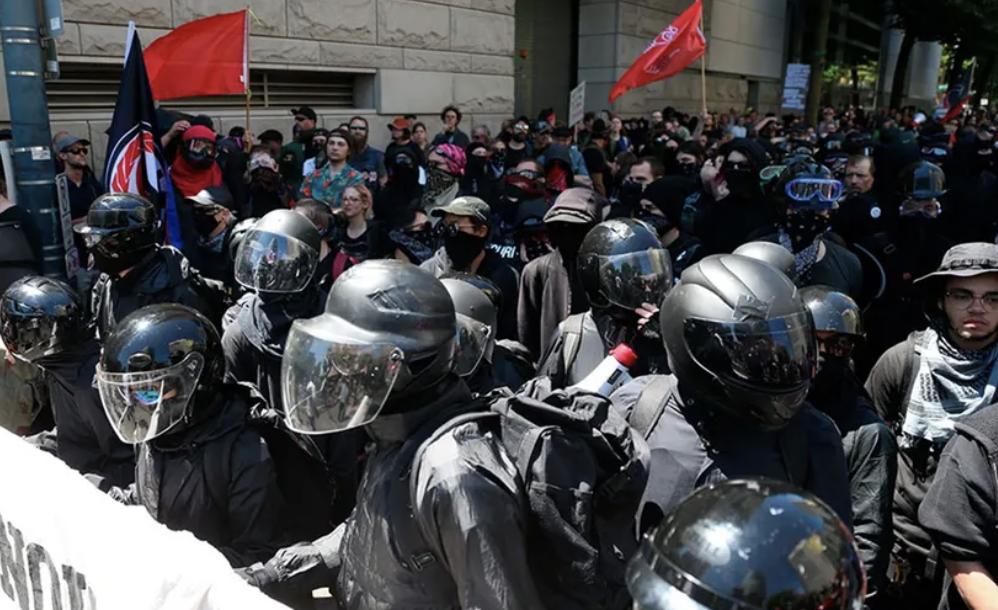
A set of internal training materials from the Sunrise Movement lays out a long-term strategy for what the group describes as a “political revolution,” including coordinated activism on college campuses and pressure campaigns targeting corporations.
The slides, dated March 2026 and obtained by Defending Education, outline a broader effort to reshape the country’s political and economic systems. The group frames its goal as “structurally chang[ing] the foundations of this country,” with an emphasis on policies tied to eco-socialism and what it calls a multi-racial democracy. Central to that vision is passing Green New Deal-style legislation and dismantling what it characterizes as a “billionaire 2 party system.”
The presentation breaks this effort into multiple phases stretching over several years. In what it calls “Phase 1,” the group focuses on building momentum through protests, political organizing, and the 2026 midterm elections. The stated goals include opposing President Donald Trump’s influence, organizing large-scale demonstrations such as May Day actions, and using elections to build toward what it describes as an “electoral breakthrough.”
Looking ahead, “Phase 2,” set for 2028, emphasizes escalation. The materials reference mass strikes, high voter turnout tied to a preferred candidate, and broader mobilization against Trump and wealthy political allies. The following phase, spanning roughly 2029 to 2031, is labeled as the period of “political revolution,” though details are less specific. A final phase, described simply as “The New System,” suggests a transformed political structure, with one slide loosely summarizing the outcome as “Happiness (maybe).”
Part of the strategy focuses on applying economic and institutional pressure. The slides encourage activists to target corporations through coordinated actions, including tactics like booking and canceling hotel reservations to disrupt business operations. Hilton is mentioned as an example in connection with immigration enforcement concerns. Students are also encouraged to push universities to cut ties with companies labeled as “ICE enablers,” using campus contracts and partnerships as leverage points.
The materials connect campus activism directly to national political goals, suggesting that universities can serve as pressure hubs for broader economic campaigns. This approach includes encouraging students to organize within their institutions to influence vendor relationships and administrative decisions.
The presentation also outlines several possible political scenarios for the coming years. One envisions an authoritarian outcome in which elections are undermined and opposition is suppressed. Another describes a cycle of electoral wins that fail to produce lasting governance changes, leading to political instability. The preferred scenario, according to the slides, involves sustained protest activity combined with strong voter turnout to remove political opponents and create the conditions for more sweeping reforms.
Critics say the approach raises concerns about the role of activism in academic settings. Rhyen Staley of Defending Education argued that efforts to pressure universities for political ends could undermine their role as places for open inquiry and debate.
The Sunrise Movement did not respond to requests for comment on the materials.
The group’s organizing efforts appear to align with broader calls from some activist networks for nationwide demonstrations, including a May Day strike. At a recent rally in Minnesota, activist Ezra Levin encouraged supporters to participate in coordinated economic disruption, framing it as a way to challenge existing power structures.












