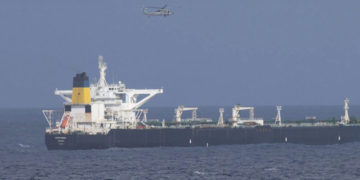





At least 15 U.S. sanctioned oil tankers have reportedly broken the complete blockade of Venezuelan oil exports since the Saturday capture of ousted socialist dictator Nicolás Maduro, using so-called “dark mode” tactics to evade capture.
The now-departed ships had been docked in Venezuelan ports for weeks, the New York Times (NYT) reported Monday. Tankers in the group used techniques employed by the modern “ghost fleet” of sanction skirting ships, including painting names of decommissioned vessels on ships’ hulls, misrepresenting their positions, and leaving in coordinated fashion to escape the blockade.
Four tankers, now some 30-miles off port, were tracked by satellite sailing east, according to the NYT. These tankers did not secure authorization from the new interim government led by Maduro’s former vice president, the NYT reported citing internal communications and two anonymous sources in the Venezuelan oil industry. The remaining ships have not been located and are not broadcasting any signals.
“The embargo on all Venezuelan oil remains in full effect,” President Donald Trump said on Saturday during a press conference detailing Maduro’s capture. “The American armada remains poised in position, and the United States retains all military options until United States demands have been fully met and fully satisfied.”
All fifteen of the identified tankers are under U.S. sanctions Trump imposed on Dec. 16 against Maduro, according to a Reuters report Monday.
“The only real way for oil-laden tankers to break through a naval blockade is to overwhelm it with outbound vessels,” Samir Madani, the co-founder of TankerTrackers.com, told the NYT. Reuters and the NYT both cited TankerTrackers.com on Monday as first flagging the fleeing ships.
The Venezuelan government had cleared at least four tankers “in recent days” to leave port while employing dark mode tactics, Reuters reported.
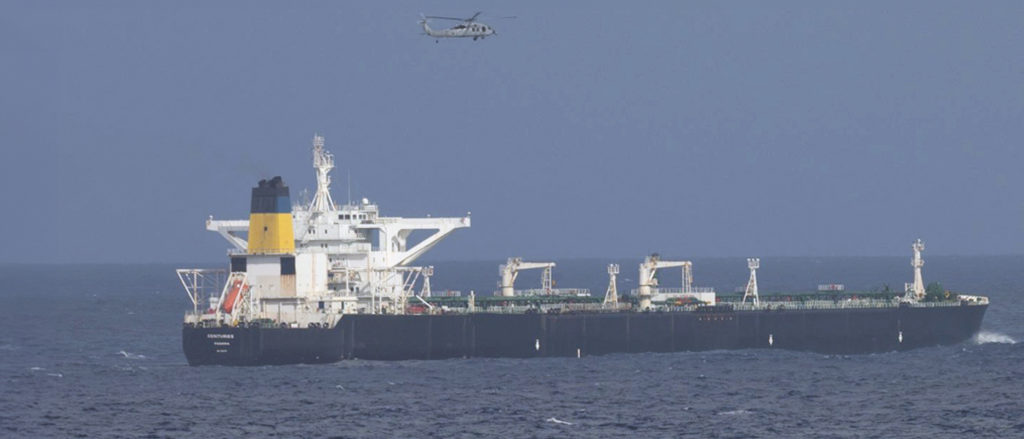
During the course of the blockade, three tankers have been confronted by U.S. forces, the NYT reported. The “Skipper” was halted and seized by the Coast Guard on Dec. 10. The “Centuries” was halted and boarded, but not seized, on Dec. 20. A third ship, previously identified as Bella 1, now bearing the name Marinera, is being pursued by U.S. forces.
U.S. authorities last week claimed they held a seizure warrant for the Bella 1, and said the ship, sailing from Iran to pick up Venezuelan oil, was not flying a valid national flag, making it a stateless vessel susceptible to boarding under international law, the NYT reported on Jan. 1. The government of Russia made a formal diplomatic request on News Year’s Eve that U.S. forces stop pursuit of the Bella 1, after which the crew painted a Russian flag on the ship’s hull and claimed Russian authority over the ship.
The blockade has left Venezuelan state-run oil company PDVSA with a bulging inventory during the course of the three week blockade, with the company’s facilities “nearing capacity,” according to the NYT. Shutting down production, however, could risk damaging oil-extracting infrastructure.
“As everyone knows, the oil business in Venezuela has been a bust, a total bust, for a long period of time. They were pumping almost nothing by comparison to what they could have been pumping and what could’ve taken place,” Trump said during his Saturday press conference. “We’re going to have our very large United States oil companies, the biggest anywhere in the world, go in, spend billions of dollars, fix the badly broken infrastructure, the oil infrastructure, and start making money for the country.”
All content created by the Daily Caller News Foundation, an independent and nonpartisan newswire service, is available without charge to any legitimate news publisher that can provide a large audience. All republished articles must include our logo, our reporter’s byline and their DCNF affiliation. For any questions about our guidelines or partnering with us, please contact [email protected].