



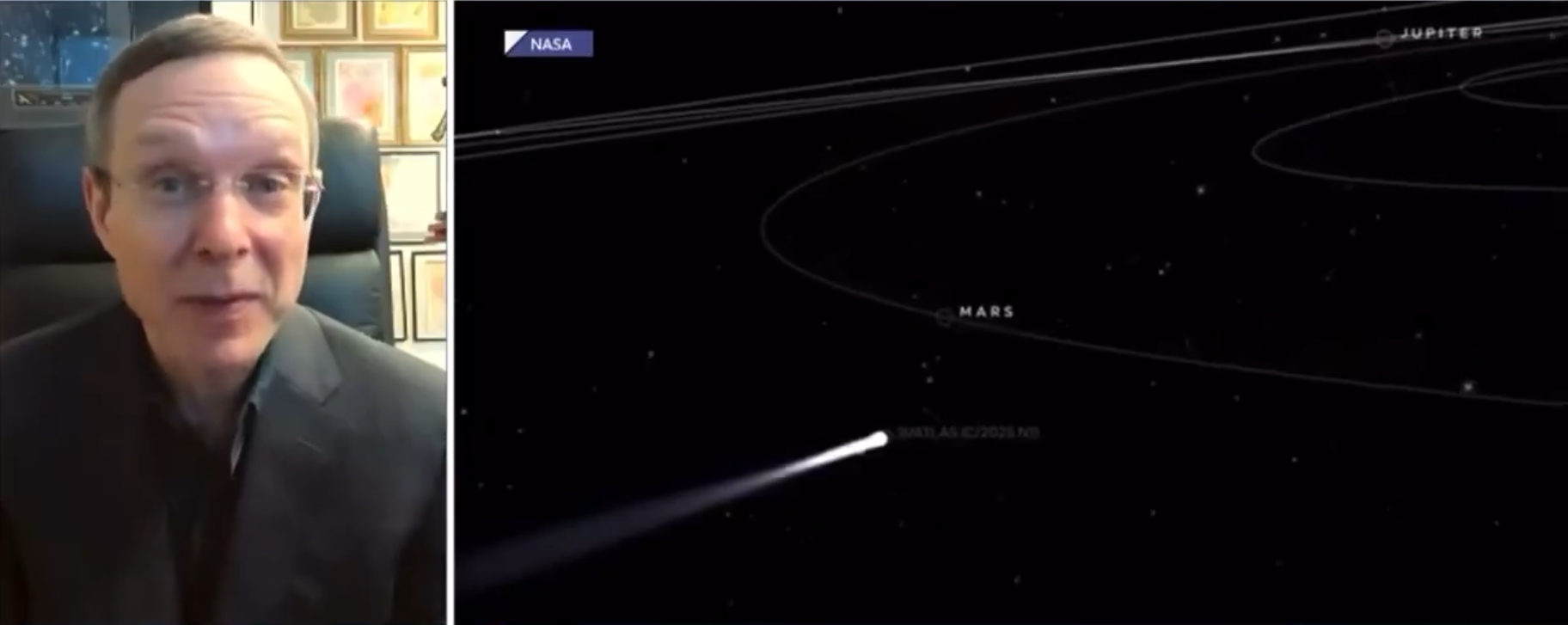
As the interstellar object 3I/ATLAS prepares for its close flyby of Earth, debate over its origins and behavior has intensified, with scientists sharply divided over whether the mysterious visitor is a conventional comet or something far stranger.
According to the New York Post, a new study led by Thomas Marshall Eubanks of aerospace firm Space Initiatives claims that 3I/ATLAS behaves like familiar comets in our solar system.
Using long-baseline astrometry from NASA’s Psyche spacecraft and ESA’s Mars Trace Gas Orbiter, Eubanks and his team measured the object’s non-gravitational acceleration, concluding it is caused by standard cometary outgassing.
“3I/ATLAS is exotic and wonderful. It is also a comet,” the team wrote. “It has obvious cometary outgassing with a non-gravitational acceleration to match. Claiming that it, too, is a spacecraft does not fit the data.”
The study argues that the gentle push from gas and dust blasting off the object’s surface near the Sun accounts for the seemingly rocket-like maneuvers observed last month, which some had speculated were evidence of artificial propulsion.
But Harvard astrophysicist Avi Loeb sharply disagrees, labeling the findings a “non-argument” that ignores the object’s anomalies.
Loeb points to 3I/ATLAS’ 13 traits that differ from typical comets, including high nickel content in its plume, an unusual trajectory around the planets, and a tail pointing toward the Sun rather than away.
“What they need to do, instead of explaining what are the commonalities with familiar comets, is explain the anomalies,” Loeb said. He also referenced observations of a wobbling high-altitude jet and the Sunward “anti-tail” aligned within eight degrees of the object’s rotational axis — an orientation he argues is unlikely for a natural body, with only a 0.5% chance of occurring by chance.
Loeb speculates that 3I/ATLAS could be technological in nature, perhaps deploying a Sun-facing jet to deflect solar wind and radiation.
“It would launch a jet that somehow deflects the solar wind particles in the direction of the Sun always,” he said, noting that the jet appears ten times longer than it is wide, unlike typical comet outgassing.
As 3I/ATLAS passes by Earth, the scientific community will be watching closely, with its true nature still fiercely contested.












