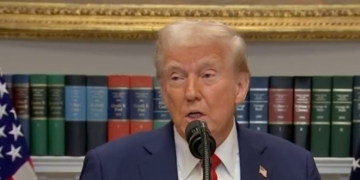





President Trump announced a new round of tariffs on Japan, South Korea, Malaysia, Kazakhstan, South Africa, Laos, and Myanmar earlier this week. Watching these developments, all part of the emerging “Trump Tariff Doctrine,” feels like an emotional rollercoaster.
Indeed, the week’s tariff news is likely to incense those who simply want U.S. trade policy to return to “normal.” Critics will doubtless point to increasing costs for consumers and damage to supply chains.
Yes, tariffs may, in the short run, produce unwanted effects. But stakeholders must look to the long run and the Trump Administration’s long game.
The administration is right to point out that countries are suddenly and uncharacteristically agreeing to negotiate matters that were once considered nonnegotiable. Vietnam has, for example, accepted the principle that transshipped goods will have a much higher tariff than goods of Vietnamese origin. This is an implicit recognition by Vietnam that violations of rules of origin are anti-competitive market distortions (ACMDs). That blatant lack of recognition was unchallenged… until now.
Meanwhile, the European Union’s tradition of imposing restrictive and burdensome regulations—under the guise of so-called “sanitary and phytosanitary” concerns—has long blocked American exports. That deliberate effort to disadvantage the U.S. was unchallenged… until now.
Prior U.S. efforts to discourage these and other non-tariff trade barriers did not work. It is equally clear that President Trump’s massive retaliation for other countries’ ACMDs has at least a chance of forcing those countries to negotiate a reduction of their barriers—especially those that lurk dangerously beneath the surface.
For the Trump administration’s trade strategy to succeed, the president must stay the course. These problems have built up over decades; they won’t be solved overnight. For some countries, they may never be solved. The Trump administration has every right to penalize countries that intentionally disadvantage the U.S. and are unwilling to make amends.
This new round of tariffs does not mark the end of a process but is rather a stopover on the way to a necessary realignment in trade relations. This follows the longer and more difficult phase of converting trade commitments made this year into legally binding obligations.
The test of whether those commitments have value is the impact they will have on U.S. producers who have historically been thwarted by anti-competitive trade barriers. Purchase agreements, while nice, are not nearly as valuable as deep, real, and lasting commitments by the US’ trading partners to lower barriers.
The challenge is that most of the economic impact of trade barriers (around 80% of them, according to our calculations) are not, in fact, tariffs, but a host of regulatory barriers, failure to protect property rights, and competition violations that fall under the banner of anti-competitive market distortions, or ACMDs. The global economy is being crushed by a field of icebergs, the most damaging parts of which lurk under the surface and are not addressed by the current trade system.
The realignment of trade relations is a gradual process initiated by a paradigm shift, resulting in a new reality. This is not new in human history. Crises erupt when the status quo eventually collapses of its own contradictions.
We are witnessing this now.
President Trump’s tariff announcements marked a paradigm shift, and now the new reality is in the process of taking root. Countries now realize they can no longer rely on their ACMDs to grant themselves a trade advantage vis-a-vis the U.S.
The U.S. is leading the way with its own effort to reduce its anti-competitive regulations. Other countries should follow suit, not only to stop the damage they are doing to their global trading partners but also the damage they are inflicting on their own economies.
President Trump’s golden age of trade is on the horizon, and with skillful sailing through many dangers, we can see the sun-kissed shores of our safe harbors heave into view.
Shanker A. Singham is the CEO of Competere, and former advisor on trade to both the UK Trade Secretary and USTR. His forthcoming book, International Trade, Regulation and the Global Economy: The Impact of Anti-Competitive Market Distortions deals with these issues and will be published by Routledge on August 12th, 2025. James Carter is a Principal with Navigators Global. He previously headed President-elect Donald Trump’s tax team during the 2016-17 transition and served as a Deputy Assistant Secretary of the Treasury for President George W. Bush.
The views and opinions expressed in this commentary are those of the author and do not reflect the official position of the Daily Caller News Foundation.
(Featured Image Media Credit: Screen Capture/CSPAN)
All content created by the Daily Caller News Foundation, an independent and nonpartisan newswire service, is available without charge to any legitimate news publisher that can provide a large audience. All republished articles must include our logo, our reporter’s byline and their DCNF affiliation. For any questions about our guidelines or partnering with us, please contact [email protected].