




President Donald Trump is already pursuing a new path to impose tariffs, but a long road likely remains ahead for companies seeking refunds.
Though the president can impose tariffs under other statutes, the Supreme Court held 6-3 that he cannot do so under the International Emergency Economic Powers Act (IEEPA), which allows the president to regulate importation during a national emergency. What happens now as the administration grapples with refunds of collected revenue and potential effects on existing trade deals remains an open question.
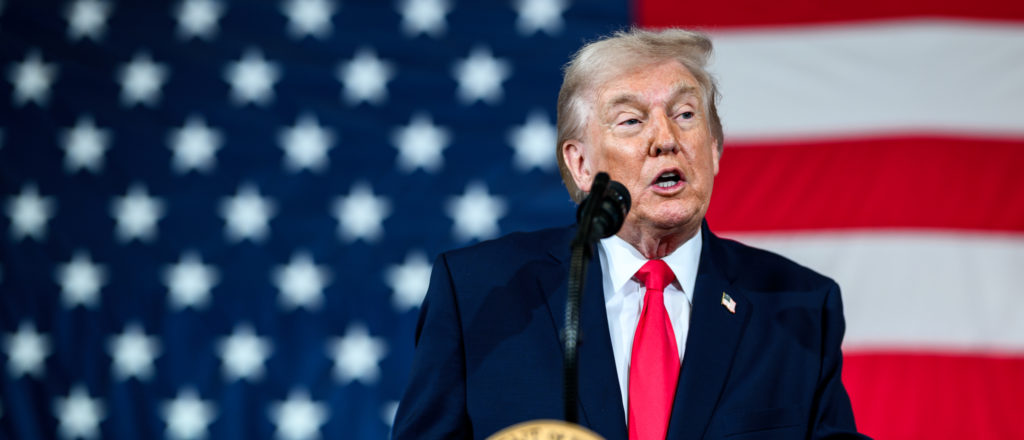
“Effective immediately, all national security tariffs under Section 232 and existing Section 301 tariffs — they’re existing, they’re there — remain fully in place and in full force and effect,” Trump said. “Today, I will sign an order to impose a 10% global tariff under Section 122, over and above our normal tariffs already being charged.”
He increased the 10% tariff to 15% on Saturday.
Trump slammed the Supreme Court’s ruling as “deeply disappointing” in a Truth Social post, stating he is “ashamed of certain Members of the Court for not having the Courage to do what is right for our Country” and suggesting the court was “swayed by Foreign Interests.”
He also criticized the court for not addressing what to do with the billions of dollars already collected.
“Wouldn’t you think they would’ve put one sentence in there saying keep the money or don’t keep the money?” he said. “I guess it has to get litigated for the next two years.”
Up to $175 billion in funds could be refunded, according to a Friday estimate by the Penn Wharton Budget Model. The government has collected more than $133 billion from tariffs imposed under IEEPA as of December, federal data shows.
“Refunds of billions of dollars would have significant consequences for the U.S. Treasury,” Justice Brett Kavanaugh wrote in his dissent. “The Court says nothing today about whether, and if so how, the Government should go about returning the billions of dollars that it has collected from importers.”
“Because IEEPA tariffs have helped facilitate trade deals worth trillions of dollars—including with foreign nations from China to the United Kingdom to Japan, the Court’s decision could generate uncertainty regarding various trade agreements,” Kavanaugh continued. Justices Clarence Thomas and Samuel Alito joined the dissent.
Some companies began filing protective actions in the Court of International Trade (CIT) before the ruling to preserve their refund rights, including Costco Wholesale.
Treasury Secretary Scott Bessent told Reuters in January that the refunds would not go out in a single day but could take weeks, months or over a year. The Treasury has $774 billion in cash on hand, the outlet reported.
“It won’t be a problem if we have to do it, but I can tell you that if it happens — which I don’t think it’s going to — it’s just a corporate boondoggle,” Bessent told Reuters. “Costco, who’s suing the U.S. government, are they going to give the money back to their clients?”
Yet Bessent has also warned a ruling against tariffs would be a “gigantic loss,” given how Trump has used it to bring other countries to the negotiating table.
“It’s an emergency authority, and what was an emergency if it wasn’t the fentanyl crisis? We are seeing Canada, Mexico, [and] China come to the table to stop this scourge of the American people,” he told Fox News on Feb. 8.
Wilbur Ross, who served as Secretary of Commerce during Trump’s first term, told Politico on Friday the administration will probably “fight the idea of refunds, and that’ll be the next thing that’ll go winding through the courts.”
The court’s decision might “not substantially constrain a President’s ability to order tariffs going forward,” Kavanaugh writes in his dissent joined by Thomas and Alito.
But “the interim effects of the Court’s decision could be substantial.”
“The United States may be required… https://t.co/mYZWflWUTS pic.twitter.com/84bdfe4s62
— Katelynn Richardson (@katesrichardson) February 20, 2026
Congress would have included explicit authorization in the IEEPA statute if it “intended to convey the distinct and extraordinary power to impose tariffs,” Chief Justice John Roberts reasoned in the majority opinion.
Trump wrote that the decision actually made a president’s power to regulate trade and impose tariffs “more powerful and crystal clear,” given the Supreme Court allowed the power to “block, embargo, restrict, license, or impose any other condition” on a foreign country’s trade under IEEPA.
Kavanaugh’s dissent noted there are other statutes that allow the president to impose tariffs, “albeit perhaps with a few additional procedural steps that IEEPA, as an emergency statute, does not require.”
“Those statutes include, for example, the Trade Expansion Act of 1962 (Section 232); the Trade Act of 1974 (Sections 122, 201, and 301); and the Tariff Act of 1930 (Section 338),” he wrote. “In essence, the Court today concludes that the President checked the wrong statutory box by relying on IEEPA rather than another statute to impose these tariffs.”
The statutes Kavanaugh cited “contain various combinations of procedural prerequisites, required agency determinations, and limits on the duration, amount, and scope of the tariffs they authorize,” Roberts wrote in a footnote in his majority opinion.
“We do not speculate on hypothetical cases not before us,” Roberts said.
Trump cited the fentanyl crisis for a first set of tariffs imposed on Canada, China and Mexico using IEEPA in February. He pointed to a growing trade deficit as the emergency justifying his second set of “Liberation Day” tariffs in April, imposing a baseline 10% tariff on imports and increasing rates depending on the country.
The decision was a “narrow legal ruling in that it says that this statute doesn’t justify these tariffs,” Ilya Shapiro, senior fellow and director of constitutional studies at the Manhattan Institute, wrote in a statement Friday
“It effectively calls the administration out on a process foul, telling it not to steal bases in pursuit of what may be worthy goals,” Shapiro said.
All content created by the Daily Caller News Foundation, an independent and nonpartisan newswire service, is available without charge to any legitimate news publisher that can provide a large audience. All republished articles must include our logo, our reporter’s byline and their DCNF affiliation. For any questions about our guidelines or partnering with us, please contact [email protected].