



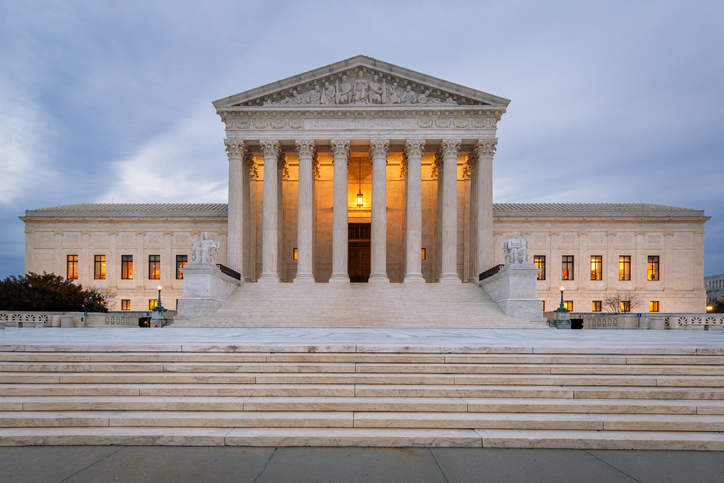
The Supreme Court signaled Monday that it may soon rewrite the rules governing Washington’s vast bureaucracy.
According to The Associated Press, the justices appeared open to expanding presidential authority over independent agencies — a change that would upend decades of limits on executive power.
Such a ruling would hand President Donald Trump a significant boost in his drive to assert more control over the federal regulatory machine, tightening his grip on agencies that have long operated with insulation from the White House.
In a spirited session, the Court’s conservative majority hinted that it is ready to gut or fully overturn Humphrey’s Executor, the 1935 precedent that has insulated agency board members from political dismissal for nearly a century.
That decision has long served as the backbone for independent entities overseeing everything from nuclear power to product safety to labor disputes.
Justice Brett Kavanaugh framed the dispute bluntly, arguing the officials at these agencies “are exercising massive power over individual liberty and billion-dollar industries” but remain largely unaccountable to any elected leader.
The liberal justices warned that tossing aside the old rule could open the door to sweeping political purges.
Justice Elena Kagan cautioned that the change would grant presidents “massive unchecked, uncontrolled power.”
Justice Ketanji Brown Jackson raised the stakes even further.
“So having a President come in and fire all the scientists and the doctors and the economists and the PhDs and replacing them with loyalists and people who don’t know anything is actually not in the best interest of the citizens of the United States,” she said.
But Trump’s administration has argued that the system created by Humphrey’s Executor has outlived its time, enabling what Solicitor General D. John Sauer described as a “headless fourth branch” of unaccountable bureaucrats.
Sauer said the president was well within his authority when he removed Federal Trade Commission member Rebecca Slaughter without cause.
Chief Justice John Roberts twice referenced the 1935 ruling in withering terms, calling it “a dried husk.”
Over the past year, the conservative majority has repeatedly allowed Trump to dismiss officials at the National Labor Relations Board, the Merit Systems Protection Board, and the Consumer Product Safety Commission, even as their legal battles play out.
The only exceptions so far: Federal Reserve Governor Lisa Cook and Library of Congress copyright official Shira Perlmutter, both of whom remain in place as the Court sorts out how far its new doctrine will reach.
The Slaughter case could ripple into Cook’s situation as well. The justices are weighing whether courts can reinstate an official even if their firing is deemed illegal. Justice Neil Gorsuch has previously written that fired officials may be entitled to back pay — but not their jobs.
Kavanaugh, however, signaled sympathy for Cook, suggesting it would be an “end run” around the law to say an unlawfully fired official should only receive a paycheck.
The case sits within a broader trend. Under Roberts’ leadership, the Court has steadily chipped away at limits on presidential removal power, including a 2020 ruling that declared “the President’s removal power is the rule, not the exception.” And in last year’s immunity decision, the Court placed firing authority among the president’s “conclusive and preclusive” powers.
The original Humphrey’s Executor decision, rooted in President Franklin Roosevelt’s effort to replace a stubborn FTC commissioner, upheld restrictions on removing agency officials except for “inefficiency, neglect of duty, or malfeasance.” That standard has shaped federal governance for nearly 90 years.
But after Monday’s arguments, it appears the Supreme Court’s conservative bloc is prepared to rewrite that relationship — and redefine the boundaries of presidential power for decades to come.