




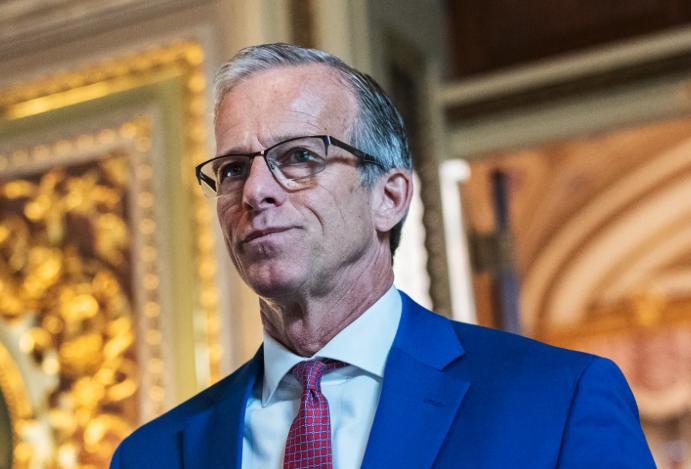
As the government shutdown stretches into its 36th day — now the longest in American history — pressure is mounting in Washington. President Donald Trump returned from the White House after once again urging Senate Republicans to eliminate the filibuster, a longstanding rule requiring 60 votes to advance most legislation. Despite the president’s calls, Senate Majority Leader John Thune made clear there still aren’t enough Republican votes to change Senate rules.
When asked directly if President Trump could persuade some of the more hesitant members of the GOP to flip on the filibuster, Thune didn’t dismiss the president’s influence but stood firm on the reality of the vote count. “I don’t doubt that he could have some sway with members,” Thune said. “But I know where the math is on this issue in the Senate, and… it’s just not happening.”
The filibuster has been a subject of heated debate for years, and while frustrations over the ongoing government shutdown have pushed some lawmakers closer to considering rule changes, many Senate Republicans remain hesitant. Thune and others have long defended the filibuster as a way to protect the rights of the minority party and encourage long-term bipartisan solutions.
Senator Mike Rounds, who met with President Trump for breakfast Wednesday morning along with other GOP senators, acknowledged that the president made a strong case for ditching the rule but said he’s not ready to sign on. “I think there’s a lot of us that really think the Senate was designed in the first place to find a long-term, stable solution to problems,” Rounds said. “So we’ll listen to what the president has to say.”
Senator John Kennedy also pushed back on the idea, calling the filibuster “important.” Kennedy said the job of a senator isn’t just to pass laws, but also to stop bad ones. “We’re not in the minority now, but we could be someday. It’s important to have a filibuster,” he said.
Senator Thom Tillis didn’t mince words. “There’s nothing that could move me on the filibuster,” he said. “I’ve been that way for 11 years. Too old to change now.”
Still, not all Republicans are drawing red lines. Senator John Cornyn said he’s now “open to changing the filibuster,” citing problems with passing regular appropriations bills and the ability of a small group to allegedly force shutdowns. Senator Josh Hawley echoed that frustration. He said Democrats should come to the negotiating table, adding, “If you’re putting me to a choice between, are people going to eat, or am I going to defend arcane filibuster rules, I’m going to choose people eating. So, we’re getting there real fast.”
Thune confirmed that President Trump “honestly believes” removing the filibuster is the right move. But he emphasized that the focus needs to be on reopening the government. The shutdown, which has entered its sixth week, is beginning to cause deeper concerns across the country, especially in areas with a high number of federal workers, like Northern Virginia.
At this point I have to be convinced that Thune is the one really holding back the Filibuster. He can bring it up in the Senate for a vote just tell people to vote their conscious (as will he) and see where everyone stands. But that of course leads to constituent accountability https://t.co/1BY6DdEU4z
— Chris2theJ (@chris2the_j) November 6, 2025
When asked if the shutdown might have impacted Tuesday’s elections — where Democrats saw big wins in races for governor, lieutenant governor, and attorney general in Virginia — Thune said it’s possible. “This is a community here, obviously, in Northern Virginia, that has a lot of federal workers. So it certainly could have been a factor in the elections,” he said.
Senate Democratic Leader Chuck Schumer celebrated the election results as a message from voters. “Last night was a great night for America and a five-alarm fire for Donald Trump and Republicans,” Schumer said on the Senate floor. “The American people said last night, ‘Enough is enough.’”
Schumer, along with House Democratic Leader Hakeem Jeffries, sent a letter to the White House urging the president to agree to bipartisan talks to end the shutdown and work toward solutions, including what they called the “Republican health care crisis.” Both leaders say they’ve been asking for a meeting for weeks.
“It is time to sit down and negotiate with Democrats to bring this Republican shutdown to an end,” Schumer said. Whether those talks happen — and whether the filibuster survives this political storm — remains to be seen. But one thing is clear: with the government still closed and elections signaling warning signs, both sides are under pressure to find a way forward.












