



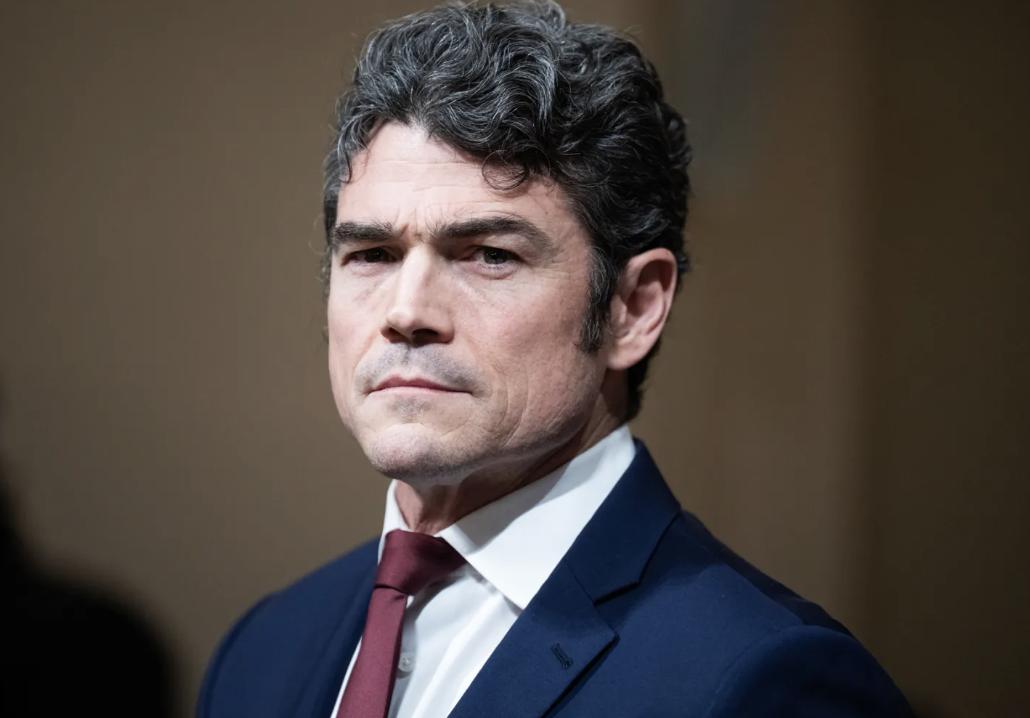
President Donald Trump didn’t hold back Tuesday after the sudden resignation of National Counterterrorism Center Director Joe Kent, bluntly declaring it “a good thing” that Kent is out—and ripping him as “very weak on security.”
The moment unfolded during a high-profile Oval Office meeting with Irish Taoiseach Micheál Martin, when Trump was asked directly about Kent’s departure. His answer was immediate and pointed.
“I always thought he was a nice guy, but I always thought he was weak on security, very weak on security,” Trump said. “When I read his statement, I realized that it’s a good thing that he’s out.”
At the center of the firestorm is Kent’s resignation letter, where he claimed that “Iran posed no imminent threat”—a statement that instantly triggered backlash across Trump’s inner circle and top Republican leadership.
Trump flatly rejected that claim, arguing the danger from Iran was obvious and widely recognized.
@SpeakerJohnson on resignation of Joe Kent, Director of National Counterterrorism Center : “I don’t know where Joe Kent is getting his information, but he wasn’t in those briefings clearly…they had exquisite intelligence that we understood this was a serious moment for us.” pic.twitter.com/7FDWfyYmwT
— CSPAN (@cspan) March 17, 2026
“Iran was a threat. Every country realized what a threat Iran was,” Trump said, adding that the real debate wasn’t about the threat itself—but whether leaders had the will to act on it.
He went even further, invoking years of warnings from military experts who argued that decisive action against Iran should have come long ago, particularly over its nuclear ambitions.
The White House quickly moved to dismantle Kent’s narrative.
Press Secretary Karoline Leavitt blasted the resignation letter as riddled with “many false claims,” zeroing in on the Iran assessment as the most glaring example. She insisted Trump had “strong and compelling evidence” that Iran was preparing to strike first—intelligence gathered from multiple sources.
“This is the same false claim that Democrats and some in the liberal media have been repeating,” Leavitt wrote, doubling down on the administration’s position that Iran posed a real and immediate danger.
.@POTUS: “I always thought he was a nice guy, but I always thought he was weak on security… When I read his statement, I realized that it’s a good thing that he’s out because he said that Iran was not a threat… Iran was a tremendous threat.” https://t.co/atnLqkUsde pic.twitter.com/d8t8DZEUfu
— Rapid Response 47 (@RapidResponse47) March 17, 2026
She pointed to Iran’s status as the world’s leading state sponsor of terrorism and accused the regime of actively working toward a lethal combination of ballistic missile expansion and nuclear capability—what she described as a strategy to “hold us and the rest of the world hostage.”
Leavitt also dismissed Kent’s suggestion that foreign influence, including from Israel, played any role in Trump’s decision-making, calling the idea “insulting and laughable.”
The backlash didn’t stop at the White House.
House Speaker Mike Johnson said Kent was clearly out of the loop on critical intelligence, suggesting he “wasn’t in those briefings.” Trump ally Taylor Budowich went nuclear, branding Kent “a crazed egomaniac” who allegedly tried to undermine the president.
Conservative commentator Mark Levin added fuel to the fire, speculating that Kent may have resigned ahead of being fired—and warning that media outlets would seize on his claims to attack Trump’s Iran policy.
Sen. Lindsey Graham piled on, declaring Kent’s resignation couldn’t have come “at a better time.”
The clash exposes a deeper divide inside Washington over Iran, intelligence assessments, and the justification for military action. But inside Trump’s orbit, the message is unified and unmistakable: Kent’s exit wasn’t a loss—it was overdue.












