



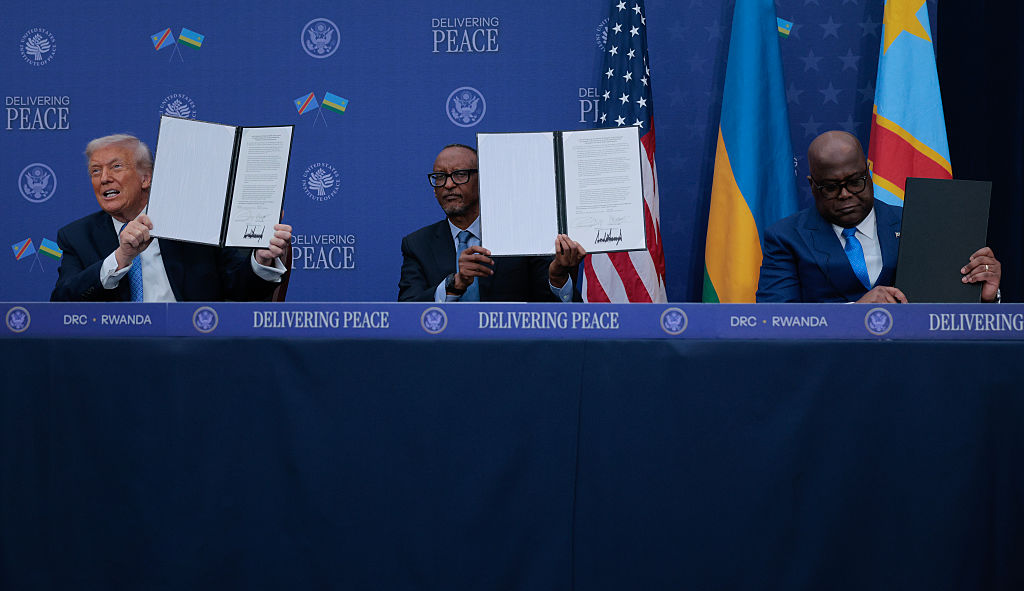
A high-stakes diplomatic moment unfolded in Washington on Thursday as President Donald Trump brought together the leaders of the Democratic Republic of Congo and Rwanda for the signing of an agreement aimed at easing long-running tensions in eastern Congo.
According to The Associated Press, the pact gives Trump another opportunity to showcase his role as a broker in international disputes — a point he emphasized repeatedly as he highlighted the significance of the moment.
“It’s a great day for Africa, a great day for the world,” Trump said before the deal was finalized. “Today, we’re succeeding where so many others have failed.”
The agreement brought Presidents Felix Tshisekedi of Congo and Paul Kagame of Rwanda to Washington, along with officials from several African nations who came to witness the signing.
Their visit came the same week Trump sharply criticized Somalia, comments that sparked headlines but did not overshadow their decision to proceed with the event.
The White House cast the pact as “historic,” noting it capped months of diplomatic work involving the United States, the African Union, and Qatar. It also formalized discussions launched in June.
Even with the signing, the fragile nature of the peace efforts was clear. Fighting between Congolese forces and the Rwanda-backed M23 rebels has continued in parts of eastern Congo, illustrating the limits of a single agreement. But both leaders chose to strike an optimistic tone.
“No one was asking President Trump to take up this task. Our region is far from the headlines,” Kagame said. “But when the president saw the opportunity to contribute to peace, he immediately took it.”
Tshisekedi echoed that sentiment as he reflected on the long road ahead.
“I do believe this day is the beginning of a new path, a demanding path, yes. Indeed, quite difficult,” he said. “But this is a path where peace will not just be a wish, an aspiration, but a turning point.”
Trump framed the deal as a chance for the two nations to move past years of violence.
“They spent a lot of time killing each other,” Trump said. “And now they’re going to spend a lot of time hugging, holding hands, and taking advantage of the United States of America economically like every other country does.”
The pact also builds on an existing Regional Economic Integration Framework that outlines how Congo, Rwanda, and their partners will structure future cooperation.
Alongside the peace agreement, Trump announced that the United States had signed new bilateral deals with both countries to increase access to critical minerals — resources deeply important to American manufacturing and seen as a strategic counterweight to China’s dominance in the sector.
“And we’ll be involved with sending some of our biggest and greatest U.S. companies over to the two countries,” Trump said. “Everybody’s going to make a lot of money.”
Thursday’s event followed one-on-one meetings at the White House and a three-way discussion held before the signing ceremony at the newly renamed Donald J. Trump Institute of Peace.
Later in the day, the U.S. Chamber of Commerce planned to bring together American business leaders with the visiting delegations to explore potential investments in minerals, energy, and tourism.
Despite the uncertainty surrounding the situation on the ground, officials in both Congo and Rwanda praised the U.S. role and said they hoped Washington would remain engaged.
“We need that attention from the administration to continue to get to where we need to get to,” said Congolese spokesperson Tina Salama Makolo. “We are under no illusion that this is going to be easy. This is not the end, but it’s a good step.”












