



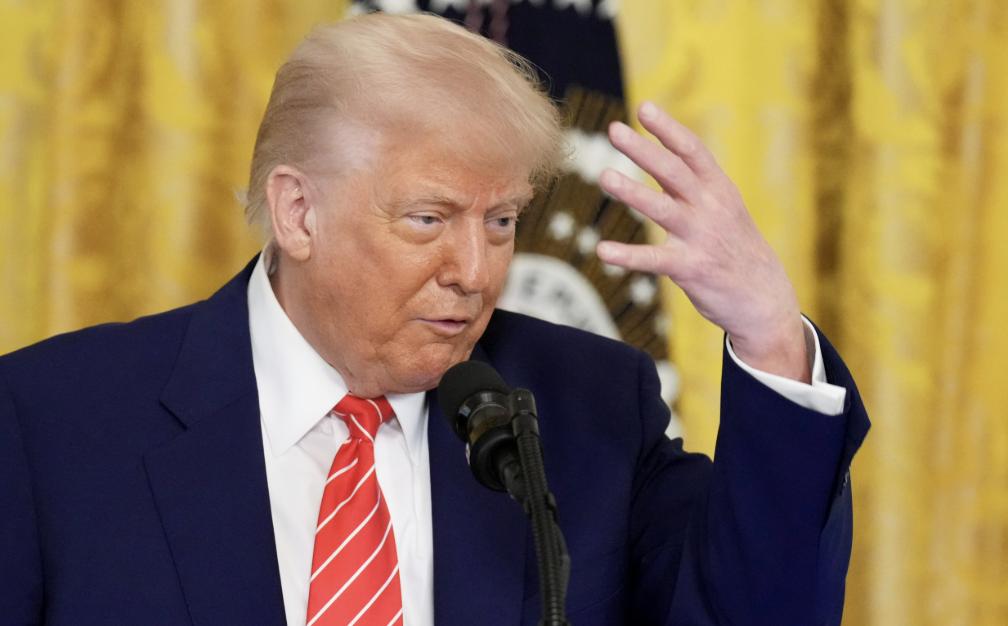
President Donald Trump dropped a political grenade late Wednesday, signing an executive order aimed at ramping up domestic production of glyphosate and elemental phosphorus — and the backlash was immediate.
Invoking the Defense Production Act, Trump’s order moves to safeguard U.S.-based production of elemental phosphorus and glyphosate-based herbicides, calling both “crucial to the national security and defense” of the United States. The White House made the case bluntly: without these inputs, America’s food supply — and by extension, national security — is vulnerable.
“Ensuring an adequate supply” of these materials is essential to “protecting the health and safety of Americans,” Trump wrote.
Glyphosate, first registered as a pesticide in 1974, is one of the most widely used herbicides in the world. Farmers rely on it to kill weeds and grasses that threaten crop yields. But it has long been at the center of heated legal and scientific battles. A June 2025 Environmental Health study found low doses of glyphosate caused multiple types of cancer in rats, according to researchers at George Mason University.
That finding adds fuel to a fire that has been burning for years.
Health and Human Services Secretary Robert F. Kennedy Jr. previously blasted glyphosate as “one of the likely culprits in America’s chronic disease epidemic.” In a June 2024 post on X, Kennedy claimed much exposure comes from its use as a desiccant on wheat, writing, “From there it goes straight into our bodies. My USDA will ban that practice.”
Yet on Thursday, Kennedy stood firmly behind Trump’s executive order.
“Donald Trump’s Executive Order puts America first where it matters most — our defense readiness and our food supply,” Kennedy said in a statement. “When hostile actors control critical inputs, they weaken our security. By expanding domestic production, we close that gap and protect American families.”
The White House doubled down. Spokesman Kush Desai stressed that modern weapons systems and food production alike depend on elemental phosphorus. “America has just one domestic producer,” he said, warning of “precarious foreign reliance.”
Desai later clarified the move “is not an endorsement of any product or practice” but rather a national security measure designed to end “decades-long reliance on foreign imports and supply chains.”
The politics, however, are anything but simple.
Kennedy famously won a nearly $290 million case in 2018 against Monsanto, the maker of Roundup — later acquired by Bayer — on behalf of a man who alleged the weedkiller caused his cancer. Bayer now faces thousands of lawsuits and has proposed a $7.25 billion settlement plan.
Critics argue Trump’s move sends a contradictory message to the “Make America Healthy Again” coalition that helped power the administration.
Environmental Working Group President Ken Cook didn’t mince words. “If anyone still wondered whether ‘Make America Healthy Again’ was a genuine commitment to protecting public health or a scam concocted by President Trump and RFK Jr., today’s decision answers that question,” Cook said. He called the order “a bigger middle finger to every MAHA mom” and accused the administration of giving Bayer “a license to poison people.”
Healthy eating activist Vani Hari echoed that frustration, arguing that MAHA voters were “promised health reform, not chemical entrenchment.”
The herbicide Glyphosate is one of the likely culprits in America’s chronic disease epidemic. Much more widely used here than in Europe. Shockingly, much of our exposure comes from its use as a desiccant on wheat, not as an herbicide. From there it goes straight into our bodies.…
— Robert F. Kennedy Jr (@RobertKennedyJr) June 14, 2024
Lori Ann Burd of the Center for Biological Diversity described the executive order as “a sickening love letter” to major pesticide companies.
The reaction wasn’t limited to traditional environmental groups. Some conservative influencers and MAHA supporters openly questioned the political timing. “Have we ever lost the midterms this early or is this a new record?” Turning Point USA podcast host Alex Clark posted on X.
Food and health activist Kelly Ryerson warned that just as the MAHA base begins weighing its 2026 midterm strategy, “the President issues an EO to expand domestic glyphosate production.”
Yet Republicans on Capitol Hill struck a very different tone.
The House Committee on Agriculture praised the move, declaring, “FOOD SECURITY IS NATIONAL SECURITY.” The committee thanked Trump for “acknowledging the importance of glyphosate-based herbicides in American agriculture,” calling it a “vital step forward” for producers.
Internationally, the issue remains contentious. No European Union country has fully banned glyphosate, but several — including Austria, France, Germany, Belgium, Luxembourg, and the Netherlands — have imposed partial restrictions limiting its use in certain areas.
The executive order also lands amid broader regulatory shifts. In March 2025, the EPA announced it would reconsider rules governing chemicals already in commerce, promising to “efficiently and effectively protect human health and the environment.” Meanwhile, in December 2025, Kennedy, Agriculture Secretary Brooke Rollins, and CMS Administrator Dr. Mehmet Oz unveiled a $700 million regenerative agriculture pilot program aimed at lowering farmer costs and advancing the MAHA agenda.
Now, those parallel tracks — boosting domestic chemical production while promoting regenerative farming — are colliding in public view.
As Republicans craft their messaging ahead of 2026, Trump’s executive order has exposed a real tension inside the coalition: national security hawks and agricultural producers on one side, grassroots health reform activists on the other.
Whether voters see the move as America First pragmatism or a betrayal of health-focused promises could shape more than just the glyphosate debate. It may define the next chapter of the MAHA movement itself.
The post Trump’s New Executive Order Invoking The Defense Production Act Draws Attention appeared first on Red Right Patriot.












