



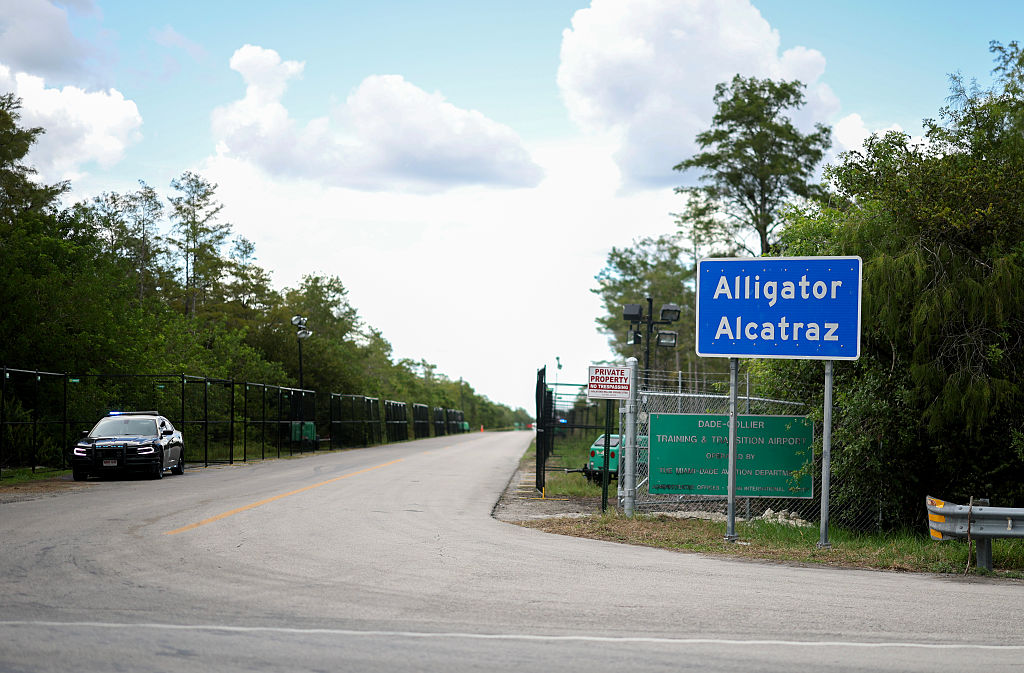
A controversial immigration detention camp deep in the Florida Everglades, known as “Alligator Alcatraz,” has been ordered to cease operations immediately after a federal judge ruled that the facility violates environmental protections and lacks proper oversight.
U.S. District Judge Kathleen Williams issued a preliminary injunction Thursday, effectively shutting down the remote detention camp located on a former airport site, according to CNN.
The facility, which has become a symbol of the Trump administration’s immigration crackdown, can no longer accept new detainees and must remove all added infrastructure within 60 days.
“The project creates irreparable harm in the form of habitat loss and increased mortality to endangered species in the area,” Williams wrote in her order. She added that lighting, fencing, generators, gas, sewage, and other waste added to the Collier Dade Training and Transition Airport must be dismantled.
The case was brought by environmental groups and the Miccosukee Tribe of Indians of Florida, who alleged that the state’s rapid development of the site bypassed environmental reviews and ignored tribal sovereignty.
“Every Florida governor, every Florida senator, and countless local and national political figures, including presidents, have publicly pledged their unequivocal support for the restoration, conservation, and protection of the Everglades,” Williams wrote. “This Order does nothing more than uphold the basic requirements of legislation designed to fulfill those promises.”
“We are so relieved,” said Elise Pautler Bennett, an attorney representing one of the groups. “We feel we presented voluminous evidence that is presented in her (Williams’) order showing this was the right decision to protect the environment and the interest of Americans in the Everglades.”
The judge’s ruling drew immediate backlash from the Trump administration and Florida officials, who have championed the camp as part of a broader strategy to manage immigration flows.
“This is not going to deter us,” said Gov. Ron DeSantis on Friday. “We are totally in the right on this.” He has pledged to open a new facility he calls “Deportation Depot.”
“We are committed to the mission,” he said.
Department of Homeland Security Assistant Secretary Tricia McLaughlin slammed the ruling, calling it an obstruction to immigration enforcement.
“This ruling from an activist judge ignores the fact that this land has already been developed for a decade,” McLaughlin said. “It is another attempt to prevent the President from fulfilling the American people’s mandate to remove the worst of the worst including gang members, murderers, pedophiles, terrorists, and rapists from our country.”
Williams, who was nominated by President Barack Obama, had previously found Florida Attorney General James Uthmeier in civil contempt of court in June after he appeared to defy a court order halting a new state immigration law.
A key issue in the case is oversight. Though Florida claims the camp is a state-run facility under agreements with ICE, Williams pointed to federal involvement.
“The project was requested by the federal government; built with a promise of full federal funding … staffed by deputized ICE Task Force Officers,” Williams said. “If it walks like a duck, quacks like a duck, and looks like a duck, then it’s a duck.”
Talbert Cypress, chairman of the Miccosukee Tribe, which joined the lawsuit, said the ruling was a victory for tribal rights and the environment.
“This is not our first fight for our land and rights,” Cypress said. “We will always stand up for our culture, our sovereignty, and for the Everglades.”
Located about an hour west of Miami, the facility was built hastily on an old airstrip, featuring FEMA trailers, tents, and fencing. During a tour before it opened, DeSantis called the site “temporary and necessary” to relieve pressure on Florida jails overwhelmed by a surge in illegal immigration.
But critics say the move was more political than practical.
“Opening up the Everglades was a political decision, not a policy one,” said Democratic state Rep. Anna Eskamani, who toured the facility in July and testified during the trial.
The state plans to appeal the ruling, according to a spokesperson for the Florida Attorney General. But for now, the remote detention camp is on a 60-day clock to shut down — marking a significant blow to one of the most controversial immigration efforts in recent memory.