


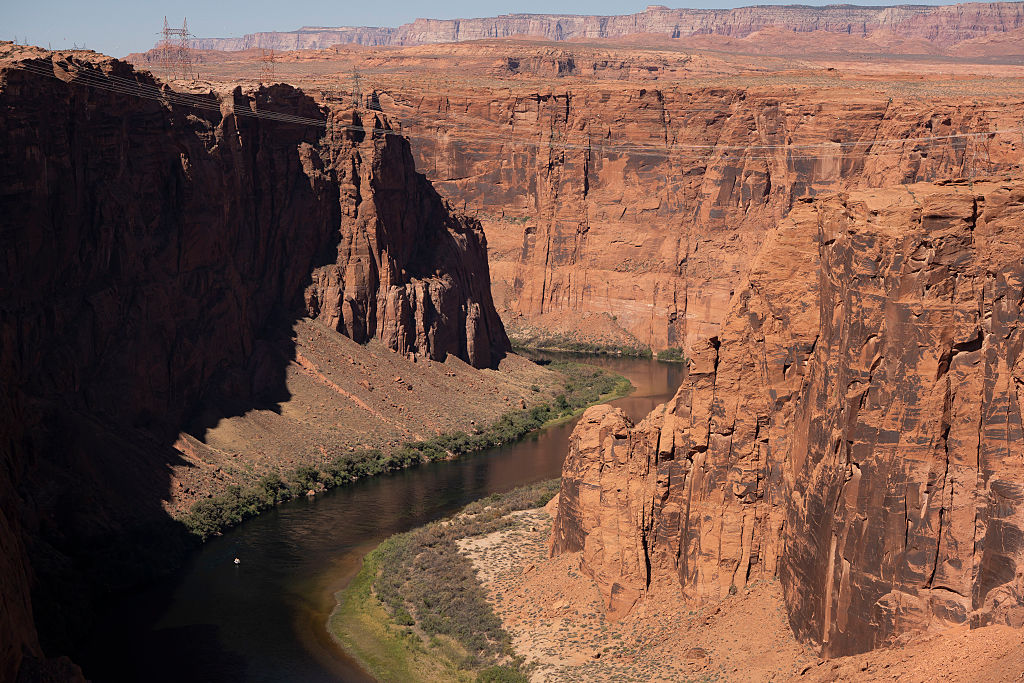
Environmental advocates are urging the federal government to take swift action to curb what they describe as widespread water waste from the Colorado River — a vital lifeline that supports 40 million people across the American Southwest and beyond.
In a formal petition sent earlier this year, several environmental groups called on the U.S. Bureau of Reclamation to ensure that water diverted from the river is being used only for “reasonable” and “beneficial” purposes, according to the Associated Press.
The groups argue the Bureau has existing authority to enforce these standards, especially in the Lower Basin states: California, Arizona, and Nevada.
“We don’t have a management future for the Colorado River right now and it’s getting pretty scary,” said Mark Gold, adjunct professor at UCLA and former director of water scarcity solutions with the Natural Resources Defense Council. “We should be dealing with this as a water scarcity emergency, and one of the things that you really want to do in an emergency is, let’s deal with water waste first.”
The pressure comes as states that depend on the river are racing toward a 2026 deadline to craft new rules for sharing its water. If they fail to strike a preliminary deal by mid-November, federal officials could be forced to intervene — a move that could carry political and economic consequences.
The concept of “reasonable and beneficial” use is not new, but environmentalists say it’s long been underused as a regulatory tool. According to the Bureau’s own code, “deliveries of Colorado River water to each Contractor will not exceed those reasonably required for beneficial use.”
The Bureau hasn’t formally responded to the petition. In a statement to the Associated Press, the agency said it continues to operate under existing agreements while employing other strategies to “reduce the risk of reaching critical elevations” at major reservoirs like Lake Mead and Lake Powell.
But critics argue that’s not enough.
Cara Horowitz, director of UCLA’s Frank G. Wells Environmental Law Clinic, said she and her students examined how the Bureau applies the “reasonable and beneficial” standard and came up empty.
“As best as we could tell, it’s never defined the phrase and it does not use the phrase in any meaningful way as it’s making water delivery decisions,” Horowitz said.
Her clinic is representing the environmental groups behind the petition. They’re asking the Bureau to periodically review water usage and develop a clear framework to identify and curb unreasonable or wasteful practices.
That effort could prove controversial.
“It’s potentially a whole can of worms that we need to approach very carefully,” warned Sarah Porter, director of Arizona State University’s Kyl Center for Water Policy. “Who gets to be the entity that decides what’s an appropriate amount of use for any particular water user or community?”
While supporters of the petition believe it’s a necessary step toward sustainability, critics — particularly in agriculture — warn the changes could hurt food production and local economies.
The Bureau has previously cited the “beneficial use” clause. In 2003, it ordered water cuts to California’s Imperial Irrigation District after concluding the district could not use its full allocation. That legal battle was eventually settled.
Still, with ongoing drought, climate change, and growing populations placing unprecedented strain on the river, some argue it’s time for federal officials to act more boldly — before time runs out.