



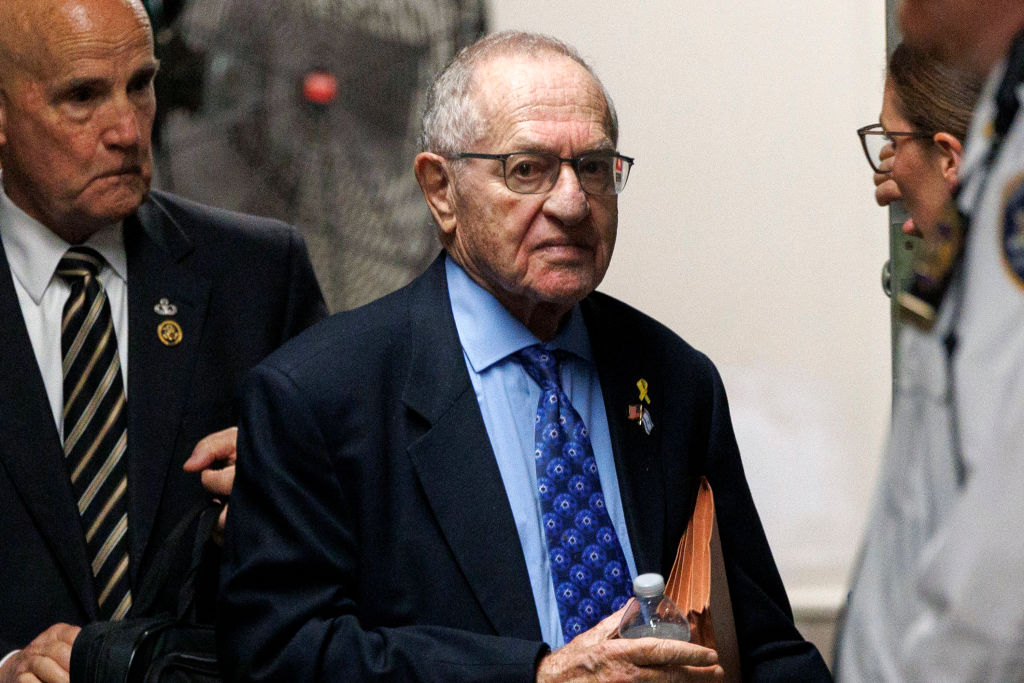
Famed criminal defense attorney and Harvard Law professor emeritus Alan Dershowitz has lost again in his $300 million defamation lawsuit against CNN.
A federal appeals court upheld the dismissal of the case, but one judge’s concurring opinion may fuel Dershowitz’s efforts to challenge the landmark defamation precedent set by New York Times v. Sullivan, according to Law&Crime.
The 11th U.S. Circuit Court of Appeals unanimously affirmed a lower court ruling tossing Dershowitz’s lawsuit, which stemmed from CNN’s coverage of his defense of President Donald Trump during the first impeachment trial.
Writing for the panel, Judge Britt Grant said Dershowitz “offered no evidence” that CNN commentators “intentionally” misled viewers. Instead, she said, they “believed in the truth of their reporting,” “formed their opinions independently,” and had a “sincere” belief their interpretation was accurate.
“For a public figure like Dershowitz to prevail, defamation law has long required proof of a speaker’s actual malice,” Grant wrote. “Dershowitz has presented no evidence that shows otherwise.”
The lawsuit alleged CNN selectively edited Dershowitz’s Senate remarks to suggest he believed Trump could act illegally if it was in his own electoral interest. Specifically, CNN omitted context from Dershowitz’s response to Sen. Ted Cruz, where he said:
“The only thing that would make a quid pro quo unlawful is if the ‘quo’ were in some way illegal… If a president does something which he believes will help him get elected — in the public interest — that cannot be the kind of quid pro quo that results in impeachment.”
CNN portrayed this as Dershowitz arguing Trump was above the law if he believed his re-election served the public. Dershowitz called that a “false narrative.”
His case initially survived a motion to dismiss. U.S. District Judge Raag Singhal ruled in 2021 that CNN had “presented an official proceeding in a misleading manner.” But after discovery, Singhal ruled Dershowitz hadn’t met the Sullivan standard of “actual malice.”
“After full discovery, extensive briefing, and oral argument, the Court concludes that he has not,” Singhal wrote in 2023.
Though the appeals court upheld that decision, Trump-appointed Judge Barbara Lagoa issued a notable concurrence criticizing Sullivan and CNN.
“I concur with the majority because, under New York Times Co. v. Sullivan, we are obliged to hold public-figure defamation plaintiffs to the actual-malice standard,” she wrote. But she called Sullivan a “policy-driven decision dressed up as constitutional law.”
“There can be little dispute that CNN ‘defamed’ Alan Dershowitz under any common understanding of that term,” Lagoa continued. “In some instances, they blurred the line between fact and commentary, and in others, they simply lied about what Dershowitz had said.”
She noted that Dershowitz “offered evidence… he was harmed,” including being dropped by media outlets he previously frequented.
“I agree with the district court that the only thing standing between Dershowitz and justice is Sullivan,” she wrote.
Dershowitz told Law&Crime he plans to pursue further legal action, likely including an appeal to the U.S. Supreme Court.
“We intend to seek further review based in part on the concurring opinion that correctly concluded that CNN ‘lied’ about me,” he said. “The trial judge also found that I had not said anything close to what CNN falsely claimed I said. A jury, not judges, should be allowed to decide whether CNN’s defamations were malicious.”
However, Senior Judge Charles Wilson, a Clinton appointee, cautioned against overturning Sullivan, writing:
“For it is hard to overstate the value, in a country like ours, of stability in the law.”
He warned that dismantling Sullivan would create a “serious risk of chilling protected speech.”
While Dershowitz lost this round, Lagoa’s concurrence may give his team ammunition to continue challenging the boundaries of modern defamation law.












