



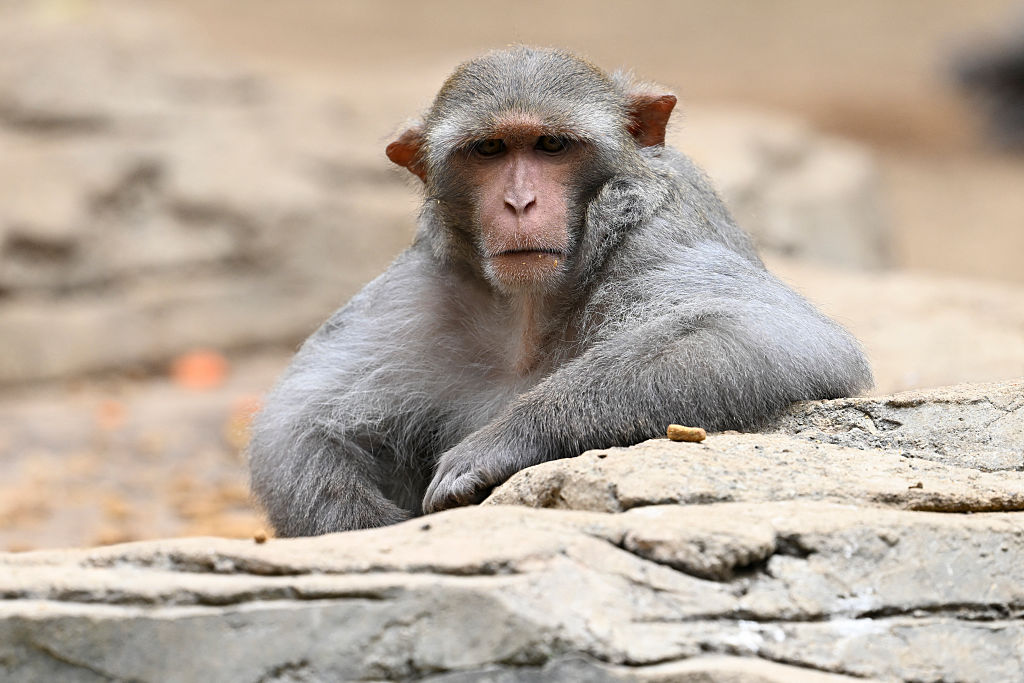
One of the monkeys that escaped last week after a truck carrying research animals overturned on a Mississippi highway was shot and killed early Sunday by a woman who says she feared for her children’s safety.
According to The Associated Press, Jessica Bond Ferguson said she was woken by her 16-year-old son, who believed he saw a monkey in the yard of their home near Heidelberg, Mississippi. She grabbed her gun and phone before stepping outside, where she spotted the animal about 60 feet away.
Bond Ferguson said residents had been warned that the escaped monkeys could carry diseases — so she fired.
“I did what any other mother would do to protect her children,” Bond Ferguson, who has five children ages 4 to 16, told The Associated Press. “I shot at it and it just stood there, and I shot again, and he backed up and that’s when he fell.”
The Jasper County Sheriff’s Office confirmed a homeowner found one of the monkeys Sunday morning but offered no additional details. The Mississippi Department of Wildlife, Fisheries, and Parks later took possession of the animal.
The rhesus monkeys had been housed at the Tulane University National Biomedical Research Center in New Orleans, which supplies primates for medical studies. Tulane said in a statement that the animals did not belong to the university and were not being transported by it.
The truck carrying 21 monkeys overturned Tuesday on Interstate 59 north of Heidelberg, killing most of the animals. Experts from Tulane determined three monkeys had escaped. The Mississippi Highway Patrol said it is investigating the cause of the crash, which happened roughly 100 miles from Jackson.
Rhesus monkeys, which typically weigh about 16 pounds, are widely used in medical research. Video from the crash site showed monkeys crawling through tall grass near smashed crates labeled “live animals.”
Jasper County Sheriff Randy Johnson said Tulane officials assured authorities that the monkeys were not infectious, though the animals still needed to be “neutralized” due to their aggressive nature. Tulane added Wednesday that the monkeys had recently undergone checkups confirming they were pathogen-free.
Rhesus macaques “are known to be aggressive,” according to the Mississippi Department of Wildlife, Fisheries, and Parks, which worked alongside sheriff’s deputies to locate the animals.
The incident comes about a year after 43 rhesus macaques escaped a South Carolina breeding facility when an employee failed to secure an enclosure, prompting a large-scale effort to recapture them.












