



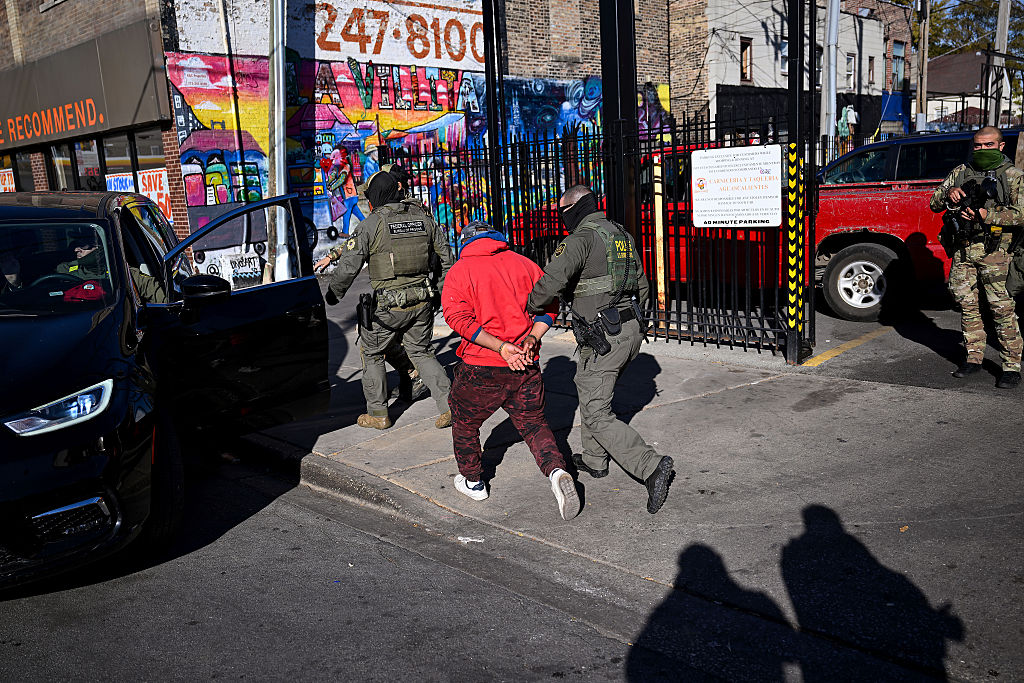
Chicago is entering a tense and uncertain chapter in President Donald Trump’s immigration crackdown, even as the city moves past the most intense stretch of federal enforcement that saw thousands of arrests across the region.
According to The Associated Press, for more than two months, Chicago and its suburbs were the center of an aggressive operation led by Gregory Bovino, a U.S. Border Patrol commander known for controversial enforcement surges in other major cities.
His agents — armed, masked, and often traveling in unmarked SUVs — fanned out across the metro area, using helicopters and rapid-response teams to target suspected criminals and immigration violators.
Although Bovino has since been reassigned to North Carolina, federal agents continue making arrests throughout the nation’s third-largest city. And for many Chicagoans, particularly in immigrant-heavy neighborhoods, the anxiety has not faded.
“I feel a sense of paranoia over when they might be back,” said Santani Silva, who works at a vintage store in Pilsen. “People are still afraid.”
At the height of the crackdown, activists documenting enforcement activity said they confirmed 142 daily sightings of federal agents. Since Bovino’s departure, that number has dropped to about six a day. But advocates say the lower count doesn’t mean the threat has passed.
“It’s not over,” said Brandon Lee of the Illinois Coalition for Immigrant and Refugee Rights. “I don’t think it will be over.”
Broadview, a small suburb long home to an ICE processing center, has borne the brunt of the turmoil. Protests outside the facility escalated as federal agents deployed chemical agents that drifted into nearby residential areas. Broadview police opened three investigations into federal tactics, and Mayor Katrina Thompson declared a civil emergency last week after the town received bomb threats, death threats, and reports of escalating aggression.
“I will not allow threats of violence or intimidation to disrupt the essential functions of our government,” Thompson said.
The Department of Homeland Security has highlighted more than 3,000 arrests since the surge began, but public data tells a more complicated story.
According to federal records provided to the courts, only 16 of 614 recently detained immigrants — less than 3% — had criminal histories deemed to pose a “high public safety risk.”
That discrepancy has fueled a wave of lawsuits, including challenges to the use of force and allegations about conditions inside the Broadview facility.
Clergy members recently sued the administration for blocking them from ministering inside one detention center. Prosecutors have also dropped multiple cases against protesters and bystanders swept up in chaotic encounters.
Federal agents are also under scrutiny for a pair of high-profile shootings. In one case, charges were dismissed against a woman shot several times by a Border Patrol agent.
In another case, ICE agents fatally shot Silverio Villegas González, a suburban man and longtime U.S. resident, during a traffic stop. An autopsy found he died from a close-range gunshot to the neck. His death was ruled a homicide.
Despite the fear lingering in many neighborhoods, some businesses are seeing glimmers of recovery. Andrea Melendez, who owns Pink Flores Bakery and Cafe, said sales have ticked up after months of steep declines.
“As a new business, I was a bit scared when we saw sales drop,” she said. “But this week I’m feeling a bit more hope that things may get better.”
Eleanor Lara, 52, said she has avoided unnecessary trips for months out of fear of encountering immigration agents. Although she is a U.S. citizen, she carries her birth certificate everywhere. Her husband, who is from Venezuela, is still waiting for his immigration status to be resolved.
“We’re still sticking home,” she said.












