



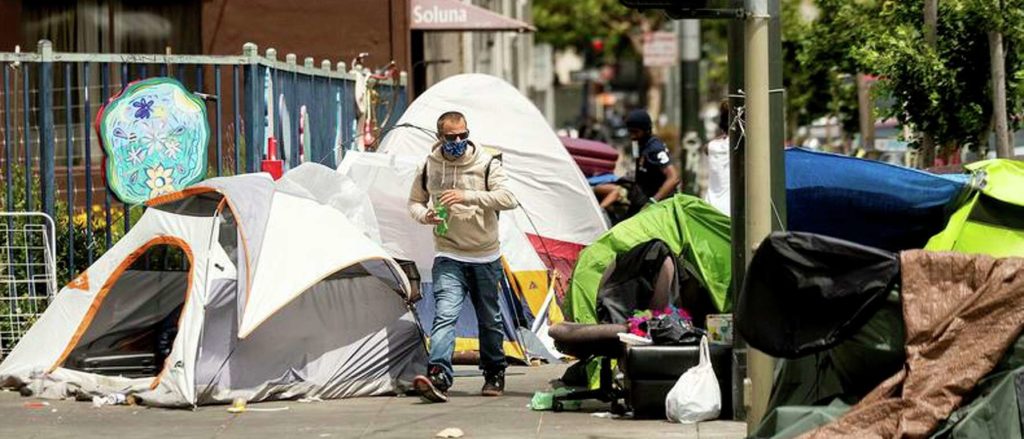

Democratic Gov. Gavin Newsom touted a 9% decline in homelessness during his final state address based on dubious data that omitted nearly half the state.
Throughout Newsom‘s term, California has maintained the highest homeless population in the country. Entering office in 2019, Newsom pledged to launch a Marshall Plan for affordable housing and “lift up the fight against homelessness from a local matter to a state-wide mission.”
“We face a gulf between the rich and everyone else – and it’s not just inequality of wealth, it’s inequality of opportunity. A homeless epidemic that should keep each and every one of us up at night,” Newsom stated during his 2019 inaugural address.
With his final year in office now in full motion, the Democratic governor stated on Jan. 8 that his administration calculated data reported to the U.S. Department of Housing and Urban Development (HUD), finding that the state reduced its unsheltered homeless population by an estimated 9%.
Although the press release states the data comes from 30 Continuums of Care (CoC), a regional planning body that collects the data, it neglects to mention that the state has a total of 44 CoCs covering 58 counties. This leaves 14 CoCs, an estimated 46.6%, of the data in limbo until HUD releases its full report.
Newsom’s office did not respond to the Daily Caller News Foundation’s request for comment.
HOW IT WORKS
In order for HUD to release annual reports on official homelessness data for California, the state uses federal CoCs that cover specific areas.
As part of HUD’s framework, the CoCs in California were established in the 1990s to coordinate competitive homeless assistance funding under the McKinney-Vento Homeless Assistance Act. The CoCs are federally required to coordinate local efforts to end homelessness, manage data, plan strategically and secure/allocate funding.
CoCs gathers the estimated total number of homeless people in each region they cover. The data collected is broken down by the total number of homeless people, sheltered homeless (i.e., staying in a supervised publicly or privately operated shelter or facility) and unsheltered homeless (i.e., primary nighttime residence is a public or private place not meant for habitation).
Notably, CoCs conduct their count of unsheltered homeless using a Point-In-Time (PIT) snapshot.
Each CoC selects a specific night during the last 10 days in January to have fieldwork teams — a mix of volunteers, paid staff and outreach workers — physically count people sleeping in places like streets, vehicles, abandoned buildings and encampments.
Although brief interviews with people on the streets are allowed if they engage willingly, the teams are typically instructed not to enter private spaces like tents and cars.
There are concerns about undercounting those who are not seen on that particular night, as well as those in tents and encampments as teams are typically instructed not wake people and must rely solely on visible and known locations.
As part of HUD’s requirements, CoCs do not have to count unsheltered homeless people annually and instead may do so biennially, leaving many to wonder about the accuracy of the data as California’s homeless population has drastically increased over the years.
NEWSOM’S DATA
In September 2025, the chief executive officer Joe Colletti at Hub for Urban Initiatives released a report on the 30 CoCs with fully completed data, showing a statewide decrease in the homeless population of roughly 4.3%. Of the 30 that submitted their data, one had completed its report but had yet to publicly release the details.
The remaining 14 CoCs completed their sheltered count but will use 2024 data for their unsheltered numbers, per the biennial allowance. While the names of the 14 CoCs yet to publicly release data weren’t explicitly named, some believed to be among them include the San Francisco area, Oakland and Alameda County and the Sacramento area, each known to have a large homeless population.
Among those officially reported is one of California’s largest CoCs, Los Angeles. According to the original data submitted to HUD in 2025, Los Angeles’ CoC, managed by the Los Angeles Homeless Services Authority (LAHSA), reported 67,918 total people experiencing homelessness in the greater Los Angeles area. Of the total, 23,503 were counted as sheltered homeless and an estimated 44,413 as unsheltered.
But changes had to be made. After the initial report was sent to HUD, adjustments — which LAHSA described as “statistically insignificant” — were made, resulting in a net downward revision for some categories but upward for others.
According to LAHSA after the HUD review, the sheltered homeless count was revised downward by 141 people, from 23,503 to 23,362. The unsheltered count was revised upward by 37 people, making the official count roughly 47,450. The total number of homeless people was also revised downward, dropping from 67,918 to 67,777.
CONCERNS ABOUT LA DATA
Following LAHSA’s data submission to HUD, the RAND Corporation, an American nonprofit global policy think tank, released its own independent report on PIT counting in October 2025.
In their review, which heavily criticized the growing inaccuracies of the official count, researchers conducted their own count using professional teams through their ongoing project known as the Los Angeles Longitudinal Enumeration and Demographic Survey (LA LEADS).
Notably, the count included only three neighborhoods within Los Angeles: Hollywood, Venice and Skid Row.
According to their data, the 2025 LA PIT count showed a 32% undercount of unsheltered homeless people in the three neighborhoods, up 26% from their 2024 count.
“An extrapolation of the 2025 undercount in three neighborhoods to the city as a whole shows that up to 7,900 persons and dwellings may be missing from LA’s most recent official homelessness count,” the report states.
Of the widest gap in the neighborhoods examined, PIT captured only 61% of the homeless population that LA LEADS estimated in Skid Row, with Hollywood at 81% and Venice roughly at 76%.
According to RAND, the PIT’s undercount has worsened due to growth in rough sleeping areas. With errors in the homeless count, per RAND, the issues of homelessness become harder to understand and to determine if programs are working well.
RAND stated that ironically part of the problems stem from programs the city has set up and invested in, like Inside Safe housing, which gives people in tent encampments a motel room to live in.
While the program has helped cut the number of tents in half since late 2021, according to its own tracking data, the program reduced visible tents but also removed people who were easier to spot and count. As a solution to the city’s issues, RAND suggested that “PIT organizers should rely more heavily on professional field teams to independently cross-check volunteer counts during the PIT.”
HOMELESSNESS ON THE RISE
With concerns about inaccuracies in homeless counting and what the state’s true total is, data shows that homelessness grew during most of Newsom’s time in office.
HUD data from 2019, his his full first year in office, showed roughly 151,000 people counted as homeless. By 2020 the estimated total number increased to about 161,548 people.
During 2021 there was no full PIT count in many areas due to COVID-19 and state lockdowns. However, by 2022 the state hit roughly 171,521 total homeless people, growing again the next year to an estimated 181,399 total.
California officially spiked at its highest point in 2024, hitting a total of 187,084 homeless people, making nearly a 24% increase in homelessness overall since Newsom entered into office. The 2025 preliminary data results show the first decrease of less than 5% in Newsom’s term in office.
The small decrease comes after the state spent approximately $24 billion over five fiscal years on programs like Homekey, Homeless Housing, Assistance and Prevention (HHAP) grants and other areas like housing development.
*Editor’s note: This article was corrected to reflect that RAND reported the unsheltered homeless count increased from 26% to 32% between 2024 and 2025 rather than by 26%.
All content created by the Daily Caller News Foundation, an independent and nonpartisan newswire service, is available without charge to any legitimate news publisher that can provide a large audience. All republished articles must include our logo, our reporter’s byline and their DCNF affiliation. For any questions about our guidelines or partnering with us, please contact [email protected].