



The fanfare faded almost as quickly as it began.
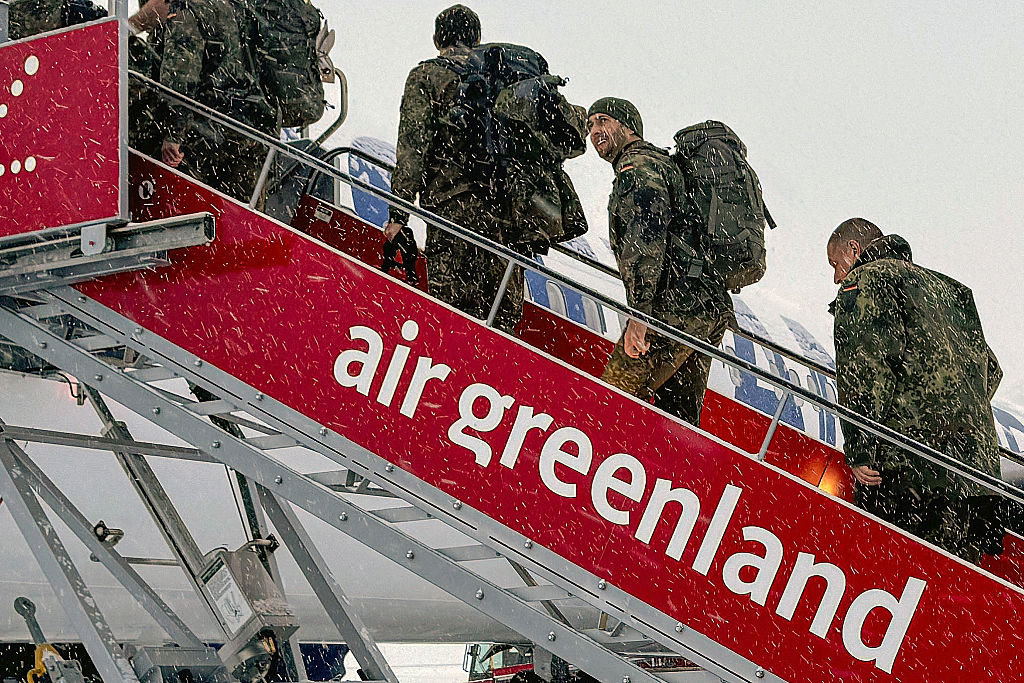
According to the New York Post, just days after German troops landed in Greenland for a closely watched NATO exercise, the soldiers quietly departed Sunday, boarding a commercial flight out of the Arctic territory less than 48 hours after their arrival.
The sudden exit came amid rising tensions sparked by President Donald Trump’s repeated threats to take control of the island.
Residents in Nuuk looked on as the uniformed German personnel filed onto a civilian aircraft instead of a military transport.
Some observers noted that about half of the troops were seated in business class, adding to the optics of an unusually brief and subdued deployment.
The German contingent had arrived as part of “Operation Arctic Endurance,” an exercise requested by Denmark and billed as a show of resolve following Trump’s warnings that the United States could seize Greenland if it deemed such a move necessary for national security.
German officials denied that the operation had been cut short, insisting the mission unfolded as planned and promising additional international coordination in the future. Still, the speed of the withdrawal raised questions about Europe’s appetite for sustaining a visible military presence in Greenland while tensions simmer between NATO allies.
The episode highlighted the delicate position facing European leaders as Denmark and the United States clash over the strategically vital island, which sits astride key Arctic shipping routes, contains valuable natural resources and rare earth minerals, and hosts significant U.S. military infrastructure.
Seeking to cool the situation, Denmark released a joint statement Saturday alongside Finland, France, Germany, the Netherlands, Norway, Sweden, and the United Kingdom.
“As members of NATO, we are committed to strengthening Arctic security as a shared transatlantic interest,” the statement said. “The pre-coordinated Danish exercise ‘Arctic Endurance’ conducted with Allies responds to this necessity. It poses no threat to anyone.”
The eight nations also reaffirmed their support for Danish sovereignty over Greenland, home to roughly 56,000 people, most of them Inuit.
“We stand in full solidarity with the Kingdom of Denmark and the people of Greenland,” the statement continued. “Building on the process begun last week, we stand ready to engage in a dialogue based on the principles of sovereignty and territorial integrity that we stand firmly behind.”
The message was widely seen as a direct response to Trump, who has recently escalated pressure on Denmark, including floating new tariff threats tied to Greenland.
“Tariff threats undermine transatlantic relations and risk a dangerous downward spiral,” the statement warned. “We will continue to stand united and coordinated in our response. We are committed to upholding our sovereignty.”
Despite the firm language, Germany’s rapid departure suggested Europe may be wary of converting symbolic military gestures into a prolonged standoff with Washington.
That hesitation contrasted sharply with public sentiment on the ground. On Saturday, several hundred Greenlanders marched in an anti-American protest toward the local U.S. Consulate, holding signs that read, “Yankee Go Home,” “F— Trump, F— [Vice President JD] Vance, F— USA” and “We are not for sale.”
Demonstrator Ivik Daorana questioned Washington’s rationale for annexation, noting the existing U.S. presence on the island.
“I think it’s nonsense, because the Danish own Greenland and said you can open more military bases here in Greenland if you’re concerned about the national security,” Daorana said. “But we don’t want to be part of the United States.”
“It does not make sense at all, because China and Russia — they don’t want to do with Greenland, and then Trump, he keeps talking about Russia and China,” he added.
As tensions continue to build, European Council President Antonio Costa called Sunday for an “extraordinary meeting” in the “coming days” to address the Greenland situation.
In a post on X, Costa said EU leaders agreed on unity behind Denmark and Greenland, respect for territorial sovereignty, opposition to tariffs that could “undermine” EU-U.S. ties, and a commitment to resist “coercion” while continuing to engage “constructively” with the United States.