



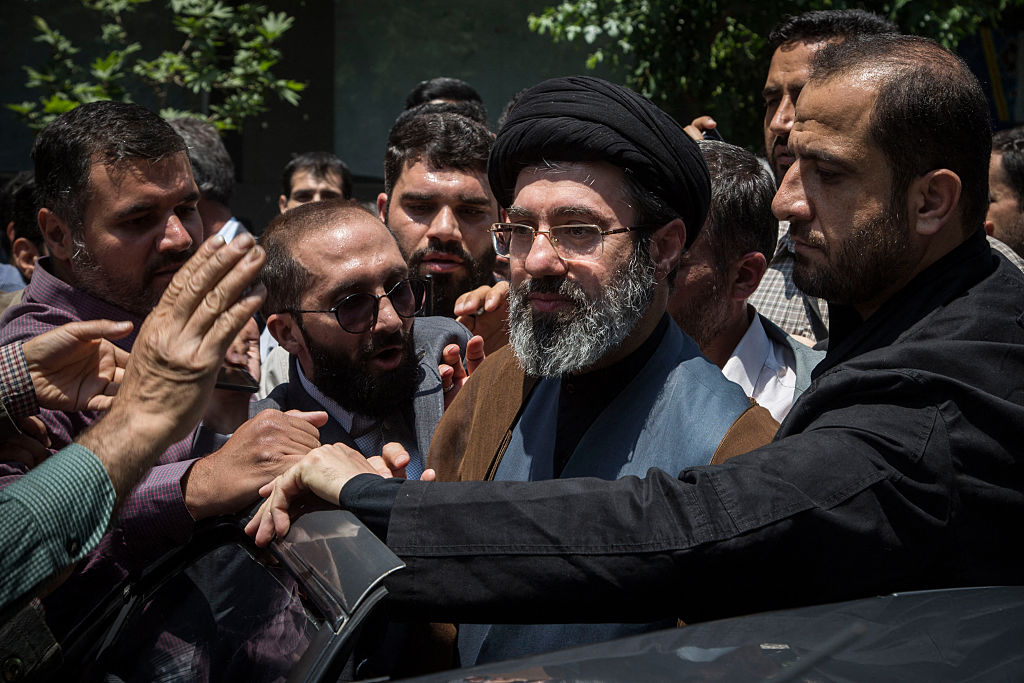
The selection of Mojtaba Khamenei as Iran’s new supreme leader has raised concerns among analysts who say his leadership could strengthen the country’s security establishment and continue the policies of his father.
According to Fox News, Mojtaba Khamenei, the son of longtime Iranian leader Ayatollah Ali Khamenei, has reportedly been chosen to lead the Islamic Republic following his father’s rule.
Some observers say the younger Khamenei has long wielded influence behind the scenes within the regime’s inner circle.
Kasra Aarabi, director of Islamic Revolutionary Guard Corps research at the advocacy group United Against Nuclear Iran, described Mojtaba’s role as already significant within the leadership structure.
“Think of Mojtaba Khamenei as his father on steroids,” Aarabi told Fox News Digital.
He said Mojtaba had effectively been operating as a powerful figure inside the office of the supreme leader.
“Mojtaba was already operating as a ‘mini supreme leader’ in the Bayt-e Rahbari — his father’s office and the core nucleus of power in the regime,” Aarabi said.
According to Aarabi, the elder Khamenei had built an extensive power network within that office designed to maintain continuity within the system.
“His father had created the Bayt’s extensive apparatus as a hidden power structure to ensure continuity should he be eliminated — and through Mojtaba’s appointment, this is exactly what we will get,” he said.
President Donald Trump also reacted to the development during an interview with the New York Post.
Trump said he was “not happy with” Mojtaba Khamenei becoming Iran’s leader but declined to say how the United States might respond.
“Not going to tell you,” Trump said. “Not going to tell you. I’m not happy with him.”
Questions have also surfaced about whether Mojtaba could pursue reforms inside Iran.
However, an Iranian source familiar with the leadership transition told Fox News Digital that such expectations now appear unlikely.
“Previously there were whispers suggesting that if Mojtaba were to become the leader, he might introduce reforms that would both open up the domestic political space and bring a more interactive approach to foreign policy,” the source said.
“However, now this possibility seems very weak.”
The source added that Mojtaba’s selection occurred amid internal disputes and pressure from Iran’s Islamic Revolutionary Guard Corps.
“Mojtaba was chosen amid disputes, controversies, and pressure from the IRGC,” the source said, adding that he “owes his appointment to their support and therefore cannot act against their wishes.”
Behnam Ben Taleblu, senior director of the Foundation for Defense of Democracies’ Iran Program, said Mojtba’s rise reflects long-developing trends inside the country’s power structure.
“Despite donning a turban, Mojtaba is the product of the regime’s national security deep state,” Ben Taleblu said.
“Expect him to work with and through the IRGC to keep his hold on power.”
Opposition figures also expressed doubt that the leadership change will bring new policies.
“He’s the son of Khamenei and they have same ideology and they same strategy and they try to continue the same policy,” said Khalid Azizi of the Kurdistan Democratic Party of Iran.
“So far it’s very difficult to say what he will be done and is he going to have a different policy? I don’t expect this.”
As Aarabi summarized, Mojtaba’s leadership may simply continue the path set by his father.
“In short,” he said, “Mojtaba is his father on steroids. He’s certainly no MBS.”