



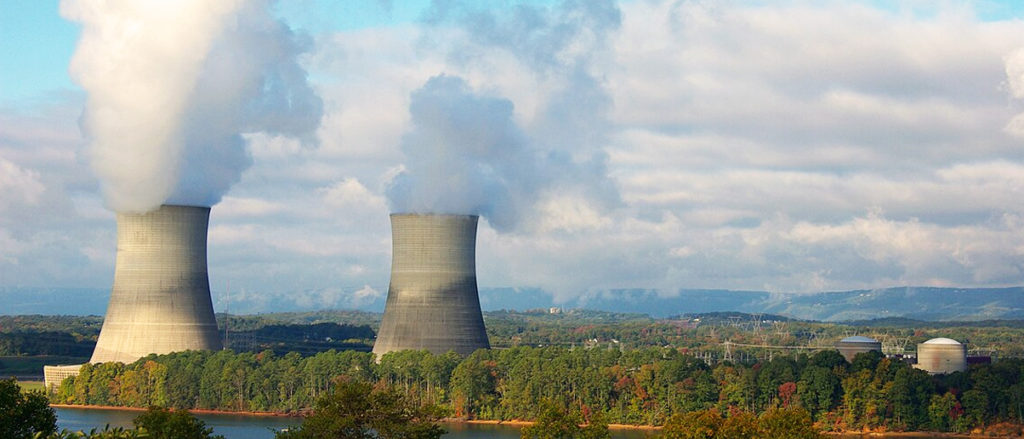

Two Appalachian states are pushing legislation to introduce nuclear energy to their coal-dominant energy grids.
Kentucky’s State Senate passed Senate Bill 57 on March 27, which would create a Nuclear Reactor Site Readiness Pilot Program to lay the foundation for bringing nuclear energy to the coal-dominant state. On the same day as SB 57’s passage, Republican West Virginia Gov. Patrick Morrisey approved House Bill 5381 which would expand the electrical grid through utilizing a plethora of different energy sources, including nuclear.
SB 57 would require the Kentucky Nuclear Energy Development Authority to make annual submissions to the General Assembly to grant funds to eligible partners looking to develop nuclear power facilities. The grants would cover 1/3 of the cost, up to $25 million, to apply for and procure permits, including early site approval, site construction, and operational licenses from the United States Nuclear Regulatory Commission.
Republican Kentucky State Sen. Danny Carroll, who sponsored SB 57, told the Daily Caller News Foundation that Kentucky’s nuclear goal would be to have a reactor running in 10 to 15 years. Carroll said coal will still play a massive role in the state’s energy production and will be vital in generating as much electricity as possible to efficiently transition to nuclear power.
Carroll said green groups have offered no major resistance to the bill, and that it enjoys support “across the board” in the state. “Nuclear is green energy, and we have established that in the Commonwealth,” said the Kentucky state senator.
“When you look at the newer technologies, [which are] much safer, the repurposing, recycling of spent fuel is getting to where it’s more advanced and so the issues of any waste or concerns about that are becoming less and less as we move forward in the technologies. When we get to where we’re producing nuclear fusion, energy that carries it to another level where waste is no concern at all. There is obviously no CO2 emissions from fission or fusion.”
HB 5381 would change the Office of Energy’s priorities from energy saving to energy independence and production. The West Virginia bill leverages all available energy technologies to achieve Morrisey’s goal to increase power production from 16 gigawatts to 50 gigawatts by 2050.
West Virginia’s Office of Energy must create a comprehensive long-term energy policy that embraces coal, natural gas, nuclear
energy, hydropower, hydrogen, and geothermal energy by Dec. 1, according to HB 5381. The policy must focus on increased reliability through stable baseload generation, improved efficiency via innovation, low-cost energy as the foundation for economic development, and energy independence and security through increased domestic production.
Both Kentucky and West Virginia lack nuclear power stations and rely heavily on coal for energy generation. West Virginia implemented a nuclear energy ban in 1996 over waste disposal concerns but repealed the ban in 2022, according to a report by Bowles Rice Energy Group.
“That’s really kind of part of the model we establish with this… whereby it’s a partnership between the state, utility, a nuclear developer, hyperscaler/AI data center, or some other manufacturer,” said Carroll. The state senator said there is a strong possibility that businesses building AI data centers would partner with Kentucky utility companies to help build the new energy projects.
Morrisey announced on Friday that he approved Google’s bid to open a data center in Putnam County, West Virginia. Morrisey said Google would pay 100% for the energy costs needed to run the data center and Google also pledged to replenish more water than it consumed by 2030, according to a West Virginia Governor’s Office press release.
The Trump administration has been aggressively pursuing energy policy to expand America’s generation potential. Interior Secretary Doug Burgum announced March 23 that the administration would cancel a Biden-era offshore wind farm. TotalEnergies will be reimbursed for the $1 billion they spent on the offshore wind project and reinvest the funds into U.S. fossil fuel energy projects.
All content created by the Daily Caller News Foundation, an independent and nonpartisan newswire service, is available without charge to any legitimate news publisher that can provide a large audience. All republished articles must include our logo, our reporter’s byline and their DCNF affiliation. For any questions about our guidelines or partnering with us, please contact [email protected].