



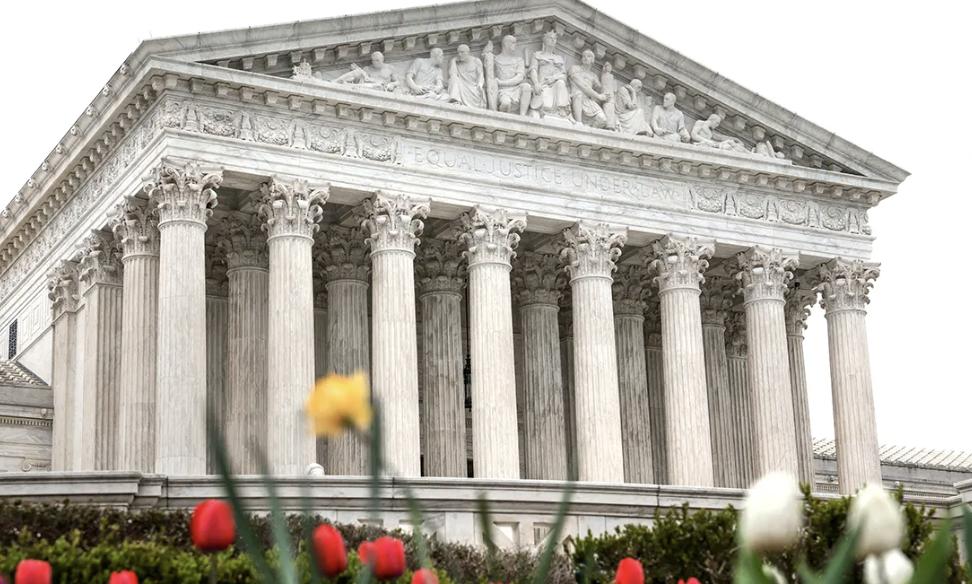
The Supreme Court is set to hear arguments in a case that could reshape how citizenship works in the United States, as justices consider the legality of President Donald Trump’s executive order aimed at ending birthright citizenship for certain groups.
Trump is attending the oral arguments in person, alongside Attorney General Pam Bondi. That alone is notable—no sitting president has previously shown up for Supreme Court arguments—underscoring how central this issue is to his administration’s immigration agenda.
The case, Trump v. Barbara, centers on an order signed on Trump’s first day back in office. It directs federal agencies to deny citizenship documents to children born in the U.S. if their parents are either in the country without legal status or are here on temporary visas, such as student or work permits. The policy would apply to children born after February 19, 2025.
At the heart of the dispute is the 14th Amendment, which states that anyone born in the United States and “subject to the jurisdiction thereof” is a citizen. For more than a century, that has generally been understood to guarantee birthright citizenship, regardless of a child’s parents’ immigration status. The Trump administration argues that this interpretation is too broad and that the clause was originally meant to apply more narrowly, particularly in the context of formerly enslaved people after the Civil War.
Opponents, including civil rights groups and immigration advocates, say the order conflicts directly with both the Constitution and long-standing Supreme Court precedent. They point in particular to the 1898 case United States v. Wong Kim Ark, in which the Court affirmed that a child born in the U.S. to noncitizen parents was still a citizen. That ruling has served as the foundation for modern interpretations of birthright citizenship.
Legal analysts widely expect the justices to grapple with that precedent, along with decades of consistent government practice and federal law, including the Immigration and Nationality Act of 1952, which mirrors the language of the 14th Amendment.
Beyond the constitutional questions, there are practical concerns. If the executive order were upheld, it could affect roughly 150,000 children born each year in the U.S. to noncitizen parents. It would also raise immediate questions about what legal status those children would have, since Congress has not established an alternative framework. Some justices have already expressed skepticism about how such a policy could be implemented, pressing government lawyers on how hospitals or state officials would determine a newborn’s citizenship status in real time.
The outcome may hinge on a few key members of the Court, particularly Chief Justice John Roberts and Justice Brett Kavanaugh, both of whom have shown an interest in preserving precedent in past cases. Their approach to balancing long-standing interpretations of the Constitution against the administration’s arguments could prove decisive.
A ruling in Trump’s favor would mark a significant shift in U.S. immigration policy and constitutional interpretation. A decision against the administration would reaffirm a long-established understanding of citizenship. Either way, the case is likely to have lasting consequences well beyond the current political moment.












