



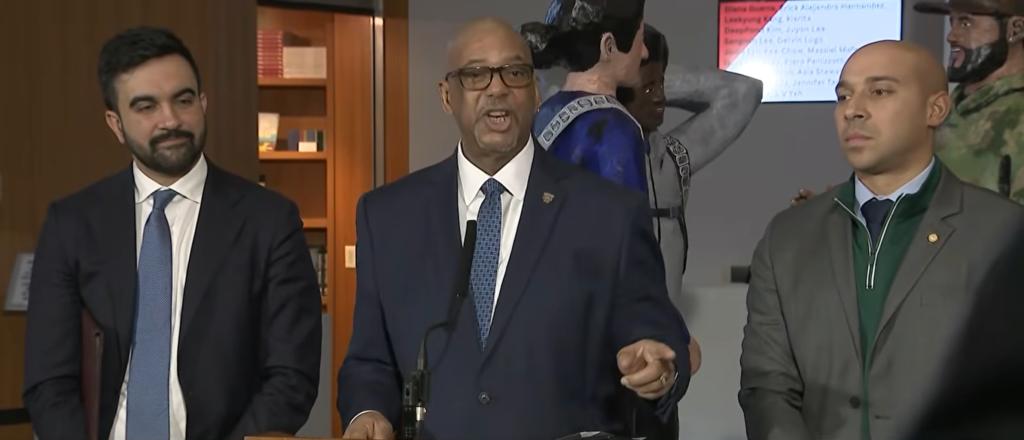

Stanley Richards finished his sentence for robbery in 1991 and joined a leftist charity focused on keeping criminals out of custody. Thirty-five years later, he runs the prison system in America’s largest city.
Democratic New York City Mayor Zohran Mamdani picked Richards as Department of Correction (DOC) commissioner in January, touting his liberal reform advocacy for the New York-based nonprofit Fortune Society. Richards was in and out of jail for years before he started climbing the ladder at Fortune Society from a counselor role to president and CEO by 2024, according to a Vice Magazine interview and his government bio. Along the way, he served a senior DOC role under former Democratic Mayor Bill de Blasio, his LinkedIn profile shows.
Richards’ work in the criminal reform movement even earned him recognition from the White House’s “Champions of Change” program under former President Barack Obama. The repeat offender’s career path shows how Fortune Society and Democratic politicians propelled him to a position that puts his anti-incarceration agenda into overdrive — one that critics fear will encourage lawlessness.
“We know what works to combat violent crime: policing and prosecuting criminals,” Heritage Foundation senior legal fellow Zack Smith, a former federal attorney, told the Daily Caller News Foundation. “Historic drops in NYC crime rates occurred during the early 90s by adopting a broken windows approach to crime. The idea that community safety can be improved without holding repeat violent offenders appropriately accountable is nonsense.”
Mamdani’s office, Richards and Fortune Society did not respond to multiple requests for comment from the DCNF.
“This appointment is an opportunity to lead from the top, advocating for both incarcerated individuals and correction officers to create safer jails and real pathways to rehabilitation,” Richards said in the January announcement by Mamdani’s office. “This is a chance to drive upstream change, connecting people to services like those at Fortune Society that transformed my own life.”
‘Jail Does Not Equal More Public Safety’
Richards’ former employer continues to fight harsh crime-related policies via relationships with government officials, testimony to lawmakers and lawsuits claiming it is racist for businesses to factor criminal records into housing or employment. Meanwhile, the nonprofit enjoys heaps of taxpayer money for ostensibly charitable services.
Fortune Society received $215,913,766 in government funding from mid-2019 to mid-2024, its latest tax filings show. Federal, state and local agencies have poured money into the nonprofit for decades to provide resources such as “homeless assistance,” housing opportunities for ex-inmates and drug addiction treatment for the “justice-involved,” according to public spending records. New York City awarded the nonprofit more than $3 million in fiscal year 2026 to assist the city’s “Alternatives to Incarceration” program, which keeps thousands of criminals out of jail even with certain violent and non-violent felonies.
Mamdani and Richards are now moving to address the city’s vast public safety problems with more leniency toward criminals.
Richards oversees Mamdani’s mission to shut down Rikers Island, one of the nation’s largest jail facilities — and his former home as a convict, the mayor’s office said in January. Richards’ agency will encourage courts and prosecutors to let more criminals pay their debts to society without being locked up, leading to “responsible population reduction” at jails, he told city councilors in a March hearing.
While at Fortune Society, the activist was included in a 27-member city panel — dubbed the Lippman commission — that recommended closing Rikers in 2017 due to reports of rampant inhumane conditions. The report also rebuked incarceration in general.
“For more than 20 years, New York City has successfully driven down both crime and incarceration, a trend which has continued under Mayor Bill de Blasio,” the commission wrote. “The City has proven that more jail does not equal more public safety. Indeed, an emerging body of research suggests that jail can actually undermine public safety, encouraging criminal behavior and undermining the stability of families and communities.”
The Lippman Commission’s claims did not age well, with the city still recovering from a COVID pandemic-era crime spike since 2020, New York Police Department (NYPD) data show. The pandemic coincided with a wave of liberal criminal reform policies passed at the city and state level in 2020, including expansions of pretrial release that Richards promoted as a senior Fortune Society employee.
Misdemeanor crimes and the city’s seven “major” felonies were higher in 2025 than in 2019, while “non-seven major” felonies such as arson and certain sex crimes were at their highest in 17 years, the NYPD found. The Big Apple’s recovery from 2020 “has been slower than that of many peer cities,” especially in specific areas, according to a February analysis by local think tank Vital City. Alarmingly, felony assaults are the most frequent they have been since 1997.
Opening The Floodgates
New York City diverted about 4,000 people from jail through its Alternatives to Incarceration annually for its first three years, the city’s website says. It has served more than 35,000 defendants since expanding in 2020.
Richards and the Lippman Commission argue diversion is often necessary because incarceration breeds more criminals, a claim lacking evidence, Manhattan Institute senior fellow Charles Lehman told the DCNF.
“That claim is confusing observations about the average offender detained pre-trial — for whom, yes, jail can be criminogenic — with what’s true about all offenders,” the public safety researcher said.
New York state law allows pretrial detention only for the most violent offenders and those who are a flight risk, Lehman noted.
“It is unlikely that jail is criminogenic for such people, and even if it is, it is hard to argue that the public safety costs outweigh the benefits in their situation,” he told the DCNF. “No, you shouldn’t put everyone in jail. But you do need to put some people there, and it’s bad public policy to generalize from one to the other.”
Rikers Island is legally required to close by August 2027, but Lehman and Richards alike worry that the city will not finish building the network of smaller jails needed for its inmate population by that time. Construction is slated to cost $5 billion over budget, and the city does not expect to finish the first of the four jails until 2029, City & State reported.
Releasing more inmates ought to make the situation easier, Richards told lawmakers in March.
“We can’t punish our way into compliance,” he said of the justice system. “I think we have to start in a different way.”
All content created by the Daily Caller News Foundation, an independent and nonpartisan newswire service, is available without charge to any legitimate news publisher that can provide a large audience. All republished articles must include our logo, our reporter’s byline and their DCNF affiliation. For any questions about our guidelines or partnering with us, please contact [email protected].