




National Library Week (April 19–25) arrives each year with cheerful slogans about literacy, community and the joy of reading. But behind the celebration stands the American Library Association (ALA), an organization that has shifted dramatically from its original mission. Today, the ALA functions less like a professional association and more like an activist hub advancing a highly ideological agenda — one that increasingly conflicts with the values of American families and the constitutional rights of parents.
This is not speculation. It is openly acknowledged by the ALA’s own leadership. The organization’s recent president has publicly described herself as a “Marxist lesbian,” a label she embraces as part of her political identity and governing philosophy. Her statements are not the issue; her ideology is. When the head of the nation’s most influential library organization proudly aligns herself with Marxist principles — a worldview fundamentally at odds with parental authority, individual liberty and local control — it raises legitimate questions about the direction of the ALA and the policies it promotes.
And those policies increasingly undermine the rights of parents and the legal protections afforded to minors.
For more than a century, the U.S. Supreme Court has affirmed that parents have the fundamental right to direct the upbringing, education and moral development of their children. Cases such as Pierce v. Society of Sisters (1925) and Troxel v. Granville (2000) make clear that this authority does not originate with the state. Parental rights are fundamental, inferred by the Constitution in the rights bestowed on us by our Creator as opposed to being specifically enumerated.
Yet the ALA’s policy framework treats parents as intruders rather than primary stakeholders. The organization routinely encourages libraries to adopt policies that give minors unrestricted access to sexually explicit or developmentally inappropriate material, even over parental objections. When parents raise concerns, the ALA does not engage them as partners. It labels them “book banners,” “censors” or “extremists.”
This is not merely dismissive. It is legally backwards. Public institutions do not have the authority to override parental rights simply because an activist organization urges them to.
The left has executed one of the most effective rhetorical maneuvers in recent political memory: redefining any parental objection as a “book ban.” By collapsing all distinctions — between adult and minor, between access and placement, between removal and relocation — they have created a narrative in which even the most reasonable boundaries become authoritarian threats.
But the law draws distinctions for a reason.
Courts have long recognized that the government has a legitimate interest in protecting minors from obscene or sexually explicit material. Public schools and libraries are not required to provide children with unrestricted access to everything ever printed. They never have been.
Parents who object to graphic sexual content in a children’s section are not banning books. They are exercising their constitutional right — and moral duty, ordained to us by God — to protect their children.
The ALA’s “book ban” narrative is not a defense of freedom. It is a political weapon designed to silence parents and shield ideological content from scrutiny.
Public libraries and school libraries are funded by taxpayers and accountable to local communities. They are not private advocacy groups. Yet the ALA encourages libraries to adopt policies that elevate activist priorities over community standards and parental authority.
When a national organization with openly ideological leadership pressures local institutions to disregard parental concerns, it is not promoting intellectual freedom. It is undermining democratic accountability.
National Library Week, in this context, becomes less a celebration of literacy and more a branding exercise — a way to sanctify the ALA’s agenda and portray any criticism as an attack on libraries themselves.
The ALA’s recent president’s self‑description as a “Marxist lesbian” is not relevant because of her identity. It is relevant because Marxism is a political ideology that rejects the primacy of the family, elevates the state over parental authority, and views children as instruments of social transformation.
When the leader of the nation’s most influential library organization embraces that worldview, it is reasonable to ask how it shapes the ALA’s policies — especially its insistence that librarians, not parents, should determine what minors can access.
This is not about personal attacks. It is about transparency, governance and the ideological direction of an organization that wields enormous influence over public institutions.
Conservatives should be clear, confident and unapologetic:
- Protecting minors from graphic sexual content is not censorship. It is a legal and moral obligation.
- Parents have a constitutional right to guide their children’s education and exposure to sensitive material.
- Taxpayer‑funded institutions must respect community standards, not override them.
- The ALA’s leadership and policies reflect an ideological agenda, not neutral librarianship.
- The “book ban” narrative is a political strategy designed to silence parents, not a reflection of legal reality.
National Library Week could be a unifying celebration of literacy and civic life. Instead, it has become a platform for an organization that seeks to redefine parental rights and reshape public institutions according to its own ideological commitments.
The debate is not about banning books. It is about who has the authority to protect children — and the law is clear: that authority belongs to parents.
Sheri Few is the Founder and President of United States Parents Involved in Education (USPIE), whose mission is to end the U.S. Department of Education and all federal education mandates. Few speaks regularly on radio and television across the country and served as Executive Producer for the documentary film titled “Truth & Lies in American Education.” Few is also the host of USPIE’s podcast, “Unmasking Government Schools with Sheri Few,” which educates Americans on the various forms of indoctrination, harmful policies and affronts to parents’ rights occurring in government schools across the country. Listen to “Unmasking Government Schools with Sheri Few” on YouTube,Facebook, Spotify and X.
The views and opinions expressed in this commentary are those of the author and do not reflect the official position of the Daily Caller News Foundation.
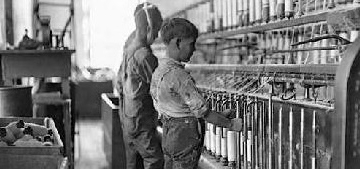
(Featured Image Media Credit:24-child-labor https://www.flickr.com/photos/88036768@N00/5574930304/in/photolist-9uCYy1-9YymQ2-ozgpWN-2oofSGi-bDy9r2-38SVaH-5MWgZp-9wq7RJ-2njRRRM-HgYdh-vvGFub-jtt5sx-5AkHQq-JYUrej-2sCJaT-aV15E2-djtoYP-7QST2E-Nqdvr-acFsbD-8S3L7y-2njUnkr-2njUmMn-2njT4GS-2njRW4S-8od4eg-dbAvD1-jduYhH-oJGH8G-dbArbM-9EQcJT-dbAvHf-4R1sTQ-dbAu6F-2o2y7nz-dbXWYJ-8RBiA2-AnmSoy-2oMce1j-eNUnDh-2UB3W7-4ihLZj-bYgbHW-9ETa1m-9uzYdz-68LxKS-r6TRJ-9E9zmp)
All content created by the Daily Caller News Foundation, an independent and nonpartisan newswire service, is available without charge to any legitimate news publisher that can provide a large audience. All republished articles must include our logo, our reporter’s byline and their DCNF affiliation. For any questions about our guidelines or partnering with us, please contact [email protected].