



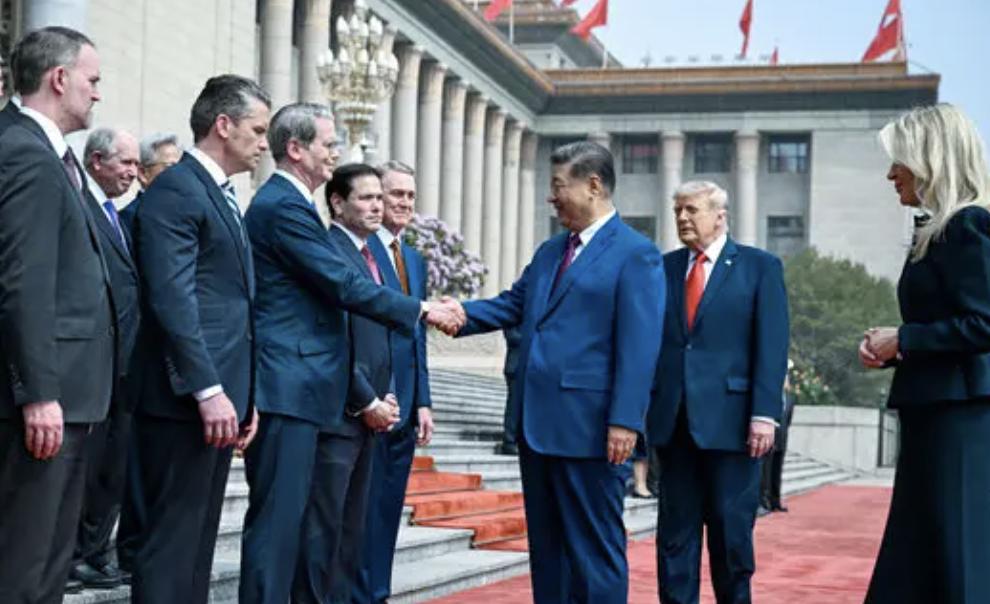
President Trump’s welcome in Beijing on Thursday closely mirrored the elaborate ceremony Chinese President Xi Jinping staged during his 2017 visit, but diplomatic experts say the atmosphere this time felt noticeably different.
While the formalities remained largely unchanged, the interaction between the two leaders appeared warmer and more relaxed than it did nearly a decade ago.
“What changed tonight was not the ceremony — it was the chemistry,” said Isabelle Vladoiu, founder of the US Institute of Diplomacy and Human Rights.
According to Vladoiu, Chinese officials intentionally preserved the same carefully choreographed state-visit format used during Trump’s first trip to China. The grand military displays, ceremonial greetings, and tightly controlled visuals all reflected Beijing’s traditional approach to high-level diplomacy. But beneath that structure, she said, the tone between Trump and Xi felt far more personal.
“Tonight’s ceremony appeared significantly more jovial, conversational, and personally interactive,” Vladoiu explained.
Trump traveled to China in 2017 during a five-country Asia tour focused heavily on trade tensions and concerns surrounding North Korea’s nuclear ambitions. This year’s summit carries a broader agenda, with discussions expected to include trade relations, fentanyl trafficking, tensions involving Iran, and Taiwan.
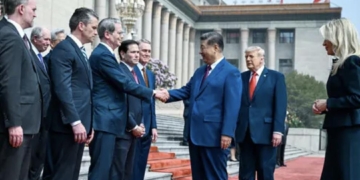
As in 2017, Xi greeted Trump on the steps of Beijing’s Great Hall of the People Thursday afternoon. The event featured a ceremonial military parade, children waving flags, and the playing of both national anthems.
Still, several moments stood out to observers.
“The handshake was longer, and the two leaders continued speaking while greeting and walking together,” Vladoiu noted.
Trump and Xi reportedly shook hands for around 15 seconds before Xi stepped back and Trump gave him a brief pat on the back — a small gesture that drew attention because of Xi’s typically reserved public demeanor.
“Xi Jinping — who is typically extremely reserved in public protocol settings — spent considerable time personally engaging with President Trump throughout the ceremony,” Vladoiu said.
One moment in particular caught her attention. Before entering the Great Hall, Xi paused beside Trump on the staircase and appeared to point out details about the ceremony and surrounding architecture while speaking with him.
“In Chinese protocol, warmth is often communicated not through the ceremony itself, but through the moments between the ceremony,” she explained.
Vladoiu also pointed to subtle visual symbolism during the visit. Trump swapped the blue tie he wore after arriving on Air Force One for his signature red tie before the ceremony began, visually matching China’s dominant ceremonial color palette.
Xi, meanwhile, wore a violet-purple tie, which Vladoiu suggested could carry symbolic meaning tied to the historic “Purple Forbidden City,” long associated with imperial authority in China.
Trump’s 2017 visit marked the last time a sitting US president traveled to China before Thursday’s summit.
“Overall, tonight’s protocol preserved the grandeur and parity symbolism of the 2017 visit while projecting a noticeably warmer and more conversational dynamic between the two leaders,” Vladoiu said.
Following more than two hours of bilateral meetings, Trump and Xi made a brief visit to Beijing’s Temple of Heaven, the 15th-century UNESCO World Heritage Site historically used by Chinese emperors for ceremonial prayers and rituals.
The two leaders are also expected to attend a formal state dinner later Thursday evening as the summit continues.