



Former members of an al-Qaeda-linked movement may be the unexpected winners of the Iran war as the naval conflict forces oil to be shipped by land rather than sea.
Iraq and Gulf states, including the United Arab Emirates, have begun shipping oil overland through Syria to reach Mediterranean ports, giving fees to the current Syrian regime, which consists of leadership with former Al-Qaeda ties, The New York Times reported. President Ahmed al-Sharraa’s movement, Hay’at Tahrir al-Sham (HTS), split from al-Qaeda in 2017, according to the Center for Strategic and International Studies. The State Department revoked the group’s Foreign Terrorist Organization designation in 2025.
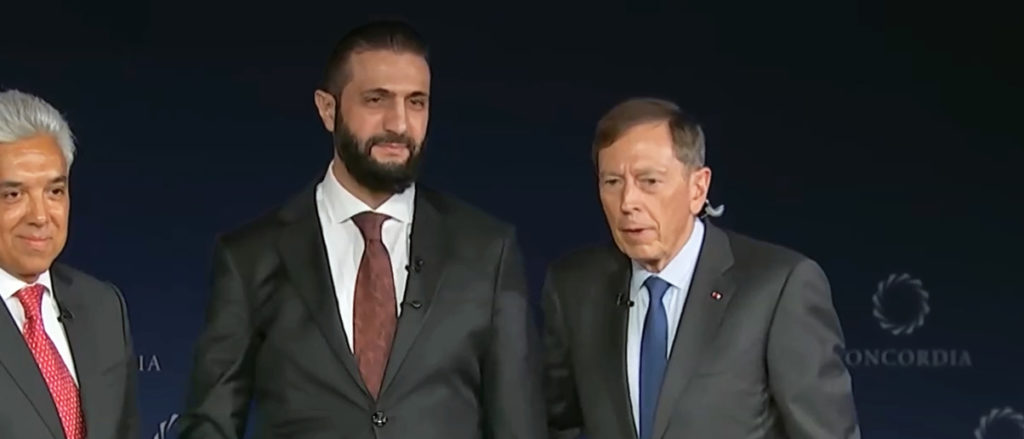
President Donald Trump invited the former terrorist al-Sharraa to the White House shortly after the U.S. normalized relations with Syria.
“President Trump thanked President Erdogan and the Crown Prince for their friendship, and told President Al-Sharaa that he has a tremendous opportunity to do something historic in his country. President Trump encouraged President Al-Sharaa to do a great job for the Syrian people,” White House press secretary Karoline Leavitt said in an X post on May 14, 2025.
Today, President Trump, at the invitation of Crown Prince Mohammed bin Salman, met with Syrian President Ahmad al-Sharaa. President Erdogan of Turkey joined by phone. President Erdogan praised President Trump for lifting sanctions on Syria and committed to working alongside Saudi… pic.twitter.com/0yhyZbQ1o0
— Karoline Leavitt (@PressSec) May 14, 2025
Al-Sharaa, once a member of al-Qaeda, fought as an insurgent against U.S. forces in Iraq and later led one of Syria’s largest Islamist armed groups before being welcomed by Trump in Washington, The Conversation reported on Nov. 12, 2025.
“The United States supports a Syria that is stable, unified, and at peace with its neighbors, as well as a Syria that denies safe haven to terrorist organizations and ensures the security of all minority groups,” a State Department spokesperson told the Daily Caller News Foundation. “The Department is reviewing our remaining terrorist designations related to HTS and Syria, in accordance with the President’s promise to deliver sanctions relief to Syria.”
“After the closure of the Hormuz Strait, pretty much all the neighboring countries in the region knocked on our door to get access to our Syrian ports,” Mazen Alloush, director of local and international relations for Syria’s borders and customs authority, told the Times. “They are making Plan B’s in case the crisis goes on longer.”
It has been well documented that Nusrah Front, the brainchild behind Hay’at Tahrir al-Sham’s creation, was responsible for hundreds of terrorist attacks in Syria over the years.
“Opposition armed groups began using car bombs and improvised explosive devices (IEDs), sometimes in suicide attacks, in areas under government control in 2012,” Human Rights Watch reported in 2015. “Initial attacks targeted state security forces and outposts, but the groups soon began to carry out bombings in populated areas without evident military targets.”
“Since November 2011, al-Nusrah Front has claimed nearly 600 attacks – ranging from more than 40 suicide attacks to small arms and improvised explosive device operations – in major city centers including Damascus, Aleppo, Hamah, Dara, Homs, Idlib, and Dayr al-Zawr,” former State Department spokesperson Victoria Nuland said in a press release on Dec. 11, 2012. “During these attacks numerous innocent Syrians have been killed.”
‘Strong Backing’
Iraq’s state oil marketer SOMO finalized contracts to supply about 650,000 metric tons of fuel per month from April through June to be trucked overland via Syria, utilizing up to 400 tanker trucks per day, Reuters reported, citing a SOMO document.
“With strong backing from the Trump administration, Syria’s transitional government has emerged as a potentially vital component of a new and more interconnected Middle East — tying together Asia to Europe through a series of land corridors for energy, telecommunications, and commercial trade,” Charles Lister, the director of Syria and counterterrorism at the Middle East Institute, told the DCNF. “The recent conflict in Iran as well as persistent threats in the Red Sea have boosted Syria’s economic pitch and triggered many early moves to get involved, involving by American energy giants Chevron and ConocoPhillips, as well the UAE, Saudi Arabia, Qatar, Jordan, Lebanon, Iraq, Turkey and more.”
This deal is meaningful for Syria’s struggling economy, but it is not close to replacing the Strait of Hormuz.
More than 400 tanker trucks sometimes cross into Syria in a day, with each carrying up to 10,500 gallons of crude, the Times reported. Using 400 trucks as a benchmark, that comes out to about 4.2 million gallons, or 100,000 barrels, because one oil barrel equals 42 gallons.
By comparison, roughly 20 million barrels per day flowed through Hormuz on average in 2024, according to the U.S. Energy Information Administration. The trucks in Syria account for less than 1% of the oil that was flowing through the Strait of Hormuz based on these numbers.
“With major conflict raging across the region in recent months, Syria has had 10 successive weeks in which it has enjoyed the greatest level of stability in 15 years,” Lister told the DCNF. “By avoiding regional tensions and aligning with the U.S. and Europe, Syria’s pitch to be a hub for greater regional stability and prosperity has been significantly strengthened and the rush to engage is evidence that it’s working.”
Syria’s Latakia port reportedly began loading vehicles that arrived in transit from the United Arab Emirates via the Nasib border crossing for export to Europe, according to Syria’s state news agency, SANA.
But, electricity shortages, water shortages, banking problems and political uncertainty from 14 years of civil war continue to scare off investors, the Times reported.
“Ultimately, this is a long-term project requiring major infrastructure investment, but some of that has already begun, so a path is being paved as we speak,” Lister told the DCNF. “And should this all succeed, the benefits will not solely be Syrian — the region and beyond will reap the rewards, which is precisely why the U.S. government has backed this vision from the start.”
Editor’s note: This article has been updated to include comment from the State Department.
All content created by the Daily Caller News Foundation, an independent and nonpartisan newswire service, is available without charge to any legitimate news publisher that can provide a large audience. All republished articles must include our logo, our reporter’s byline and their DCNF affiliation. For any questions about our guidelines or partnering with us, please contact [email protected].