



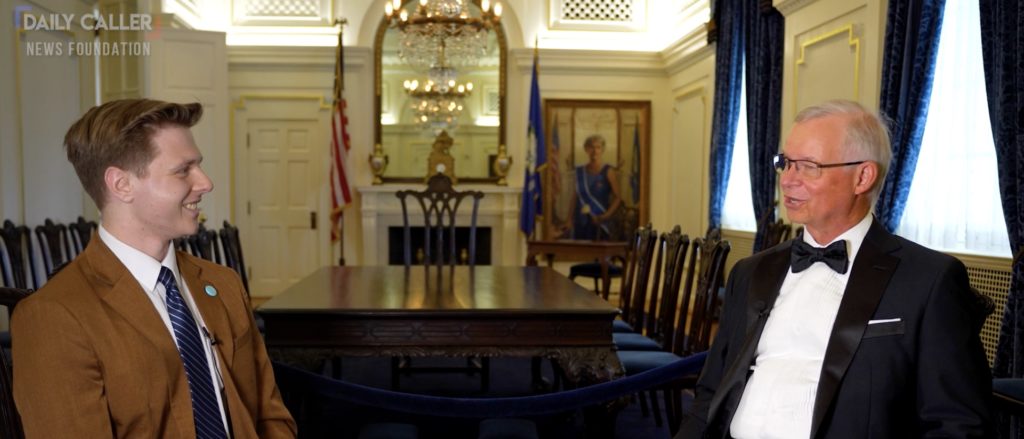

A senator, a rabbi and a professor walked into a concert hall to accept their 2026 Bradley Prizes on Thursday.
Former Republican Texas Sen. Phil Gramm, Rabbi Meir Soloveichik and Professor James Hankins discussed freedom, faith and Western civilization after receiving their Bradley Prizes, an award given to conservative champions of American exceptionalism. Bradley Foundation President and CEO Richard Graber discussed the prizes’ mission and each speaker shared personal stories inspired by foundational U.S. principles.
WATCH:
“Senator Phil Gramm, for decades, really for his entire life, has been a champion of free markets and capitalism,” Graber said. “And of the economic system we have in this country that has enabled so much for so many and is very reflective of what the Bradley brothers believed in.”
Graber noted that each of the recipients embodied a different component of the Bradley brothers’ vision for the U.S.: Gramm cherished free markets, Soloveichik freedom of religion and Hankins classical education.
Gramm was first to speak. Elected in 1978 to the House of Representatives as a Democrat before switching parties, Gramm served for 24 years in Congress. Among his legislative achievements is the 1981 Gramm-Latta Bill, which passed President Ronald Reagan’s first budget into law. The bill increased military spending amid the Cold War, codified tax cuts and instituted legally binding restrictions on federal appropriations.
“I take special pride in receiving the Bradley Prize because The Bradley Foundation is dedicated to promoting American exceptionalism, freedom, free enterprise and limited government,” Gramm said during his acceptance speech. “These are the values that I believe in and have taught, advocated and fought for all my life.”
“In accepting this great honor, it is so tempting to tell you my poor boy story. It is true that neither of my parents graduated from high school and my father was invalided when I was two years old and spent most of the rest of his life in the veterans’ hospital. But beneath this thin veneer of hard scrabble, I have lived a highly privileged life. I was born and grew up in America,” the former senator added.
Gramm shared stories from his childhood, noting his mother’s work ethic and admiration for successful individuals in their hometown. He also noted his educational difficulties and efforts to overcome them. Gramm went on to become a University of Texas A&M economics professor before founding his own consulting firm.
“My mother took the GI insurance she had received when my father died and sent me to Georgia Military Academy. The GI Bill and my mother’s sacrifice gave me what we would call today an education voucher,” the Texas Republican said in his speech.
“Our economic careers blossomed, we bought our dream home, had two children and everything we touched turned to gold. But while everything was great in our lives, I was increasingly unhappy with what was happening in America,” Gramm added. “I knew in the 1970s we weren’t running out of oil and gas. I wasn’t ready to learn to live on less. This was not the America I had signed on for.”
The former senator reflected on his life of service and the importance of free markets for a functional society.
“When I came to Congress the inflation rate was 13.3%, interest rates were 21.5%, unemployment was 12.2% and the Soviet Union was on the march all over the world,” Gramm said. “Almost a quarter of a century later, when I announced I was leaving the Senate, we were in a 40-year period of price stability, the economy was booming, the budget was balanced and the Soviet Union was on the ash heap of history.”
President Graber told the DCNF that Rabbi Soloveichik served as “an incredibly eloquent spokesperson for religious liberty, really very effectively making the case that religion in our country is central to who we are as opposed to just something that’s out there.” The rabbi’s remarks emphasized faith’s importance in establishing and maintaining a free country.
“Sitting in Newark airport, I received a call from Rick Graber informing me that I had been awarded the Bradley Prize,” Soloveichik began. “Rick had, in that moment, achieved a miracle: he had rendered a rabbi speechless. Tonight, Rick has charged me with seeking something even more miraculous: a rabbi speaking for only ten minutes.”
Soloveichik serves New York’s Congregation Shearith Israel as its rabbi, leading the oldest Jewish congregation in the United States. He is also Director of the Straus Center for Torah and Western Thought at Yeshiva University and a Senior Fellow at Tikvah.
“America’s 250th anniversary is a summons to renewal, to recommending the virtues of our past to our posterity. Thus, in this year of the American semiquincentennial, I am so moved to receive the Bradley prize: not only because Bradley seeks to preserve the exceptional nature of America; but also it has done so much to sustain the future of education in America about America,” Soloveichik said during his speech. “The former depends on the latter. Memory is indeed the guardian of liberty.”
Soloveichik detailed education’s importance in transmitting patriotic values across generations.
“The vision of equality and liberty at the heart of Jefferson’s declaration will only endure if, like Adams, we see ourselves as part of a continuum and evoke to our children the qualities of those who have preceded us. The former cannot be attained without the latter, especially in our moment, when the spirit of the Founding is endangered,” the rabbi said. “Endangered by an ahistorical assault on the Founding; and then, there is the specter of festering antisemitism, a poisonous sentiment that has destroyed so many societies in the past, and which is so contrary to the story of America itself.”
President Richard Graber also introduced Hankins. The professor’s public profile grew in December 2025, when Compact Magazine published his piece “Why I’m Leaving Harvard.” Hankins cited pervasive anti-white discrimination, an antisemitic campus environment and Harvard’s responses to COVID-19 as primary reasons for his departure. He now teaches at the University of Florida’s Hamilton School for Classical and Civic Education.
“Professor James Hankins, one of the most distinguished scholars of Western history in the country, without question, makes the point over and over again that we need more of that kind of education,” Graber told the DCNF. “And there’s so much to learn from that, to have the ordered liberty that we all aspire to.”
I’m not quite so full of myself that I think I can single-handedly revive Western civilization,” Hankins’ speech began. “But I do think that we live in a moment when for the first time in decades, we have a fighting chance to restore the study of Western civilization in our schools and universities.”
“Education’s being re-imagined all over America and a rebellion is underway against the present educational establishment that offers us a rare opportunity for reform.”
Hankins extolled Western civilization’s aesthetic and moral accomplishments, reflecting on his role as founding editor of Harvard University Press’ I Tatti Renaissance Library. Hankins contrasted the medieval and renaissance periods with contemporary politics, issuing a rallying cry to his peers.
“We must oppose with the utmost firmness the Marxist utopian narrative which is the source of so much misery over the last two centuries with our own narrative of rebirth and resurrection that is so deeply rooted in the tradition of the West,” Hankins said. “Let’s revive the memory of our Western traditions. Let’s start a new renaissance.”
President Graber asked up-and-coming leaders to “celebrate free markets, celebrate our freedom of speech, freedom of religion” and also to “celebrate the Western history and the Western tradition and all that it can offer.”
“It’s there for all of our winners tonight,” Graber said. “And again, it really does reflect the Bradley Brothers, those two brothers from the east side of Milwaukee, who’ve been gone a long time.”
All content created by the Daily Caller News Foundation, an independent and nonpartisan newswire service, is available without charge to any legitimate news publisher that can provide a large audience. All republished articles must include our logo, our reporter’s byline and their DCNF affiliation. For any questions about our guidelines or partnering with us, please contact [email protected].