



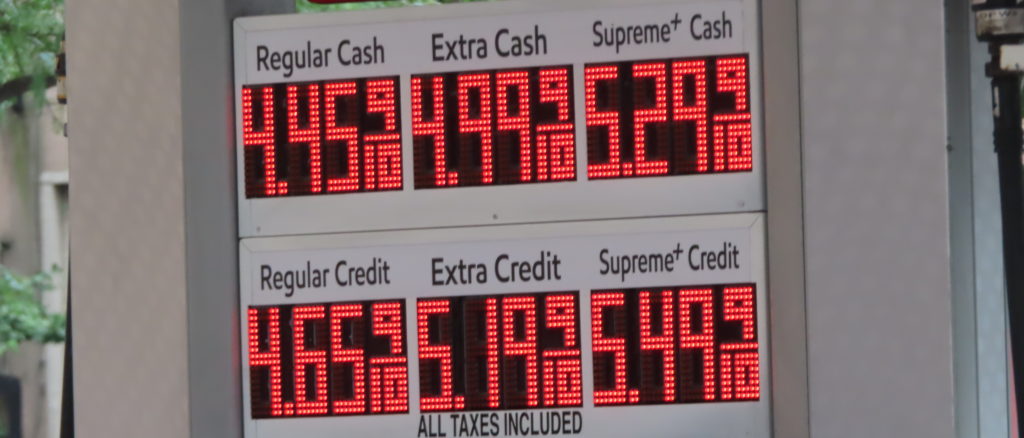

An oil executive warned on Thursday that global oil prices may soar even higher as reserves dwindle.
ExxonMobil Senior Vice President Neil Chapman delivered remarks on global energy markets at the Bernstein 42nd Annual Strategic Decisions Conference in New York. Chapman predicted a near $70 increase in oil prices if the Iran War continues to disrupt shipping lanes.
The U.S. has been negotiating with Iran to reopen the Strait of Hormuz since early April, and multiple outlets recently reported a deal is taking shape. An Iranian official and one other diplomat told The New York Times on Friday that a draft peace deal includes a U.S.-backed $300 billion reconstruction fund.
“Commercial inventories of crude oil, of liquids-linked petroleum, gasoline, diesel, jet fuel, they’ve all run down. And running down those inventories has mitigated or offset, supplemented by the release of strategic petroleum reserves, which most of the Western countries have done,” Chapman said. “We’re approaching unheard of inventory levels. I mean, really, really low levels. You can debate whether that’s going to hit those really low levels in 2 weeks or 3 weeks.”
“But once you get to that point, then you’ll see price shoot up. And I think dated Brent, most people will have modeled, would say dated Brent will shoot up. Once you get to that really low inventory level, up to $150, $160 [per barrel].”
Dated Brent refers to barrels marked for purchase and retrieval. It is the immediate cost of purchasing a barrel. Dated Brent costs roughly $91.71 per barrel as of May 29, according to Business Insider. Brent prices previously reached a 52-week high of $126.41 per barrel on April 30.
“What happens is when the price gets to a certain level, demand destruction brings it back into balance. Prices go so high, it becomes unaffordable and that’s what happens,” Chapman said. “And so we’re at that level right now, and I think crude being in the sort of $90 to $110 for the last whatever it is, 6 weeks has really been mitigated by running down inventories. Can’t last forever.”
The Department of Energy has authorized record Strategic Petroleum Reserve (SPR) releases via an exchange contract system. Companies are obligated to repay more barrels than they withdrew at their initial purchase. The SPR holds 365 million barrels as of May 22, according to the U.S. Energy Information Administration. Former President Joe Biden previously drew the SPR down to roughly 350 million barrels in 2022 amid the Russia-Ukraine War, its lowest level since the 1980s.
The SPR contained over 600,000 barrels when Biden took office.
“I think most people don’t really appreciate what’s happened. You take arguably 11 million or 12 million barrels a day of crude oil out of the global market. The market is about 100 million, 103 million, 104 million barrels a day. Normally, you’d see prices go through the roof. So what’s happened to mitigate that?”
“The Saudis maxed out on their East West pipeline. So they’re running 5 million barrels a day of crude from the east to the Red Sea and that obviously, you can get into the global market,” Chapman said. “I think what people appreciate less, there was a lot of sanctioned crude oil on the water. In other words, unsold. Iranian, Venezuelan — Venezuelan, Russian crude was — and that has now gone to the market, and that’s mitigated some of the loss of oil through the Strait of Hormuz.”
The Treasury Department announced its Economic Fury initiative on May 28, further sanctioning Iranian oil sales and state or non-state purchases of sanctioned crude. The announcement follows a previous advisory warning purchasers that paying Iranian tolls subjects them to U.S. sanctions.
Iranian-ally China has dramatically cut crude oil imports since Operation Epic Fury began in February, according to Reuters. The reduction eased pressure on global demand.
“While the Chinese have been building steadily a strategic petroleum reserve for years, consistently building it, our data would suggest they haven’t touched it very much during this crisis. They’ve managed to secure crude oil. They’ve managed to use commercial inventories within the country,” Chapman said. “They have a very large petroleum, strategic petroleum reserve, which they’ve obviously planned and built for a long, long time.”
All content created by the Daily Caller News Foundation, an independent and nonpartisan newswire service, is available without charge to any legitimate news publisher that can provide a large audience. All republished articles must include our logo, our reporter’s byline and their DCNF affiliation. For any questions about our guidelines or partnering with us, please contact [email protected].