



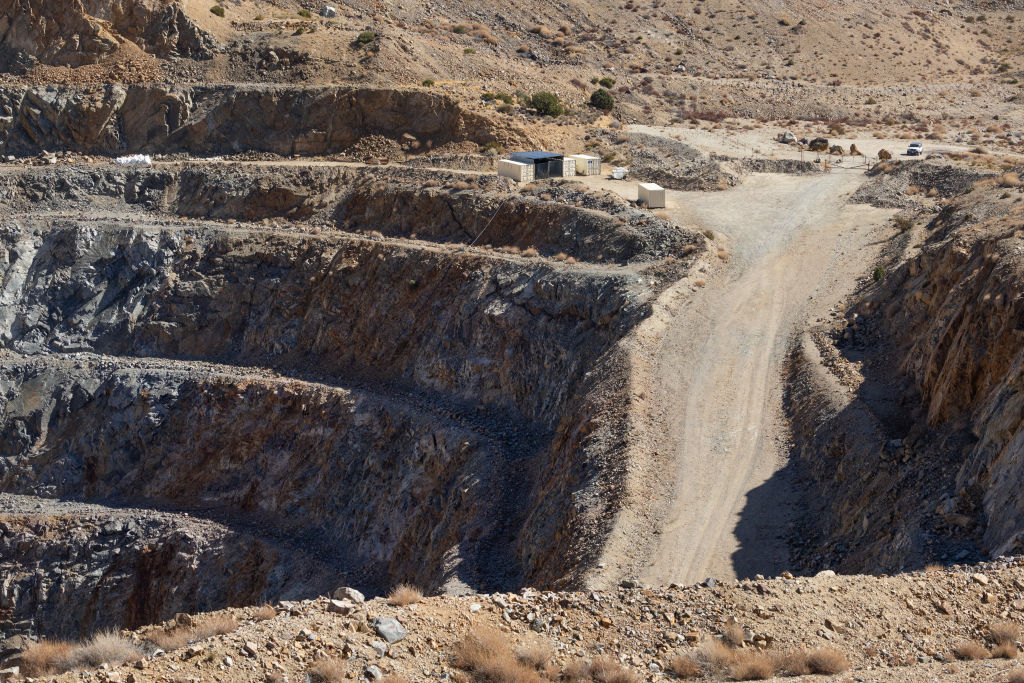
At the edge of California’s Mojave Desert, the Mountain Pass mine looks like any other stretch of dust and rock. But for decades, this unassuming pit supplied the rare-earth elements that power everything from smartphones to fighter jets.
According to Fox News, in the 1980s, Mountain Pass met nearly two-thirds of global demand, giving the United States a quiet but decisive technological edge.
Then it all collapsed.
Tougher environmental rules and a flood of cheap, state-subsidized Chinese production pushed the mine offline. Processing plants rusted. Workers left. And the world’s leading economy suddenly found itself dependent on its top strategic rival for the minerals essential to modern warfare.
China understood the stakes early.
“The Middle East has oil; China has rare earths,” former Chinese leader Deng Xiaoping said in 1987.
Today, Beijing controls roughly 70 percent of rare-earth mining and nearly 90 percent of refining — the most valuable and strategically important link in the chain.
The U.S. didn’t just fall behind; it gave away the crown jewels. In 1995, General Motors sold Magnaquench, a company producing 85 percent of the magnets used in precision-guided weapons, to a group that included Chinese buyers.
Within a year, the technology had migrated to China, and the U.S. magnet-making capability vanished.
Abigail Hunter, who leads the Ambassador Alfred Hoffman Jr. Center for Critical Mineral Strategy at SAFE, said the sale symbolized a deeper problem. “We were focused on the internet and globalization, not on where our materials were coming from,” she said. “Policy became episodic rather than strategic.”
Meanwhile, China poured massive investments into innovation, refining, and manufacturing.
“Our total capacity was under 2,000 metric tons a year,” said Wade Senti, president of Advanced Magnet Lab. “China moved at a scale that far exceeded what we ever had.”
By the early 2000s, the U.S. mining and refining base had nearly disappeared. China didn’t just mine the minerals — it mastered the high-value processing that turns them into powerful magnets used in nearly every modern weapons system.
“They steer missiles, power radar, and drive the night-vision goggles Marines wear in the field,” Hunter said. “If it moves, sees, or communicates in today’s military, there’s probably a rare-earth element in it.”
Washington’s attitude shifted rapidly this year after Beijing temporarily restricted rare-earth exports. Factory lines in the U.S. stalled. The administration scrambled to negotiate with China and simultaneously expanded support for MP Materials, the operator of Mountain Pass.
That support marked a turning point.
For the first time, the federal government committed to rebuilding an end-to-end rare-earth supply chain — from mining to magnet production. MP Materials, which restarted operations in 2018, is expanding refining and magnet manufacturing in Texas.
A second manufacturer in South Carolina is also coming online.
But the road back is long. “It’s a ten-year project,” Hunter said. “We’re nowhere near self-sufficiency.”
The Trump administration has elevated the effort, taking a 15 percent stake in MP Materials and launching an international campaign to cut China out of critical supply chains.
New agreements with Australia, Japan, South Korea, Rwanda, the Democratic Republic of the Congo, and Ukraine form the most aggressive U.S. mineral diplomacy push since the Cold War.
Still, officials warn that true security depends on domestic rebuilding.
A 2027 Pentagon mandate requires a fully American rare-earth supply chain for defense production — with no Chinese inputs. That means new mines, new refineries, and a workforce that hasn’t existed in decades.
“The international deals may buy time,” Senti said. “But they’re no substitute for restoring the industrial base that once made us the world’s undisputed source of strategic minerals.”












