



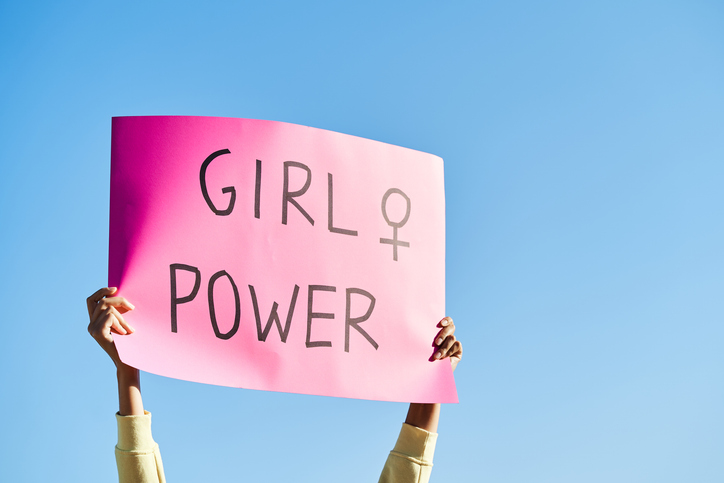
A longtime writer who has spent years studying the intersection of culture and faith says modern feminism has transformed into something far larger — and far more dogmatic — than a simple social movement.
According to Fox News, Carrie Gress, a fellow at the Institute for Human Ecology at Catholic University of America, argues that today’s feminist ideology has taken on the characteristics of an organized religion.
In an interview with Fox News Digital, she said the movement has grown into a belief system that mirrors the structure and rituals of faith traditions while promoting values she believes stand in direct conflict with Christianity.
Gress is preparing to release her new book, Something Wicked: Why Feminism Can’t Be Fused With Christianity, which outlines her case. She says feminism has “quietly captured the minds and hearts of women by mimicking aspects of Christianity,” adopting its own set of doctrines and practices.
“In many respects, it can actually be seen as a megachurch,” Gress said. “It has taken on so many of the aspects of Christianity.”
She argues that the framework was built into feminism from its earliest beginnings. According to her research, the movement’s foundational ideas were intended as a replacement for Christian teaching.
“So feminism has its own sacraments, virtues, rites, evangelization — all of that,” she said. “The simplest example is to look at what I call the ‘commandments of feminism.’”
Gress traces three of those “commandments” back to the early 1800s, connecting them to the ideas of romantic poet Percy Bysshe Shelley and his in-laws, Mary Wollstonecraft and William Godwin. She says those principles were “to have contempt for men, to really shun monogamy and to embrace promiscuity, and then to be involved in the occult.”
Critics outside her work have also drawn parallels between feminism and religious structures. A 2015 article in The Atlantic described the movement as having “startling similarity to religious fundamentalism,” citing what it called a culture of dogmatism and zeal.
Public figures have likewise framed feminism as a standalone value system. Rapper Nicki Minaj told The Cut that women should aim for full independence, saying, “You have to be able to know that you need no man on this planet at all, period.”
A Senegalese activist told an interviewer, “Feminism is my religion,” when describing how it shapes her moral decisions.
Some writings go further, claiming women are increasingly fulfilled outside of marriage or motherhood. A 2022 article in Medium argued that “women no longer need a man to make a living or have kids.”
Gress says those ideas have sold women an illusion — that personal autonomy and professional achievement are the highest forms of satisfaction, even at the expense of family.
“So feminism has created an idol, which is, of course, female autonomy,” she said. “It’s taught women… that our greatest happiness and our fulfillment is going to come when we are living by and for ourselves.”
She believes this mindset has devalued motherhood and pushed women toward alternative forms of nurturing.
“This is why we see so much of a boom in the pet industry,” Gress added. “Women are just choosing to nurture pets in a way that they in the past would nurture their children.”
She also argues that contemporary feminist activism is fueled less by empowerment and more by resentment.
“These are not movements or events that are showing happy, healthy, thriving women,” she said. “They really embody a kind of anger, rage, envy, contempt.”
Gress maintains that cultural repair will require a return to traditional — though not rigid — understandings of masculinity and femininity.
“When both roles understand their purpose… that’s really where you see major gains happen in the family,” she said. “And in the culture and, you know, ultimately, in civilization.”